Conversation Series
Frank by the Christmas Tree with a Heineken (Exhibit A)
Sarah Blesener in conversation with JoAnn Stevelos
“Where is the evidence? The images themselves, the act of taking them, the way they’re placed and redacted, the curation, the gesture of giving them to us, or the eyes that look? It is never just an image. It is a whole system showing its seams.”
These days, I’ve been thinking a lot about how soft my edges have become. I move through the world differently now. I feel more than I used to…. more tender, more open, less caught up in the world inside my own head. Over this past year, I’ve met people who have pulled me to the other side, right at that moment where that opening could just as easily have turned into a shutting. Jo is one of those people.
We met at her home in Albany, New York. I was there on assignment as a visual journalist. We had two days to work together, but something sparked between us in that time. I went back to visit Jo and didn’t leave for months. The journalism story was long over but we kept working on something together, unsure if it would become a project, unsure exactly what we were going after together. But it was the “working through and working with” each other that became the point of all of this.
What I’ve been reflecting on is how much I struggled in our dynamic. I wrestled with letting go of the power structure of “journalist” and “participant” that framed our first encounter. The rules in that system are rigid: you don’t share, you maintain distance, the direction of taking flows one way. I struggled with my own vulnerability, and with what this kind of collaboration asked of me. That struggle, meeting that limitation and failing to overcome it, changed the direction of my life. The conversation that follows is about Jo’s family story – the reason we met, her archive, and what it meant for us to look at photographs for a year together. But this work also became an excuse for us to talk about our relationship: about the beauty and ambiguity of collaboration, about fear and vulnerability, about the questions we have for one another. I’m still learning not to wait for a reason to slow down and examine these dynamics honestly and openly.
Some necessary context: Jo and her siblings filed a lawsuit under the New York Child Victims Act against the Roman Catholic Diocese of Albany. Jo has worked for decades as an advocate and has written extensively about the institutional failures that allowed Father Francis Melfe, known publicly as a priest, but in her house as “dad,” to remain in her life for so long. Before she died, Jo’s mother left her boxes of archives. In them is a world her mother carefully curated, a fabricated reality that both hid the truth and preserved proof that it existed.
Sarah Blesener: Jo, I remember meeting you for the first time and sitting in your living room next to a box of family albums. What was inside them, and why were they in your home?
JoAnn Stevelos: I didn’t have many family photographs until recently. Just a few of my father, grandparents, and some old school photos. The few photographs my brothers had from our childhood were used as evidence in court – we used them to sue the Catholic Church for clergy abuse. During the legal case, our mother died, and my siblings went to her home and found the boxes of albums.
Sarah: Your family albums were used in your deposition?
Jo: Yes, but here’s the thing: the photos didn’t show anything explicitly incriminating. What they showed was that the priest had been in our home for nearly two decades. During the court case, the Diocese tried to deny our story by insisting the obvious: a priest couldn’t be living a double life under our roof while appearing at Mass and tending his parish. It was their version of certainty, offered as fact rather than inquiry. Our attorneys pressed back, asking how often anyone had actually set foot in the rectory, checked on their priests, or documented anything resembling oversight. Unlike the Diocese, we had documentation – in the kind of domestic record-keeping that’s usually ignored as evidence. My mother had obsessively assembled family photo albums over our entire childhood, essentially documenting our lives with this priest. So when the Diocese claimed we were lying, our lawyers had about 30 photos from her albums ready: Frank barbecuing in his purple bathing suit, Frank by the Christmas tree with a Heineken, Frank at our birthday parties holding his son. That’s the thing about family albums—while they rarely show anything explicit, they show proximity.
Sarah: What I find so fascinating in all of this is the double function of the photographs. Your mom is documenting as a way to cover up the abuse, to create this false reality. And we have thousands of images. But her trying to cover up or repress the truth was what led to the truth being able to be seen. The images prove the thing they are trying to deny, the thing that she was trying to pretend wasn’t happening, right? And this curation we are left with… those photos have so many layers of subjective meanings. The albums read as a totally banal, quotidian, normal family album. But when you look closer and open up those other readings… it gets incredibly complicated. You and I have talked a lot about how to listen to what’s not said, what’s left out… what’s in the gaps, silences, and redactions. There are also the archival layers here- how someone chooses to mark, annotate, date, caption and sequence these images into a story.
Jo: The photographs don’t just open; the questions do. Was my mother complicit? What did she know, and when? Even after she knew, she went on curating the albums, assembling a happy family for some imagined audience and then handing those albums to us. Were they meant as proof, as manipulation, or just a kind of voyeurism? Where is the evidence—the images themselves, the act of taking them, the way they’re placed and redacted, the curation, the gesture of giving them to us, or the eyes that look? It is never just an image. It is a whole system showing its seams.
The story splits open in the margins. We were going through boxes—albums, envelopes, loose prints—when we found a tucked-away series my mother had altered. At first, it’s an ordinary birthday: Frank at the table, leaning over a cake, candles lit, us kids lined up behind him in that obedient half-smile. Except his face and hands are blacked out. Not once, but in several nearly identical shots: same angle, same candles, same moment—developed again and again, each time with his face and hands inked over.
The archive she left behind was not designed to tell the truth, but the truth pushes through anyway, one blacked-out face and hand at a time. Those marks rupture the narrative she’s staging, turn into evidence in their own right. And still, she slid that photo into the family album beside all the other “normal” images. The erasure and the performance, side by side.
Sarah: It’s damn fascinating. We talk a lot about this, but every family album is a manufactured reality, right? There are these moments that family photos require to function – hinging on events, dates and culturally recognized moments to mark time – but there is something so replicable in them, so interchangeable. The gestures, poses, and markers would feel almost the exact same if I were to exchange my family album with my neighbors. But if we can read against the grain of this, we can start to see that fiction, those slips, the hiccup almost or where the dream starts to reveal itself as a dream. But within your albums, there are these different textural languages at work – what photos your mom wrote over or on, the marginalia and coding system, the hidden photos behind photos, the missing photos. As an archive, it’s terribly fascinating. As a family album…Jo, I don’t know what word to use…it’s just terrible.
Jo: Terrible and incredible when it’s opened up… And don’t forget the ephemera. Boxes of ephemera. My mother, although her children and grandchildren were estranged from her, bought herself a grandmother’s book– a journal with prompts about what it is like to be a grandmother. She inserted herself into these domestic ways of record keeping as many women do in our culture but again, as a total fabrication, a wish to be remembered in a way that wasn’t at all true.
Sarah: Since we met, we’ve been doing this interesting dance… We’re still looking at the facts and timelines, looking at what doesn’t add up, and analyzing the archive as evidence. On the other hand, we’ve been working with the images as images. We’ve been reactivating the archive and painting and drawing and working through complex feelings with the archive, not just as evidence, but as what we’re calling a tool, right?
So, I’ve been wanting to ask you about this: Sometimes I worry that we edge really close to something either pretty magical or pretty dangerous, like it tips in both directions of having this investigative thrill and cathartic quality to it, and on the other hand its wildly dangerous terrain to walk into. Do you have that same fear? And what if that line between something aiding recovery is the exact same line as opening up a Pandora’s box of something harmful, problematic or simply not helpful? Do you have that feeling with our work? It does feel like playing with fire sometimes, no?
Jo: There’s a dread in going into the archive…the weight of history, the complexity of all that’s in there. It still feels like playing with fire. But the trust we built early on, and keep building, is what makes it possible. With you, I know I’ll be okay. When you say we’re playing with fire, I know it’s really a wire I’m walking: age, decades of trauma work, and then something in a box that sends me straight to the edge. That must be hard to watch. R.D. Laing says, “I experience you experiencing me experiencing you experiencing me,” and that’s what it feels like with us. As sad as we can get together, we can still laugh just as hard.
Sarah: Now that we are talking about our particular dynamic… This leads me to something else I’ve always wanted to ask you. We met in the context of a journalism story, which has a really different container than what we’re doing now. Our relationship now goes beyond any “project.” I consider you an incredibly close friend. But when I first met you, I arrived in the context of my specific role as a photojournalist, and in that role, my boundaries were different. When I work as a photojournalist, I tend to share a lot less. I’m quieter. I’m there to help facilitate a particular environment for someone else. I’m really focused on establishing safety and comfort, first and foremost, for the person in front of me. So, the question I have… we’ve left that context behind a long time ago. We’ve been working together since then, for ten months now. I’m not here as a photojournalist anymore. We’re doing something totally different.
“Do you feel that I’m too held back in our collaboration? Do you still feel that old role there more than it needs to be? Does it frustrate you that I don’t open up or share a lot about my family or give as much as you give? Do you think it affects the work or our collaboration?”
Jo: I’ve thought about that a lot. I remember asking why you didn’t bring in your own family story or images, why we weren’t doing this side by side. Part of me wanted that. But looking back, I’m glad we didn’t. I don’t think we’d have ended up here if we had. We needed one of us to stay more in the role of observer and one of us to do the falling-apart work. You had to be the observer for this to happen.
Sarah: I wonder if it would have helped to just discuss and name these underlying things we both felt – to name those roles and to recognize them as being there, versus pretending they weren’t. I wonder what kept me from doing that, or what kept me wanting to pretend I wasn’t occupying a certain role that I was. I don’t know, I’ve been thinking a lot about that refusal to name all of this and looking back… I wish I had done that.
Jo: Well, I’ve been doing a little bit of this work on my own now – just drawing, doing collage work. Now, I understand how important it is to be able to do some of this work on my own, too. I wouldn’t have had that if I hadn’t seen you doing it on your own. That’s been really inspiring to me. I don’t think collaboration is as simple as “doing something together” – there is an element here of where we are willing to go and inviting others to be a part of that.
To take it back to the archive, what I love about re-working it in a real tactile way – cutting up images and painting and drawing – is that it lets me lean into the complexity and contradictions. We all want to love our mothers, right? Even if they harmed us? I’m not willing to deny myself that basic human need – and I want to be able to love my mother and have the experience as a human of loving my mother, even after all the harm that happened.
Sarah: I think that circles back to what we were first saying at the beginning of this conversation about the way this particular register of information, an archive, speaks to us through what’s not there more than what’s there, right? Through all these images that are missing and what it avoids. Or even how repression functions on a psychological level… these obsessive recurrences keep showing up. What can we learn from the way certain things are framed if we look at them closely? What unsettled us wasn’t the chaos in the archive but its staging…intentionality…choices. I don’t know… the way certain moments were repeated and others avoided.
I’ve been thinking a lot about our conversations around how to use or not use those photos where harm is more explicit. In particular, the aesthetic choices around that – what happens when we frame those images on floral wallpaper versus a white background, has that changed the feeling? What shifts when we lay them on bed sheets versus scanning them? Do we show the images or keep them hidden, and is keeping them hidden an act of care or a second silencing? These conversations kept me up at night. Experimenting – real trial and error here with you – was deeply challenging and so damn important to not be alone in.
Also, what actually disturbs me is not just what the camera captured, but why it was used at all – what prompts someone to lift it, what purpose the pictures serve, what else they’re doing… It’s less the image than its function: how it’s sequenced in an album performing “family,” how it signals a story. And now we’re repurposing those same images as an art project! Running them through an aesthetic lens! They’re beautiful. They’re also the same pictures that once falsified reality, the same ones entered into a deposition. To use them this way feels subversive… and a little strange.
Jo: When I think about where this all sits—the archive, the denial, the evidence, the questions with no real answers—I keep coming back to a Giacometti sculpture I love: Hands Holding the Void. A figure stands rigid, almost frightened, arms out, palms cupped around nothing. The face looks terrified, but sure. As if the void is the only honest thing it holds.
That’s what this work feels like to me: standing in that void, holding what can’t be fully known and refusing to pretend it has shape.
“That’s the hard part of art and the meaningful part…the willingness to stand at the edge of the unanswerable, to look without resolving, to acknowledge both terror and possibility in the space where truth should be.”
That’s where this archive lives. I think that’s why the work matters.
Sarah: There’s something here, where we’re both really interested in looking at where identity becomes unmanageable, right? When the ideas of ourselves, of our worlds, our families or institutions are thrown into crisis, and looking at that as a gap where something new can be seen or found. And I think leaning into that crisis where things fall apart in order for something to arise again… those albums could have been written off either as 1) truth 2) a silly family album 3) complete bullshit and false so simply throw them away. But we are really engaging the unraveling of this story and what that unraveling opens up – whether that’s new images coming to the surface, a new narrative, a new way to think about it, a new relationship to your mom and to ourselves…there is this newness found there that I think ties into your hope work, but also ties into the work we’re doing, and beyond that. For me, this is really the beating center of all of this. I don’t know if you feel the same.
Jo: I feel the same. I can’t imagine this not being art now, because it is the truth. I get to say what these pictures are, and what belongs on the page beside them. We widened the frame. We talked back to the archive, asked who was missing, what was missing, and why. The art is in taking the truth of these photos and folding it into my own narrative—not letting someone else cast me, or curate my life without consent. That feels like power. There’s also the fact that I get to make choices inside the archive now, an agency I never had as a child in those photographs. I keep going back to one image: me sleeping, ten or eleven years old. In the original, it’s just another vulnerable moment my mother decided to capture. When you and I revisited it, you laid a string of pearls in a circle around my face, a kind of halo. It changed everything. Not the history, but my position inside it. For the first time, I wasn’t just the subject being framed; I was a collaborator in how the image lived in the world. That felt like reclamation, a reordering of power, a way to look back at that girl and offer what she never got: intention, care, a boundary. A way of saying, You’re not an object anymore. You get to be held differently now. I don’t think I’ll ever stop needing that.
Sarah: Back in Albany, we talked a lot about how archives seem so final – they seem contained, closed, written. You said something back then about archival work being this act of lifting the archive out of the finite, freeing it almost from the answers and neat boxes it is trapped in. The work being not so much about “truth finding” in and of itself, but maybe opening it up to multiple readings and rereadings, and maybe “freeing” it from the truth.
Jo: Speaking to a more personal side of that finality, I’m glad that I’ve started to find some peace with it all. And I’m glad that I found that I can try to love my mother despite everything. It’s always been easier for me to forgive the men in this situation. It’s been the hardest to work through with my mother.
Sarah: That’s a damn tough one, Jo. But what I’m hearing from that, is that the last thing you’d want is this incredibly nuanced, complex story to be reduced to something that it’s not – for us to try to fit into a neat little box. The story isn’t meant for a neat box. So how do we have space for the contradiction and for the complexity and the uncomfortable things in here? The love that we still want to feel, and do feel, for those who’ve harmed us? For those we shouldn’t love? And when others judge us for the love we have for them?
Jo: Yeah. I’m always asking how we can retain complexity for the people we most want to flatten, or deny it to. That’s where hope and complexity come together for me. If we don’t have hope, if we don’t believe people can ever redeem themselves,what’s the point of being here? For me, redemption isn’t about seeking absolution. It’s the possibility of leaving this earth with some peace in my heart- knowing I had the courage to seek the truth, and knowing I can’t find that truth alone. We need each other for that. We need the friction and the tenderness of shared humanity. My hope is that in this work, other people can find their own path through what they’ve inherited and share it too, so there isn’t just one story of harm, but many stories of how we learned to live with it and beyond it.
And if we deny people the chance at atonement, living amends, or redemption, if we decide certain people are beyond repair, what are we doing here? Forgiveness isn’t a gesture or a letting go; it’s a long, interior argument with yourself. It’s a moral question that sits at the center of trauma recovery and can’t be rushed. The archive has made that question sharper for me. By insisting on the truth in image after image, it gives the work of forgiveness and repair a place to stand. Forgiveness, if it ever comes, will have to live beside grief and fury and love, not instead of them.
JoAnn Stevelos is a writer, public health advisor, and researcher whose work spans memoir, fiction, poetry, and performance, exploring themes of survival, family, radical repair, and hope. A Pushcart and Best American Essays nominee, her work has appeared in The Guardian, including “This story isn’t about the priest who abused me. It’s about my mother.” (2025), “How Do You Forgive the Unforgivable?” at Chicago Story Press, and “Passersby” in The DewDrop. She is the author of the cross-genre collection Dream Alibis, and writes the Substack The Second Silence. Her essay Mugwort received distinction in the 2025 Writer’s Digest Personal Essay Awards. Her essay “The Archivist,” created in collaboration with photographer Sarah Blesener, is forthcoming in North American Review.
Sarah Blesener is an educator, socially engaged artist, and visual researcher interested in the complexity of human relationships and their visual representation. For the past decade, they have worked on investigative and long-form storytelling with outlets such as ProPublica, the New York Times and the New Yorker. Their approach uses guided participatory expression, pedagogy, and collaborative methodologies. Alongside photographs, Sarah uses archival imagery, mixed media, poetry, and painting. They are currently an MFA student at PSU studying Art and Social Practice.
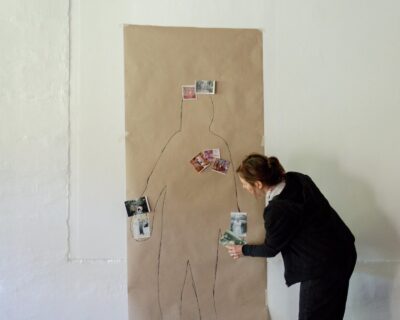
JoAnn Stevelos and Sarah Blesener
The Question Is The Practice
Peery Sloan in conversation with Yvonne Shortt
“I don’t want my board of directors to just be people. I want them to be the bobcat I see, the fox that travels along, the soil we’re using to make our instruments.” – Yvonne Shortt
I first encountered Yvonne Shortt’s work through one of her Be The Museum open calls in Forest Park, Queens, NY. It was and still is a radically transparent, artist-centered approach that flips traditional gatekeeping on its head. No juries, no portfolios, first come first served, and payment before arriving. Her Be the Museum, Be the Endowment, Women Who Build, and her Open Call projects offer artists practical alternatives to extractive funding models, treating money itself as an artistic material for creating sustained, autonomous practices.When we spoke this winter, life felt particularly precarious due to Donald Trump’s fascist policies and violent ICE enforcement. At this moment, Yvonne’s work of building rafts, teaching women to use power tools, creating tiny houses, and paying artists to simply exist in parks feels urgent. Her practice is about questions more than answers, small groups over mass movements, and the freedom that comes from understanding financial systems well enough to opt out of their more harmful aspects. This conversation took wonderful turns from financial sustainability to ethical structures and what it means to invite a fox onto your board of directors but always circled back to a central question: how can artists create the conditions for their own liberation?
Peery: Hi, Yvonne. It’s so good to see you. Thank you so much for talking to me. I wanna start by acknowledging that we’re having this conversation at a really precarious and scary moment. There have been daily attacks and killings. Before we talk about you and your work, I just wanted to check in: how are you doing? How are the communities you work with?
Yvonne Shortt: I think we’re okay. I mean, it’s pretty crazy. I think you just try to surround yourself with people who will help and who will be kind and gentle, and that’s an important aspect of it. How about you?
P: I’m really grateful for the community where I’m living right now in Portland, Oregon. There’s a really proactive resistance movement and that feels good to be part of. People are trying to take care of each other. With this reality, it feels to me like your frameworks of alternatives are that much more relevant right now. You’re building other ways of being an artist. Can you talk to me about your Open Calls?
Y: The reason why it started was because I was at A.I.R. Gallery and I was really aware of how it worked. It’s the oldest women’s gallery, started very early on to give women opportunity. But looking at where it was today, I was thinking, my God, it still feels like a hierarchy because we’re controlling who gets access through this open call. Most of the time we were giving like $2,400 for a year-long residency and a show. How many people are really gonna be able to afford to do that?
Daria, one of the founding members, the only founding member still part of that gallery 50 years later, and I started saying, “well, let’s at least name these things: there is hierarchy and let’s try different things to see what we can do about it.” We started being very transparent. Where’s the money coming from? A lot of the money for open calls goes to project coordinators & executive directors. Funding institutions want to fund a core person to administer the program, but they don’t give a lot of money to the actual artists.
We started with financial transparency. Let’s say how much money these calls are: you’re getting $40,000 from the Department of Cultural Affairs, $40,000 from NSCA, $20,000 from membership. At least we were starting with that. Then as we started experimenting with our own open calls, we were like, why are we asking people to spend so much time on an application? Let’s make it very simple: six questions. One of the open calls, we paid every single person who answered the questions. I think it was $50 if you submitted an application. We capped it at 50 applications and everyone who submits gets $50. At least we’re paying people for their time.
P: I appreciate that it’s designed to disrupt that gatekeeping and scarcity mindset. No juries, no portfolios, first come first served. I’ve been thinking about how even first come, first serve can favor people with stable internet, flexible schedules, no caregiving responsibilities. I’m not saying that to critique it, but I’m curious—do you think about that?
Y: Everyone in some way has some kind of privilege. If we make them quick, then people who aren’t looking at the internet all the time can’t see them. If we only put them online, then somebody who doesn’t have internet access can’t look at it. You cannot be everything. It’s just impossible. But at least if we’re exploring it and talking about it, then something can happen. If we’re not talking about it and not trying different things and not sharing what we’re learning, we’re not going to change it. There are definitely things in every single open call that are not accessible to every kind of person, but if you can talk about them and try to address some of them, at the very least, that’s something.
P: The fact that you’re paying people to answer the questions is so wonderful—it shows where your values lie. When I was part of Be the Museum, I was blown away that I was getting paid before I even stepped into the park. I was being valued and given free rein. It felt like permission to play, and it was such a different experience than any arts opportunity I’ve had. It gave me so much hope that things could be different. I think about adrienne maree brown and emergent strategy: we’re living in somebody’s imagined reality right now, somebody else constructed this. So if we flip that, there’s hope and power in thinking we have the same power to imagine differently. And you’re going past ideation and actually putting these things into action.
Y: Exactly! I received money to Be the Museum in a local park and said, let me split some of it and give it to other artists: I always believe in giving back.
You wonder sometimes: is it better to do an open call at all? Or do you work within a group you already know? Because inherently in the open call there’s always something you’re not giving to. But if you just pull from your local group, you’re never growing or finding different people. There’s never a completely liberating or free way.
What I get excited about is seeing open calls trying different approaches, stretching the boundaries, like ones where they say we only want you to use natural materials, only what’s in the park. I’ll email them and we’ll have this great conversation because we’re both thinking about this as artists, not administrators.
This year we’re doing it again for Be the Museum and giving out $3,000 to four artists. We’re wrapping in Be the Endowment: $2,000 for 40 hours at $50 an hour in a park, $500 for healthcare and housing, and $500 for your endowment. We’ll work as a community, set up our own brokerage accounts, figure out what we value and how we value, and let that help determine how we build our endowments for ourselves.
P: That’s so exciting and so human-focused. It seems like you’re really trying to use money as a material to help create sustained practices.
Y: When I first started getting funding from the Department of Cultural Affairs—taxpayer revenue in New York City—I thought, this is a much better way of getting it. But when you really dig in: who are these people? Some are getting their money from banks, technology companies, organizations wrapped intrinsically in the financial system. I was a little naive thinking money from the people wasn’t part of that system. It still is.
When I get money from Mellon Foundation or Creative Capital, they’re still coming from endowments and wealthy donors ingrained in that system. With collectors, we’re often not asking where did your money come from? But when you dig in, very few things don’t involve understanding how this funding machine works. So I thought, I don’t want to be naive—I want to understand it, from collectors to private foundations. And at the same time, have enough money so I don’t have to keep asking Creative Capital or Mellon Foundation for funding.
P: That’s a lot to hold: the system you’re working within and the one you’re trying to build. I also see you building things with your hands: rafts, harvesting clay from rivers, teaching women how to use power tools. Can you help me understand how questions and creating fit together for you?
Y: I think it always starts with a question and then it becomes whatever it needs to become. Sometimes the making can be physical or more mental. I’ll ask a question like, why is it that we’re often having to beg for money and it prevents us from doing something? That ultimately became Be the Endowment. But it started with a question—not necessarily physical, more with mental work and research and questions with other artists or institutions or financial people.
Then there are things like, we have this land—50 acres. We would like to give something back. While I was giving maple syrup to the farmer next door, I told him I was thinking about making a small wildflower garden, and he said, “well, I’ll help you.” The next thing I know we have one acre and he’s showing my husband and me how to use the equipment so we can till the land, plant one acre instead of maybe a 10 by 10 foot space. I asked my family if they would help throw out the seeds, and my husband’s like, let’s bring our camera and see during the night who comes. And we see this fox coming and the rabbits and the deer.
But it’s all just questions and things just kind of happen. I have no idea sometimes where anything is going. It’s just that we trust. We know it’ll be a beautiful journey because we’re trying to make sure that, at the very least, we have a certain foundation.
Even with the Women Who Build initiative: I was like, why do I not know how to use a miter saw? All these classes were costing $2,000 and you don’t even get the miter saw at the end. Forget this—I’m gonna get the miter saw and invite people into the studio and look at YouTube and we’ll figure it out. But then a woman shows up and gives us guidance. At the first meeting, 8 people came! The next thing you know we’re all cutting wood. Maybe we should learn how to frame a house because as artists, housing is really freaking difficult.
From these questions, all of these things end up happening, which is quite fun and exciting. Ultimately I think it builds a better community because at some point it opens up and it’s not just in my head. My husband often says, “it’s just your timing, it just happens.” I think that’s part of the energy around my community.
P: It seems very synchronistic, this imaginative place of asking what-if questions. It sounds like a democratic process—rotating leadership, shared responsibilities. But have you experienced when somebody dominates the conversation or doesn’t show up for their facilitation? How do you navigate it?
Y: The questions always start for me. Sometimes the people who made me think about the question come in and go out because they’re doing something else. So I only take on things that I’m really interested in seeing through.
With the tiny house, we ended up with 250 women, doing a 5K run to raise funding. People came in and came out—some were very excited and then we got to the build and they were outta there. Or they felt like their idea wasn’t being heard, maybe about the architecture even though they had no architecture experience. We had to pick and choose what directions we would go in. We really wanted to have a tiny house that would pass inspection, that we would’ve learned something from—how to install electricity, how to frame.
At some point if somebody didn’t know how to frame and somebody else said, “this is how you frame, I framed houses before,” somebody may get mad and not show up for two weeks. But we can’t please everyone all of the time. You try and maybe say, “I did this wrong, I’m sorry.” But ultimately the things I choose are things I’m committed to for a very long time: some projects are going on for 10 years. It has to be something I’m committed to, because people do come in and go out.
P: How do you handle groups without creating hierarchies that maybe you’re trying to avoid?
Y: What I’ve learned over the years is to have smaller groups. Women Who Build was the last time I had a project with 250 people—I learned so much, but I also learned I wanted intimacy. More openness, more creativity, less power dynamic.
As groups get bigger it’s harder to get things done. When it’s small and personal, we end up working together in ways we wouldn’t otherwise. Sometimes even if we think someone’s wrong, it’s like, well, we’ll fail together and we’ll fix it. They’re not gonna fail and just leave.
COVID helped change that too. I started to realize each project should be smaller, so that everyone knew each other and we could commit to something and work on it. There’s more care and kindness in a small group. In big groups, if somebody doesn’t show up for three sessions, you’re like, I didn’t know them very well. But if you’ve only got five people and someone doesn’t show up, you’re gonna call them—hey, are you okay? You may find there’s something going on and end up with a whole other project because you wanna help with that.
We were socialized to believe bigger is better and it’s very hard to come away from that. The frameworks I use aren’t for everyone. I’m just sharing things I’m working on. Oftentimes these things have all been done before. I’m just synthesizing and changing it up for the question I’m asking myself, then seeing, hey, is there anybody else out there asking this question? Maybe we can go through it together in a small group and learn from one another and be each other’s support system.
P: There’s a lot of care involved in that way of thinking. I find it really tender and generous. With those frameworks, the Open Call, Be the Endowment and Be the Museum, they’re open source, designed to travel and for other people to mutate them.
Y: They’re open source. You use them and modify however you wish.
I made the Be the Museum card because I was sick and tired of paying 20 bucks to museums. We’re artists, why are we paying so much, especially if you can’t afford it? My daughter went with me to the New Museum and we got in-it was a hoot! I shared it out and people adopted it in different ways. My friend at the Brooklyn Museum said, “I get to go for free, so you can come with me.” I was like, but what if I just made that part of my museum and have a card for contemporary artists? I put my face on it and tried it at MoMA. We got into so many museums and it was so fun.
Museums aren’t something non-Indigenous and Western cultures invented. There have been museums of many different kinds, not in these Western spaces. Now we’re bringing the two together in different ways. It felt very empowering sharing that out and people adopting it in different ways; it caused me to rethink it too. I finally started to say, I don’t want my board of directors to just be people. I want them to be the bobcat I see, the fox that travels along, the soil we’re using to make our instruments. When we think about them as being just as important, we open up the framework in many different ways. That only came from being in conversation with others, and that helped me to change it for myself and others to adopt it however they wanted.
P: It sounds so fun, like you’re just bursting open the framework and there’s so much play involved.
Y: Totally, in so many ways. These are all ideas and most things have been done before. If you realize you are just part of the energy, you’re already adapting it in your own way. I remember somebody saying, “oh, somebody’s going to take that idea.” I was like, “That’s awesome! I’m sure somebody else had this idea before me anyway.”
I would like it if you make a museum and Be the Museum inspires you, that you tell me, because it makes me feel good. But you don’t have to. If you come in and we have a conversation, you may grow and I may grow, and that’s the exciting part. Hoarding an idea or being afraid somebody uses it in a way you don’t like—I just don’t subscribe to that. All ideas are open.
P: By sharing our ideas we can create more than we could have imagined. Before we finish, what do you wish more people understood about your work or about being an artist right now?
Y: There’s no one way to be anything. No one way to be an artist. If you just have a wide open mind and try what works for you, and try not to be influenced so much by how others perceive what you’re doing: be open to the many different things that could come at you and play with them.
And you only need a few like-minded people to help you grow. The internet can be a crazy, horrible place, but it can also be amazing for finding people: one person willing to play with an idea in a certain way. I’ve met a couple of people from all over the world and it’s really opened up my mind, and I’ve opened up theirs.
P: Without the internet I never would have found you and your way of thinking. It’s giving me so much excitement: a sense of possibility and hope, especially in an art world that preys on external validation. I feel like I just got handed a miter saw.
Yvonne Shortt is a visual artist working at the intersection of public art, social practice, and financial systems. Her frameworks include Be the Museum, Be the Endowment, and transparent Open Calls which offer artists practical alternatives to extractive funding models. Based in New York, she teaches women to use power tools, has cultivated a relationship with her landscape and animal neighbors, builds rafts and tiny houses, and thinks deeply about how artists can create sustainable, autonomous practices.
Peery Sloan (she/they) likes to dig, sometimes literally, to see what’s beneath the surface: worms, bones, histories, the things we’ve learned not to notice. Through gatherings, workshops, and small acts of collective noticing, she explores how meaning surfaces through shared attention rather than finished products: what’s within arm’s reach, what touches skin, what gets missed when you’re moving too fast. She thinks of this as tending, or maybe just a lifelong need to be barefoot and looking closer; she is pursuing an MFA in Art + Social Practice at Portland State University.
Just Plug In
Haruka Ostley in conversation with Angela Ostley
“We don’t have to reinvent the wheel. There are programs and organizations that are already doing amazing incredible things on the ground in the community. So just plug in, join them”
– Angela Ostley
Angela Ostley is my sister-in-law, and I first met her when she was 19. Even then, her quiet strength and resilience stood out. She began studying photography at the Minneapolis College of Art and Design, which led her to become a freelance photographer, before life took her on a different path. After moving with her husband Matt to a small rural town, she began working in a group home supporting adults with developmental disabilities. That experience sparked her passion for social work, which she’s carried ever since. Back in the city, she has continued helping adults in semi-independent living while also pursuing her creative passions — writing, photography, poetry, painting . She is a co-founder of Those Yarn Girls, along with our other sister-in-law, Liz Ostley.
Today, Angela works with families in the federal Section 8 Housing Choice Voucher Program and the Family Self-Sufficiency (FSS) Program. She manages a caseload of 54 people, each with their own goals; some check in occasionally, while others need weekly guidance navigating community resources and tackling life’s unexpected challenges.
With all the political chaos today, I was curious to hear from her about what she witnesses in her work, how it affects her, and what advice she might have for people who want to support their communities.
H: You’ve been supporting the community as a social worker in Portland for a while — are there any stories or moments that really stand out to you?
A: There’s a woman I’ve been working with— we’re now in our eighth year of working together. She went through the full seven years of the Family Self-Sufficiency (FSS) program but didn’t quite complete it, so she re-enrolled. Now I’m walking through it with her for the second time. When I first started working with her, she hadn’t graduated from high school. The way she spoke to me about herself and her situation was very much, “I’m just stuck. I’m never going to get out of this. I’m living in a really rough neighborhood, and there are constant issues around me.” Now, eight years later, she’s got her high school diploma, and she’s in college working towards becoming a social worker. She moved out of the place where she was dealing with all this stuff and she is in a house now that she’s renting with her two kids. She has a good job working in a hospital, and she has built up savings, paid off debt and she has purchased a car and likes all these things that are slow. And now when I speak to her she says, “This is what I’m doing next, this is what I’m doing.” It’s so different the way she would speak about what was possible for her.
H: That’s so amazing. It’s such a long-term commitment, staying connected and helping someone build their confidence .
A: A lot of people who are living in poverty or dealing with systems that are providing benefits, they have to jump through all these hoops to get the benefits. And there’s always the threat of losing them. The systems that people are working with are not positive interactions. So being able to be a person who can speak to somebody one-on-one and be an encouraging positive voice helps people realize that they can achieve their goals.
H: I really believe it can make a difference when someone in your life is that encouraging voice saying, “You can do this.” That kind of support is powerful. What would you say is a common challenge you come across, especially within the systems you work with?
A: Challenges often come with more barriers than you might expect. There are programs designed to help, but many people don’t know about them. For example, in Portland, there are programs to help clear criminal records, but many people don’t realize they can reach out to public defenders and get their record expunged for free.
Then there are the systems themselves. With housing assistance, once someone reaches a certain income, the support is cut off— there’s no safety net or incentive, and the threshold is low compared to the cost of living. Maintaining benefits like food stamps or housing also requires constant recertification and paperwork, and it’s not easy to get someone on the phone at DHS or with a caseworker.
A lot of people’s attention goes just to surviving— paying rent, keeping the lights on, putting food on the table,leaving little brain space for anything beyond daily life.
H: Oh I can totally relate to that. How do you like to build trust when you start a conversation? Do you have anything that you always pay attention to when you talk to them?
A: As part of my job, we go through a lot of training: trauma-informed care, reflective listening, coaching programs… all focused on really listening to someone and reflecting back what they’re saying. It’s about hearing not just their words, but what they’re trying to communicate underneath.
A lot of it is simply building trust by being there. In our first meeting, someone might be telling me their whole life story, and we’ve just met. So I try to earn that trust by being available, by following through, by answering my phone when they call. You’d be surprised how far those small things go. People tell me all the time, “You’re the only one who answers when I call. I can always count on you.”
H: Wow, yeah. Just being there is already a big step. Sometimes all we need is someone to show up, being there to listen.
A: For a lot of people, it’s like, “Oh, you’ve been assigned a new caseworker this week,” and their paperwork just keeps getting passed around. There’s not much consistency. In my role though, I get to work with someone for five to seven years. That’s a long time. You really get to know them, not just their goals, but who they are as a person.
H: As I am looking into collaborating with Rose Haven, I’m curious,what kinds of challenges do women face within the system? Are there specific barriers that stand out to you?
A: So many challenges. I would say the majority of the people I work with right now are single women, single mothers. They’re running their households alone. They’re doing everything. They’re working, paying all the bills, taking care of the kids, dealing with school issues, finding tutors, managing activities, filling out paperwork, completing recertifications— all of it.
The expectations are all on them. They’re carrying everything by themselves. And mental health comes up a lot, because while they’re focused on everyone else;their kids, their household, their job. They always seem to come last. So they don’t really have the time, energy, or resources to take care of themselves, and that takes a toll after a while. They’re carrying the whole world on their shoulders, doing everything. And they don’t really have a choice, because they’re doing it alone. Expectations aren’t the same for men.
H: Right. Where do you see the biggest gaps in support?
A: Childcare is the biggest gap. It’s either not available, or it’s too expensive. Thankfully, there are some newer programs starting to help cover those gaps. Preschool for All in Portland is a great program, and Head Start too. But still, when you’re a mother, you can’t just leave your children to go to work.
H: I’m curious, have recent political changes or movements had an impact on the people you work with?
A: Yeah. Well, government policy really affects families. Every year, we have less and less funding for the housing voucher program. That means systems have to make changes. Take the Emergency Housing Voucher program, for example. It’s ending this fall because the funding isn’t being renewed. About 400 families are going to lose their housing assistance at the end of this year.
At the same time, budgets are being lowered, so the amount of housing assistance each household can receive is decreasing. Policies like that directly impact households.
Then there’s the issue of citizenship and immigration. I have families reach out and say things like, “I haven’t been going to work. I’m scared to go outside. I don’t know how I’m going to pay my rent this month.” People are afraid and can’t just live their lives, and they’re already dealing with so much.
When you add on all these other struggles, based on who is in office and what decisions are being made, it directly affects families and households. It’s hard to see, and it makes me feel terrible, because I’m part of that system. I work for the housing authority, so I’m part of a system that sometimes makes their lives harder, when it should be making their lives easier and providing the support they need.
H: It must be so difficult for you to be in that position. What you want to do is support the families you’ve been working with for so many years. And then at some point, you have to tell them, “This program is ending,” or share other news like that. That must be really hard. After all these years, what has this work taught you about people? And what is it that keeps you going?
A: Well, this work has taught me that people are incredibly resilient. I’ve worked with individuals who have faced some of the toughest challenges and setbacks you can imagine, and yet when I talk to them, they’re still happy, positive, hopeful, and working to make their lives better. It’s not that they aren’t affected by what happens— of course they are. But people are strong, resourceful, and determined. Even when they have very little, they find a way to make it happen. And that… that is really inspiring. I feel like I’m more passionate about this work than ever before because I see how these social programs make a real difference for families in big ways that will impact their children and future generations. I think it’s really important that we keep fighting for them.
H: I think the work you’re doing in your position is amazing. Truly making a difference for what they need. What do you think our community can pay attention to as neighbors, or what can we do to help?
A: I think building community is the biggest thing. I heard someone else say this the other day, “We don’t have to reinvent the wheel.” There are programs and organizations that are already doing amazing incredible things on the ground in the community. So just plug in, join them, figure out who they are and what they’re doing, and then help build those connections, extend their reach, and get to know your neighbors.
H: Yeah, that’s really great. It gives such a clear visual, like the wheel is already there, and you just get in it and keep it turning. It’s about supporting what already exists. You don’t have to think, “I have to make the wheel myself.” It’s more like, come in and help keep it moving. That feels like a step anyone can take. That’s great advice.
A: You can see it happen in places like Minneapolis, right now they have all of these community organizations and like mutual aid groups. That started when George Floyd was killed. So what was created when that tragedy happened is now supporting them through this craziness that they’re going through. They came together as people, as a community, to create ways to help each other. There are organizations helping families pay their rent, for example. And that’s something we can learn from. We can take what they’re doing in that city and apply it in other cities, adapting it to local needs.
What we can do is to take care of ourselves. I like to go hiking in the mountains. It’s a mental reset for me, because when I’m hiking, nothing else is on my mind except nature. It’s really peaceful. It’s actually a great way to reset mentally, especially with so much coming at us from our phones and the news. It’s good to just turn it off for a little while.
Angela Ostley (she/her) is a poet and fiction writer whose work blends tenderness and teeth, exploring grief, moral tension, and feminist defiance. Her professional background is in housing and social services and she runs a small business with her sister making and designing crochet toys and patterns. She lives in Vancouver, WA, with her children and dogs, where she works, crafts, and writes, believing each of these things are ways to change the world.
Haruka Ashida Ostley (She/her) born in Japan and raised across four continents, is an interdisciplinary artist whose work explores personal stories, vulnerability, and human connection, shaped by her experiences with illness, motherhood, and identity. Her practice spans painting, installation, performance, and socially engaged projects, often collaborating with communities to honor spoken and unspoken stories, fostering reflection, dialogue, and empowerment.
Haruka has served as an Artist-in-Residence with the Yew Chung Education Foundation in China, is currently pursuing an MFA in Art and Social Practice at Portland State University, and continues to create work that bridges personal narrative with collective experience.
Letter from the Editors
Second Year Crew: Sarah Luu, Gwen Hoeffgen, Domenic Toliver and Adela Cardona Puerta
One of the things that consistently stands out in our program is how our work is informed by those we surround ourselves by. Each of us comes with a different set of experiences, questions, and personal connections, and those differences shape our practices in ways that make them unmistakably our own. At the same time, we often find ourselves drawn together through shared experiences, interests, and processes.
This issue brings together interviews that follow those threads: the ideas we return to, the places that ground us, and the people who walk beside us. For some, literature became a site of connection—reading as a way of relating to others, or books as companions that open unexpected routes into our work. Others found themselves seeking alternative modes of expression, experimenting with forms that offer new possibilities for communication and understanding. Many contributors reflected on learning through lived experience, letting life itself act as a teacher.
Across several interviews, we also see a reconsideration of the tools we rely on. How can the same tool take on different purposes depending on intention, context, or care? Many conversations touched on the importance of praxis, the effort to align what we practice with what we believe, and to walk the walk and not only talk the talk. Themes of inner awareness, vulnerability, and the willingness to be misunderstood recur as well, along with honest reflections on anger as a meaningful way of navigating the world. These interviews invite us into alternative ways of sensing, thinking, and interpreting what surrounds us.
One of the most prominent themes this term is friendship. Many contributors chose to speak with friends, collaborators, or peers—people who have been present in their lives not only as fellow artists but as confidants and supporters. These conversations highlight what it means to show up for one another, to share resources and experiences, and to grow alongside someone else. The issue reveals how friendships, both longstanding and newly formed, can shape creative practices just as profoundly as any formal study.
Each term, this journal gives us an opportunity to reflect on our practices through the act of conversation. Interviewing—listening, responding, wondering aloud—offers its own form of discovery. While patterns inevitably emerge across issues, each interview remains distinct: its own world, its own rhythm, its own exchange.
We hope you enjoy this fall’s issue of the Social Forms of Art Journal.
Teaching a Painting
Simeen Anjum with Tamia Alston-Ward
“The fact that you can’t read it all forces you to want to read what’s in there… There are creative ways you can educate about Black historical subjects which are being erased from our curriculums. Art is a wonderful gateway into educating people on not only contemporary, but historical, political situations and environments.”
During my summer internship in Adult Education at the Barnes Foundation in Philadelphia, I found myself drawn to the dynamic conversations happening just next door at the Philadelphia Museum of Art, where an educator institute was underway. It was there that I met Tamia, a gallery educator. I was struck by Tamia’s ability to cultivate an atmosphere of curiosity and critical engagement during gallery sessions, creating space for young learners to explore art in meaningful and thought-provoking ways. As someone exploring museum education across different institutions, I’ve been interested in how various museums approach learning in their spaces, what supports meaningful engagement and what insights I can bring into my own practice.
In this interview, I speak with Tamia about her role as a K–12 educator at the Philadelphia Museum of Art, the challenges and opportunities of working in museum education today, and what it means to teach art in a city as historically rich and complex as Philadelphia. We also delve into the work of Philadelphia-born artist Henry Ossawa Tanner, whose painting, The Annunciation, offers a historically grounded and deeply human take on a biblical scene, an entry point for considering how museums can foster more accurate, inclusive narratives.
At a time when public education is facing increasing censorship through restrictions on teaching about race, gender, and LGBTQ+ issues, museums may serve as critical spaces for dialogue and reflection. How can they support more honest, expansive conversations about history and identity? Tamia shares insight into the power and responsibility of museum educators to engage students in this important work.
Simeen Anjum: What is your favorite painting in the Philadelphia Museum of Art (PMA) that you like to talk about as a gallery educator?
Tamia Alston-Ward: I would say the Annunciation by Henry Ossawa Tanner. I have a connection to the artist through the alma mater (Pennsylvania Academy of the Fine Arts).
Simeen: Is it the one he painted in Palestine?
Tamia: Yes. I love this painting and I still teach it over and over again. And what’s cool is that it’s opposite another Annunciation painting from the Baroque era by the Spanish artist Zurbarán. It’s a great contrast and shows the differences in how the story of Mary, Jesus’ mother, is depicted across time. Tanner’s is from 1898. Zurbarán’s is from 1650.
What I love most about the painting is the expression of Mary. Tanner was really focused on historical and biblical accuracy. There are so many depictions of Mary, in the museum and around the world, but none quite like this one. He traveled to Palestine to study the architecture and the people because that’s where Mary and Jesus were from. There’s a long history of Black Christian presence here in Philadelphia that Tanner and his family were part of. His father was a bishop and the family published hymnals for churches.
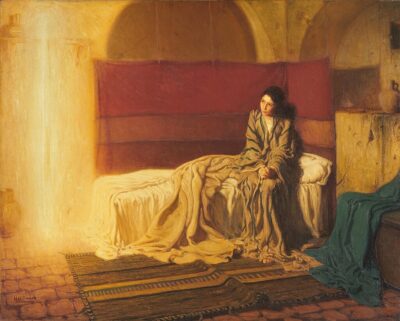
Henry Ossawa Tanner: The Annunciation (1898)
But what I really love is how Tanner shows Mary in a way that I wish everyone could see. All the other versions of Mary just aren’t accurate. You can see the realism in her expression. She looks concerned. In the Bible, when Gabriel tells her that she’s been chosen, there’s a moment where she accepts it. And the expression on her face here makes it seem like she’s still in that moment, still figuring it out. She is not yet wearing the colors blue and red that symbolize her role. You don’t have to believe in Christianity to appreciate that these were real people from a real part of the world, a part of the world that’s currently experiencing real hurt, pain, and hardship through genocide. We forget that the religious figures we revere came from that area.
If I were to go online right now and search “Annunciation,” there would be so many images and almost all of them would show a much older Mary, a much whiter Mary. The architecture would be European, the curtains, the setting, the clothing, it’s all inaccurate.
The Zurbarán painting is across from it, so we do a compare and contrast activity. I’ll bring the visitors to both and use a Venn diagram. We talk about composition—Mary is on the right, Gabriel on the left, in both. But we also look at architecture, clothing—“Do you think they wore this 2,000 years ago in Palestine?” The answer is no. Definitely not. So when I show students these paintings, I ask them: After seeing this and the Zurbarán version—which one feels more accurate? And they always point to Tanner’s.
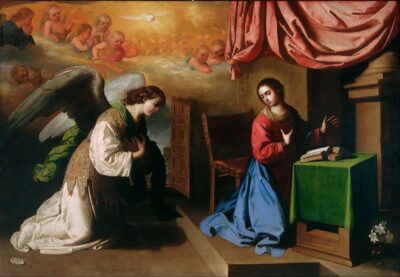
Francisco de Zurbarán: The Annunciation (1650)
All this is to say that art helps us discuss political and social issues, both from the past and today. Zurbarán’s painting is from 1650, after the medieval period when all art had to be religious. The Baroque era was dramatic and theatrical, artists were showing off their skills with drapery, perspective, etc. And the paintings were meant to depict the Bible for people who couldn’t read. But Tanner had the opportunity to travel. He made this painting in Paris, after studying at PAFA and trying to escape racism in the U.S. And you can see how that experience shaped his work, his faith, his clarity, his honesty. I think he made that painting for himself.
Simeen: I’m curious about how the Museum Educator role differs from the Docent role, and in what ways these positions overlap or collaborate. I’ve noticed that many museums are moving away from traditional docent models and shifting toward more learner-centered approaches to engaging with art, rather than strictly information-based methods.
Tamia: The docents work on a volunteer basis. And as educators, we’re constantly looking at work like, “Okay, how do we talk about different artworks to students? How do we talk about nudity?” etc. We have discussions on how to best go about teaching in the galleries. We also create the teaching resources and plan how objects of different cultural backgrounds should be taught about.
Simeen: I feel that traditional docent-led tours often don’t require deep critical engagement with the collection; they tend to focus more on familiarizing visitors with what’s on display. But museums are increasingly reconsidering how valuable it is to simply present the history of an artwork versus helping visitors actively engage with it, especially when working with visiting student groups.
Tamia: Yeah, a lot of people who come to the museum are first time visitors, so we do a lot of highlights tours and it kind of lends itself to sameness. But the museum has been making an effort to make sure docents receive training from the educators. And they’ve done some of our K–12 tours for us, and they have great relationships with us and the students. But there was a time when an object was taught that was different from what we wanted it to be taught. It was a piece by Barbara Walker. She’s a draftsperson and she makes these drawings where one person is primarily drawn and the other is embossed.
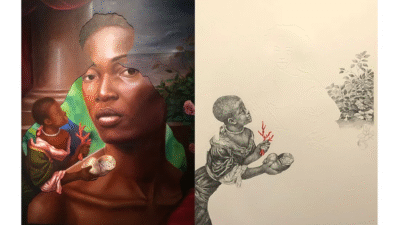
From left to right: Seeing through Time, Titus Kaphar; Vanishing Point 24 (Mingard). Credits: Héloïse Le Fourner
So this painting right here is Titus Kaphar, and this drawing right here is Barbara Walker, and they were situated in the gallery opposite each other, so they were facing one another. They are both referencing the same artwork, a European piece by Pierre Mignard of a woman. And you can kind of barely see her in one, and then she’s cut out in the other artwork. And we see only the girl who was enslaved.
We discussed amongst educators: are we going to show the students the image that both of these artists are referencing? And we decided not to. The reason being that both of these artists intentionally cut out this European woman from these images—they’re both referencing the same image, but they are both removing, intentionally, the European image. It was in the section of the exhibition called ‘Past and Present’, it was a section dedicated to reclaiming history, basically, and contextualizing history in a different way.
So, I think one of the educators noticed that one of the docents had brought the laptop to the exhibition just to be able to show the Mignard piece to the visitors.And when we heard about that, we rolled our eyes. But again, it’s really up to the educator’s discretion if they want to do whatever they want to do on a tour. They really insisted on showing the image. And I think the main kind of discussion around these pieces was: why do we insist on showing the white figure?
Why do we need to see it, when we already can assume what she looks like based on just the outline here, this embossing and the clothes.
If you just go to the third floor of the museum, you’ll see a lot of Regency, aristocratic European figures everywhere. And the real reason why we didn’t want to show these is because this girl here is enslaved. This is a picture of a woman who is a duchess who had a painting by Pierre Mignard commissioned for her, and it was depicting her with her arm around this enslaved person. When we interpret it to the kids, we ask them close-looking questions: “What do you see?” “What do you notice?” A lot of the time, they’ll say ‘some mom and her kid’ or if it’s not a mother, then maybe it’s a sister. Because of the nature of the way the images are arranged, it makes the students think that the relationship between these two figures is tender.
But it also allows for a conversation around propagandistic imagery of the “benevolent slave owner” imagery. In the 1700s it would have looked like a really pretty, beautiful painting. But was that relationship really what it is in the painting? No, because this person was owned. And it’s another reason why we would not show the image of the woman because it’s not about her. Barbara Walker, in her drawing, makes an effort to render only the things that are relevant such as this little girl here. And Titus Kaphar in her artwork manipulates the canvas to physically cut out the woman. And then he puts a painting of another canvas inside, depicting the woman, in a way that you can’t tell who she is. So a lot of times in the galleries when we ask students “Who do you think she is?” Most of them reply with, “Maybe it’s the little girl grown up,” “Maybe it’s her mother,” “Her actual mother.”
Simeen: I am sure a lot of great discussions come from this. Has there been any other artworks lately that have allowed for more critical engagement within the museum?
Tamia: Yes, this work from Brand X, a screen printing collective based in New York. And it is a piece depicting an African sculpture superimposed on an open book, that is oriented vertically, but you can see both the pages. It’s from a speech made by Malcolm X called ‘The Ballot or the Bullet’. My colleague, Cherish and I chose that image because we thought it would be great for teachers to understand that they can use this as a jumping-off point to talk about things that may be frowned upon by their administration. and then imposed over it, you have this African sculpture taken from 1970s “primitive” African works. And there’s no context, there’s really not much there that the artist, in the description, is telling you about the works. But there’s a lot that you can interpret from there. You can think about censorship, because you can’t see all of Malcolm X’s words. The fact that you can’t read it all forces you to want to read what’s in there. I think for students, it’s a great gateway for them to learn about many things. Learn about African objects, and why they are without context in certain spaces, anthropological context, but not in a formal or spiritual context. It makes you think about why there would be an African object mixed in with Malcolm X’s words, what is that connection? You could ask that to the students and have them research about Malcolm X as a historical figure, and this piece as an artwork. What I really enjoy about that piece, is that there are creative ways you can educate about Black historical subjects which are being erased from our curriculums. Art is a wonderful gateway into educating people on not only contemporary, but historical, political situations and environments.
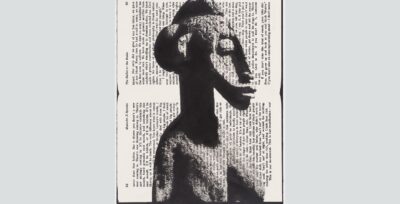
Adam Pendleton: Untitled (Figure and Malcolm), 2020
Simeen Anjum (she/her) is an artist and educator based in Portland. In her practice, she explores new ways of fostering solidarity and community in response to the late-capitalist world that often isolates us. Her projects take many forms, including sunset-watching gatherings, resting spaces in malls, and singing circles in unexpected locations. She is also interested in learning and engagement within museums and art spaces. She has explored this through internships at several institutions, including the Barnes Foundation in Philadelphia, the Partition Museum in New Delhi, and the Littman and White Galleries at Portland State University. She currently works as a K–12 Learning Guide at the Portland Art Museum
Tamia Alston-Ward is an artist and educator based in Philadelphia, Pennsylvania. Her artistic practice is deeply rooted in research and the study of material culture in the Black Diaspora. She has worked as an educator in the National Liberty Museum, Malcolm Jenkins Foundation and currently serves as the Art Speaks Coordinator and Museum educator in Philadelphia Museum of Art.
A Ripple Effect: Public Architecture and Building Collective Futures
Gwen Hoeffgen in conversation with Sergio Palleroni.
“Replicability is understanding, and analyzing, the system rather than thinking that the system doesn’t work. How do we make the system work to serve the people? And how do we rethink it so that it can be repeated?” – Sergio Palleroni
I first started thinking more deeply about architecture after reading In the Dream House by Carmen Maria Machado over the summer. In the memoir, Machado uses the house as a metaphor for her body, telling the story of an abusive relationship through the shifting rooms of a “dream house.” Reading it made me think differently about what a home can represent. I began reflecting on my own relationship to home, thinking about it as something intimate and embodied—almost like an extension of the body itself. I started wondering about what happens inside domestic spaces, who holds power there, and what the walls of these spaces hide.
This curiosity led me down a larger rabbit hole around architecture of the body and the idea of building together. I became especially interested in how people collectively create, lose, and return to “home.” While working on If We Could Talk, a project focused on displacement in Portland and the experiences of people who have returned to the area through housing bonds, I started thinking more seriously about the role architects play in these processes of negative and positive change in neighborhood communities. I became interested in what it might look like for architects to truly listen to communities, rather than design from a distance. I wanted to interview Sergio Palleroni because of his long history of public architecture projects that center community voices and socially engaged design. His work approaches buildings not just as objects, but as systems shaped through conversation, care, and collaboration, and his methodology mimics socially engaged practices that inform my own art practice. In this interview, we talk about architecture as a way of deeply listening, storytelling, and building the future with rather than for communities, and how a building can be more than an object– it can produce positive social change and strengthen relationships.
Gwen Hoeffgen: I researched many of the projects that Center For Public Interest Design has worked on, which led me to research the many projects in your portfolio. There are times in your work where you have described architectural structures, like buildings, as systems. I thought it was interesting because I think of socially engaged art projects, especially through a social justice lens, as being a way to create systems. Could you talk about that language, and how a building could also be a system?
Sergio Palleroni: You can think about architecture or the building in the environment being so dominated by a series of very structured hurdles to go through. There becomes an emphasis on building this one object. But, when you put this object in a community, it has a huge impact. For us, the thinking about the system is that the building will have a ripple effect. As a building is introduced, even if it conforms to aesthetic and expected values, will still have this ripple effect on a community. That, for us, is the system.
Also a building generates and activates all sorts of non-monetary assets in a community. So, a particular building will provide X number of jobs, or it will provide security, or cultural activities which can be important to the health and wellbeing of the community. So we are trying to rethink the field in order to educate people on how architecture could be a way to address social problems. Not just in the programming, but even in the way it’s built. Potentially in the discussion and process of building, the community can guide its investments so that there is a greater impact on the needs of the community.
When I got out of architecture school, I wasn’t even taught how to talk to a client. The drawings and models and everything you do are very beautiful, but they’re also only addressing a certain segment of the community that can understand those drawings. Really, 95% of all the drawings are impenetrable for anybody but an architect. So, it’s an exclusionary act. And we haven’t been very good about figuring out ways that we can embed ourselves in the communities and discuss its needs and things like that. How can we become more of public architects?
So we think about the system as a way to bring in all that we’ve left out of the process. Through discussions, you can affect what you have an impact on.
Gwen: The processes you’re talking about seem so similar to those in socially engaged art processes, which rely on deep listening and response to people. I listened to a podcast you spoke on, and you talked about this process of an architect as a “curator”. How are these “systems” as buildings developed using response to community?
Sergio: Let me give you an example. We are looking at housing very deeply. We spent like 30 years looking at informal settlements, in Mexico City or Africa– all over the world. We would go in and if the community needed a school, we would sit down with the community and figure out: what is a school to this community? And then we would try to figure out if the community may not have the traditional means to get the school done, but what assets does it have? And with those assets, how do we get the building that they want? So it might have been produced in unconventional ways– maybe people would collect bricks. And maybe the classroom is not the kind of thing that shuts down at three, but then has a second life as a community center. If a community is going to invest so much money to build a school, it has to address more than just education. So we’ve had instances where the school becomes a women’s center, where women have micro industries. Or we’ve even had schools that have become the infrastructure for the immediate neighbors–they’re providing waste and water, electricity, and everything else. Or we’ve had schools where the gardens become a way to protect the local species and native environments. And, in doing so, the landscape becomes both a playground for kids, but also a place to teach environmental education and cultural values and things like that.
Gwen: The way you’re describing this sounds like a form of creative problem solving, and also it sounds very imaginative. We have such strict and narrow categories for the function of architectural spaces in which we normally abide by – a school has to be for children, and we shouldn’t live in cars– but I like the idea of reimagining and literally building a new reality, and a new way of how these spaces can function.
Sergio: We have a seminar in the graduate certificate, where we go through and we look at the different challenges– like issues of inclusivity, or issues of how to do public practice in states of emergency, or when you have to reimagine society. So in our coursework, we try to expose students to different strategies so that they become aware that the role of an architect is broader. You were talking earlier about the creative process, and the process of doing architecture, and art as well, is maybe the most powerful tool. So now, Stanford, Yale, and MIT’s business schools all have design schools within them. That’s because design thinking can unite and cross between disciplinary boundaries. An economic issue and a social issue can be put on the table, and they can both be relevant to the act of creating a building. Even if you decide to become a filmmaker, you’ll carry over this idea that everything is somehow connected and taking things out of the basket may not be the best process. At first you may just have to throw out a broad net and see what all these things are and how they’re related, and figure out a way that we can see the interrelationship between them. And then, with the community, you can begin to weed out what’s unnecessary.
Gwen: Speaking of your pedagogical practices, can you talk about the importance of replicability in your work? And how teaching these socially engaged methods of building could lead to replication?
Sergio: Sometimes they’re one off, like this community center for the Mongolians, and it ends up inspiring others. The villages through Northern China, Central China, and Mongolia, are all suffering from the agricultural system becoming industrialized like ours. 30 years ago, 80% of the population was agrarian, and a lot of people are moving into cities to become industrial workers in China. But most of the population are either too old to make that adaptation, or culturally they can’t adapt to that. The idea was to rethink these villages and keep people in place in a sustainable way, and they could keep their relationships to the land. This was considered a successful experiment, because the cultural values to the land and deep philosophies of sustainability were represented in this effort. We asked, how could we embody this? And how could we rethink these villages so that they stay viable in the future. It has been repeated because there’s a way for the villages to remain–or maybe it’s a vessel in a way– where sustainability is their bridge to that, and their culture is a bridge to the future. So replicability sometimes happens because we clearly state the values, we involve the community, and the community understands those values– and they will then become proponents for future work. That’s one way they replicate.
The other way they replicate is, for instance: we did this process around homeless housing that led to the villages. We were approached by the coalition of the homeless, they called themselves a congress, and they were meeting at the Rebuilding Center. There were representatives of the major communities and street families, and they said we need to change the narrative on this, and we need the government to step in. And, they said it shouldn’t be just the housing thing, because the problems are more complex. And they had begun to have some experiments which were successful– They had built the first village with the support of a series of activists. And we knew that that was beginning to be a solution. But they wanted a solution that the city would’ve considered. So we said, what we need to do is we need to create a process of doing this that will begin to bring the normal actors involved in this into this problem. So we invited the Congress, which was made up of like 150 homeless people representing the community, and we invited the 12 largest and best known firms in the city, through relationships we had personally, to the gallery below Mercy Corps. We told them you’re going to come to an unconventional thing– you’re not going to be sitting around for investment money, you’re going to be sitting with the homeless. Artists and architects are utopian; we are believers that it would work, you know. So we sat them down for a weekend. We ended up coming up with his design and then we invited the mayor. And, he didn’t know what he was getting into. He walked in there and there were like 500 people in this beautiful building– and we ambushed him, poor guy. We presented the designs and of course he was asked to be part of the final review. We said, wouldn’t it be great if the city did something, after you’ve acknowledged that there’s a crisis in housing. The governor had declared a state of emergency, and here’s an opportunity with all of the key planners and architects in the city. So we forced them to fund the building of this first village. And, he said that there was a whole bunch of land at the city warehouses for future development. Because they were going to be temporary structures, I had a brilliant student at the time, and she figured out that if we kept them to the size of the food carts, then we didn’t have to get a permit as long as we didn’t have bathrooms and as long as they were mobile. We triangulated all that and we came up with a kind of approach to temporary emergency housing. And we found the holes in the code to allow us to do this. And we decided that the first people to deserve it should be women, because women living on the streets are most impacted. And then at Christmas, we decided to have a street of dreams right on the North Park blocks and then we invited people, and thousands of people came out to see all these beautiful houses done. And, the mayor had given us a site and he said, let’s just put ’em up. And I said, well, no, because we want to create a replicable process, so we need to engage the community, which was the Kenton neighborhood– a lovely neighborhood and middle class– not rich, but full of a lot of assets. So we’re going to engage them in this discussion of what it would be like to have a community of homeless living together. So for over three months we sat down with the community and said, okay, we are going to introduce this site– What does that feel like? We started to form the motions. And we discussed that they are people in need, but they also are bringing assets. We could have a site for a Saturday market, and community gardens introduced, which would allow you to meet and collaborate over garden plots with each other. And it was right across from their main square, which they were very proud of. So we took them through this whole process and then we invited the mayor in for a discussion and the mayor said, we don’t have to have a vote. But we insisted on having a vote because the land is owned by this city. Because it was a temporary installation, we didn’t need to be permitted for it, but we insisted on formalizing the voice of the community. So we took what would be traditional planning and everything, but made a public version of it where more people would be involved, the community would be involved in harmony, which normally would just be the city behind closed doors. When we came to a vote, I thought we were going to lose the vote because people were so angry and frustrated, and I think this was mostly due to the system in which the government operated. But when it came to the vote, it was 168 family units against 93. So it was a strong vote. And we said in a year, we’ll revisit the vote, we’ll see how it goes and how the services play out and everything. A year later we did the same vote and only three families were against it. 312 against three. So the success was the community accepting, but when they formalized it, the community was up in arms. They said, we love having the homeless community here. They fought for, and they bought, a piece of land in the community so they could have a permanent home for the homeless village. So, it moved down like two blocks. So to me, replicability is understanding, and analyzing, the system rather than thinking that the system doesn’t work. It’s how do we make the system work to serve the people? And how do we rethink it so that it can be repeated? It’s not that the permitting process is avoided– it works, but you just haven’t thought about it in terms of the situation.
Gwen: I think I have another question regarding architecture and repetition– specifically in regards to Portland’s history of urban renewal, racist land policies, and gentrification, which have occurred multiple times in Portland’s history. I see some architectural attempts to produce community movement to bring people back to areas where they were previously pushed from. For example, in the Northeast, where Albina became greatly gentrified, there are new housing developments prioritizing Black families that have historical ties to the area– they are bringing people “back home”. I am interested in what your thoughts are about harmful urban renewal, like the 5 freeway, but also in this idea of the return to community that is very different than it once was.
Sergio: Yeah. Going backwards is hard. We did the initial public profits for the Albina Trust. We called it Right2Root. We had these meetings where we inscribed abstract trees in plywood. Below were all the things that they carried value and the branches and the tree above ground became what their future was going to be. They got to put in their ideas, then we would talk about their future, week after week. I was very hopeful because, we’re thinking, we’re gonna return. Returning is very powerful, but what does it take to return? These buildings are being done, which are the outcome of Right2Root. But the problem that the community is having is that you can’t just build a community. You have to include the community in the process. It can’t be just the people that are gonna be served by that building, but how would those buildings serve the larger community. Right now, it’s a moment where more consensus building needs to happen and there are powerful forces behind Albina’s processes toward that future. We started the Afro Village– that was our baby. They were decommissioning the light rail cars. They came to us and said, we have 52– What can you do with them? They knew we did a lot of mobile urbanism. So, keeping everybody aware and connected and participating in the Afro Village as it moves forward has been a challenge. It’s a discussion that needs to be had. It can’t just happen at the beginning. It has to continue through the whole process. Maintaining that discussion, especially in highly contested environments, is really what determines whether our project will have long term success.
Gwen: I read this book over the summer– it was called In The Dream House by Carmen Maria Machado, and it was really wonderful. It’s a memoir and she is recalling traumatic experiences that she had in her past, and she’s using the house as a metaphor for her body. The way it’s written is fragmented, and disjointed, and uses the spectrum of themes I’m interested in– like domestic spaces, privacy, and power dynamics. And that led me down this rabbit hole of researching the home, and building as storytelling. What are your thoughts on the art of storytelling through building a house?
Sergio: Well, you know, next quarter, there’s a big focus on housing in the curriculum. And that’s why I teach a housing studio. A home, or a house, is significant to every culture, right? ‘Cause it’s not only a functional element of a society and the building block of any community. But it’s also a memory and dream palace. It represents and connects all your dreams into a narrative. We’ve done a lot of Native American housing for different tribes. American tribes have been displaced from their traditional way, so we had to bring back decent housing back in the central states of Dakotas and Montana and Washington– the Yakama, the Cheyenne.
And we started out by just having them begin to map the different things in the home. You know, where and in which ways are their cultural values normally mapped in a house. Like the Native Americans in Alaska, they have a room which includes all the mementos, and it has to be the first space– It’s almost like an archive. So in the beginning, it’s almost like the storytelling is wound around the different ways that the family is construed, and the different ways that the people who inhabit it relate to each other and relate to the community at large. And then we think of the building–we try to take people through this exercise of talking about what their relationships are like. How do both the familial and the the community and all of these kinds of relationships begin–it is a series of stories. And you look at how all of these things relate to each other. A home is actually maybe the most complex construct that there is because it involves all the layers of a society– From the individual to the society. And because in the end, your house is part of a community, so it constructs both the individual story, and the collective narrative.
You know, once in a while somebody gets it just right, and you go, oh, that’s fantastic. And sometimes the best description of a house is not a beautiful rendering, but it might be a story that talks about what happened in that house, or how the family interacted with each other in the space of this shared, collective construct. Even in design, sometimes writing becomes more important than drawing. And then sometimes a filmic vision becomes important. If we’re designing this right here– this is actually part of the Alaska tundra that’s melting. And so there’s a village here. If I’m designing a building here, I’ll have the students begin to make a film that starts here and determine what might be three different filmic moments about what your home is like. You’ll write the storyline of the film. For a film, every page in a storyboard tells you a lot of significant things. Not only does it tell you what’s happening, but it tells you what the mood is. Is it dark? Is there a sense of connection? Do you feel connected to the houses? Do people have porches? Can you see them? And so every frame of that is establishing a story in itself. And so if my house is here, I ask the students, include yourself in three film walkthroughs and tell me the story of your house. And to do that, you start to tell the story of these houses and how they relate to the street and what the nature of the street is. And when you get there, how does the street continue? And what’s different about it? And who is the character? Now your house is part, but only part, of the community’s narrative. So yeah, there are many ways to think of a house because a house is like a Lego piece, which belongs to all the puzzles.
Gwen: I also love what you said about the house being a site of memory, of dwelling, of dreaming. These are themes I’m really interested in.
Sergio: And, and the other thing is that it’s dynamic, right? So you want to build something that is dynamic enough so that in times of hardship for the community, and in times of affluence and success, it can play a role.
Gwen: Yeah. That’s interesting to think of how a house could adapt to community, or personal changes. And then I’m also thinking about, in storytelling through the home, who has the power to narrate the story? I think that’s the other aspect I’m thinking about in relation to socially engaged practices in architecture. It’s usually the “builder” that holds the narrative power.
I’ve been thinking about these themes in relation to my work, and my studio art processes, and I’m trying to think of ways to also create functionality and community spaces.
Sergio: I will tell you about the Gateway Pavilion, this giant chrysalis we created, that looks something like your pieces. The Gateway Park area is ethnically the most diverse part of Portland. It is home to Russian communities that came here in the fifties, and there are also around 200 Somalian families living there. We had like eight different translators come in, and that’s why people were voting with Origamis. When the design process ended, they were talking to each other after never speaking before– they asked us what happens next? They wanted to continue working on the process, even though it was done. So we came up with this beautiful idea. We folded all of the origami paper that had fertilizer on it, and we put seeds for plants. They planted seeds in a large part of the park, and that night we had a big music festival, and everyone got to take three origamis with little pots so that the plants will grow.
Professor Sergio Palleroni is a faculty member and director of the Center for Public Interest Design in the School of Architecture at Portland State University and co-founder of PSU’s Homelessness Research & Action Collaborative. He also serves as a Senior Fellow of the Institute for Sustainable Solutions and is a founding member and faculty of the federally funded Green Building Research Lab at Portland State University. Professor Palleroni received his M.S. in Architectural Studies from the Massachusetts Institute of Technology and a Bachelor of Architecture from the University of Oregon. His research and fieldwork for the last two decades has been in the methods of integrating sustainable practices to improve the lives of underserved communities worldwide. In 1988, to serve the needs of these communities he founded an academic outreach program that would later become the BASIC Initiative (www.basicinitiative.org), a service-learning fieldwork program. Today, the BASIC Initiative continues to serve the poor in Asia, Latin America, Africa and the U.S. In addition, Professor Palleroni has worked and been a consultant on sustainable architecture and development in the developing world since the 1980s, for both not-for-profit agencies and governmental and international agencies such as UNESCO, World Bank, and the governments of China, Colombia, Costa Rica, India, Kenya, Mexico, Nicaragua and Taiwan.
Gwen is a visual and social practice artist who currently investigates the physicality of emotional experiences, and how those experiences live within the body waiting to be released. After receiving her bachelor’s degree in psychology, she worked as a social worker in the mental health, addiction, and cognitive health fields, and then received her MA in Drawing at Paris College of Art. Currently, as an Art and Social Practice MFA student at Portland State University, she use mediums of painting, drawing, photography, sound, and conversation to explore how we find stories within pieces, creases, breaks, and bends.
Stories & Melodies in the School in the Sky
Domenic Toliver in Conversation with Frank Cobb, Meta 4(Sadie), Duane (Casper) and Gwen Hoeffgen
“Truth is, we aren’t out to hurt you, you act like we’re hurting you when you’re really hurting us.’”
I’ve always believed the best moments in my work happen when I’m not trying to make anything at all, when people just start talking and the room shifts. This is just a piece of that from a day at Street Roots doing our weekly photography hangouts with Frank, Duane, Joan, Sadie and everyone drifting in and out. That day Gwen and I were there to help folks make photo books with photos taken in previous hangouts. The books quickly became secondary to the stories: a harmonica origin story no one will ever know the truth of, Spider-Man facts, bad puns and poetry. I chose this conversation because it captures exactly what I love about the work. The way people build meaning together without even noticing, the way laughter and memory and small disagreements become their own kind of art. The way they move through the workshop, joking, disagreeing, teaching each other, improvising, it all reflects the knowledge they carry with them. It reminds me why I keep showing up: not just for the photos, but for the people who bring them to life, and quite frankly that’s it.
Interlude: Spur of the moment– Frank whipped out a harmonica from his jacket pocket, a childish smirk on his face, he shut his eyes tight and began to play. For all I know he played an original tune, not as easy as Roadhouse Blues but a simple melody that froze the room. What follows is a snippet of that afternoon, unedited, a little messy, and exactly what it felt like.
Frank: (harmonica)
Gwen: Wow!
Dom: Oh wait, you gotta do one more riff. I have to take a picture.
Frank: (harmonica, same tune)
Dom: You’re really good, how’d you learn to play?
Duane: Yeah yeah, it’s only because I taught him how to play it.
Frank: Tell them the real story of how that shit happened, man. Just keep it real. We were down at the –
Duane: We were down at City Hall. We were doing a camp out at City Hall. And I broke out my harmonica and started playing, and he was like, “Man, I’d like to learn how to play like that.” So I told him I’d teach him, make him a pro… What? Say it didn’t happen like that?
Frank: That’s so bullshit. The first time I ever picked up a harmonica, ever-
Duane: Was at City Hall!
Frank: It was at City Hall, I didn’t know what the fuck I was doing and-
Duane: I know and I taught you how to play!
Frank: I wanted to play and so I just started fucking playing, I just tried and it sounded like that. Just started playing like this right off the bat. Really, and I didn’t think it sounded good at all.
Dom: What?
Gwen: Really?
Frank: I kid you not, I thought I sounded stupid.
Gwen: That’s actually unbelievable!
Frank: I thought I sounded so stupid. I really did, I was like “Oh I’m done with this, it’s bad. I’m usually good at everything.”
Dom: Were they telling you that you were good?
Frank: Everyone kept trying to tell me, “You sound great, you sound amazing!” Even this guy *points to Duane*
He kept telling me to play. I was like, “Ehh nah I’m not good at it.”
Dom: So he just picked it up and started playing like that, that’s impressive.
Duane: He’s such a liar. Bullshit. He knows I taught him how to play.
Frank: I’m not making it up, you going to beat me up with your strong hand? Look out baby, hold me back.
Duane: He just doesn’t want to give up our secrets, I taught him.
Frank: That was a while ago. I’ve known you longer than I’ve been working at Street Roots, Duane. That’s crazy. Since fucking greenhouse.
Duane: I know. That’s insanity. And as long as you tried to get me to work here with you. You did try for almost twenty years!
Frank: Yeah. Damn. I would tell him every day: “Come on dude, just come work.” And he’d be like, “Nah, next time”
Duane: All it took was the right look, and you didn’t have it, Frank.
Dom: Ouch.
Sadie: Are we supposed to be working on our covers?
Gwen: You guys could do your cover or write in your books, it’s up to you.
Sadie: I think I want to do my cover with no binding.
Gwen: Oh you want to keep it how it is, we can hole punch it and tie it with string?
Sadie: I like that. Let’s do that.
Gwen: Okay, so I can do two holes on the side. And then you can choose a string and tie it together. I did it like this, I folded these two over, and then cut it barely, and then you have to get the double-sided tape right on the edge.
Frank: That looks cool.
Dom: It could look cool if you decorate both sides too.
Sadie: I want to make sure I get it right in my book, I suffer from not paying attention sometimes, your names are Gwen and Dom right?
Frank: Yeah Gwen and Dom, Gwen like Spider-Man.
Gwen: Yup.
Frank: Are you a Spider-Man fan? Gwen Stacy. Is a Spider-Man character.
Dom: Oh yeah, she is a Spider-Man character.
Frank: That’s how I remember the name Gwen, Gwen Stacy from Spider-man, maybe that’ll help.
Gwen: Or like Gwen Stefani.
Sadie: Gwen Stefani, yeah. I like that more. I’m like— Gwen Stacy? I’ve never heard of this person.
Frank: You’re like “Who the fuck is Gwen Stacy?” I guess I’m a—I’m a nerd. Yeah, I’m a nerd. But how do y’all not know Gwen Stacy. She was Spider-Man’s first love. Before what’s her name?
Gwen: Mary-Jane?
Frank: Yes, Mary-Jane
Dom: Isn’t Gwen Stacy the one that fell?
Frank: Ahh yeah she did.
Gwen: Wait, what happened to her?
Dom: You never read the story or seen the movie?
Gwen: No.
Frank: His first love and she knows he’s Spider-Man. She’s always caught in the middle of his fights. Okay, so one time, she falls from a building. Snaps her neck or something, or hits her head.
Dom: He saves her almost though right?
Frank: He almost does. His web reaches her, but she still dies.
Sadie: She should’ve aimed for the bushes.
Frank: Wow, shut up (laughs)
Duane: Am I able to put some poetry in this. I have a poem but I can’t write it.
Gwen: Yes of course, I can maybe write it in there for you.
Duane: Okay, record this.
Dom: It’s still recording.
Duane: So we’re talking about the experience of the poor and the rich. As I’m asking them if they want to buy a paper so we can support ourselves and feed ourselves, they don’t realize we’re the working class just like them. They look at us like we’re nothing, they walk around us scared to death of what we’re not going to do to them. It doesn’t hurt me like it hurts others because I’ve experienced so much of it in my life, being poor and homeless and in need a lot of the time. Broken, walking, or so. Truth is, we aren’t out to hurt you, you act like we’re hurting you when you’re really hurting us.
Gwen: That was good, yeah I can write that in your book.
Duane: Could you also do five covers for my books? I got five poetry books.
Gwen: I can’t today just ’cause we’re not gonna have time. But maybe next week we can start on that project?
Duane: Wait, oh I gotta go. What time is it?
Gwen: It’s 1:10.
Duane: Oh, I’m late.
Gwen: You’re late? Okay. Come back next week and hopefully we will have your photos by then. Fingers crossed.
Duane: Okay. You said it’s 1:08? Oh man, I’m late. Oh, Frank’s fault again.
Frank: It’s always Frank’s fault.
Duane: Yeah, just like Frank. Making me late. It’s okay. Frankly, frankly.
Frank: Frankly— frankly it’s okay.
Dom: Be frank he has to go, Frank.
Duane: Oh just Frank saying, Frankly saying Frank. Can I be frank with you right now, Frank?
Is that a frank hotdog?
Gwen: A frank dog?
Duane: Just wanna be frank with you right now.
Sadie: Lets stop.
Gwen: Yes please.
Dom: Oh I got a feeling you’re late everywhere you go, Duane.
Duane: Hi, you can call me Late
Gwen: Bye Duane. Have a good week.
Duane: I will. Bye.
Domenic Toliver is an interdisciplinary artist and educator working across film, photography, performance, and socially engaged art. His practice emerges through dialogue, where responding to people, what’s said and unsaid, becomes a creative act in itself. He approaches his work as an ongoing process of questioning rather than seeking fixed answers, embracing change as both material and method. For him, life itself is a form of art—fluid, participatory, and relational.
Frank, Sadie, and Duane are Street Roots vendors and Artists that frequent a weekly photography/art workshop to collaborate with my partner Gwen Hoeffgen and I at the Streets Roots. Their works span poetry, photography, performance, drawing, and much more. Their photos and stories were presented and exhibited at Blue Sky Gallery for the December 2025 Community art wall showcase.
Gwen Hoeffgen is a visual and social practice artist who currently investigates the physicality of emotional experiences, and how those experiences live within the body waiting to be released. After receiving her bachelor’s degree in psychology, she worked as a social worker in the mental health, addiction, and cognitive health fields, and then received her MA in Drawing at Paris College of Art. Currently, as an Art and Social Practice MFA student at Portland State University, she use mediums of painting, drawing, photography, sound, and conversation to explore how we find stories within pieces, creases, breaks, and bends.
Feeling Very Vietnamese Tonight
Text by Sarah Ngọc Lưu with Sean Xuân Hiếu Nguyễn
“I just remember walking into a restaurant and seeing that as one of their beverage options, and was like, ‘Wait, are we drinking this?’ I was gagged.” 𑁋Sean Nguyễn
Sean and I first met through Interact, a high-school service club sponsored by Rotary International. Even though we lived in different cities, we became good friends as we regularly crossed paths since our high schools fell under the same 5150 district. Over the years, we graduated, went to college, and took off to start our lives. We first reconnected after running into each other at a HorsegiirL show in San Francisco over a year ago. My best friend, Alan, bumped into his ex-roommate on the floor who just so happened to be Sean’s partner (which I had no clue). When Alan and Sean’s partner saw each other, they screamed. When Sean and I recognized each other, we screamed. And then the four of us screamed together.
After such a fateful night at the club, we followed up with each other, discovering our shared love for a documentary about the Vietnamese-American New Wave scene and realizing two things: we were both pursuing graduate degrees and our themes of research were incredibly similar. With our curiosities aligned, we spent some time chatting over the phone. Reflecting on our thoughts and shared experiences, we reimagined alternative ways our collective histories can be remembered and how our legacy can transgress inherited traumas.
Sean Nguyễn: I think the last time that we talked, there were a whole slew of combinations that just made me feel like I wasn’t stable in my research. Where I am now is still slightly unclear, but I’ve moved myself into a more interdisciplinary approach. I’m trying to think about Vietnamese American storytelling in this particular way where we’re departing from the Vietnamese American literary canon that has been set up by authors like Việt Thanh Nguyễn and Ocean Vương.
These people who were making that be their work were being produced in some type of accommodationist white market. I think particularly why the Ocean Vương books did so successfully was because it really allowed white people to self-flagellate themselves and induce white guilt.
Sarah Lưu: How so?
Sean: I think now we’ve surpassed this really interesting period between 2018 and 2021 of just like pure unadulterated wokeness. I’m wondering how we move on from here where there’s movement outside of identity politics into something more critical?
Sarah: Is there anything you might be looking into that you feel brings a more critical sense beyond identity politics?
Sean: I just finished this book called Mỹ Documents by Kevin Nguyễn. The way that it’s written borrows from the history of Japanese American incarceration camps. Basically it’s about a series of terrorist attacks in the United States, seven bombings in different airports. The assailants are Vietnamese, and that triggers an executive order that puts all Vietnamese Americans into mass detention.
It’s in the perspective of these four half siblings. Because their father left several families, he now just has this cohort of half siblings and they kind of know each other. So he reinvents another set of contemporary displacement to think and exercise how we might reexamine Vietnamese American trauma, how we endure it, and how we could resist it without necessarily having to reinvoke the Vietnamese American refugee narrative.
Sarah: Which in many ways, is what we’re both thinking about now, too. We’re just both wondering what our “how” is.
And I definitely agree about those works appealing to a white audience in some ways. My first impression of Ocean Vương’s work was that it was beautifully written from a Vietnamese experience, but it didn’t particularly feel like it was for a Vietnamese audience. It didn’t feel like it was written for me.
Sean: I’ve been thinking, there’s a significance of family archives in Vietnamese American storytelling. Oftentimes family archives or family histories are the loci of how a Vietnamese American writer would want to approach storytelling, even if not for it being the main part of the story. It’s how one gets findings and the research to start writing.
There’s this idea of the second-generation Vietnamese American storyteller whose writings are incredibly distinct from that of the 1.5 generation* who hold direct experience of the war and can recall their own personal memories and/or the lack of it. Second-generation writers have it a bit more complex because they have to draw from different sources, but also hold a responsibility to acknowledge the distance between generations and their disconnection from the war.
*1.5 Generation: Those who were born in Vietnam but immigrated to the U.S. as children due to the American War.
Sarah: How does this responsibility affect the way we evolve? What are some of the implications it might have on how the second generation sees itself?
Sean: Hmm. Maybe responsibility isn’t the right word because I feel it makes it sound like a burden that we haven’t experienced the war, but it does complicate our identities in the way that our direct history has to do with state-sanctioned trauma. It’s more of asking ourselves, “How do we continue to acknowledge and critique the war without having to always resurface the terrible?”
Sarah: Which is literally what I’ve been asking myself in my own research. As a child, anytime I wanted to learn something about our people’s history in America, I would see our people subjected to pain. They’re hiding, running, or lifeless. They’re in tears, faces filled with fear, desperation and uncertainty. I always felt like there could be more beyond the suffering. Wanting to know more about our ancestors’ history in the land we were born in just shouldn’t solely lead others like myself to the terrible and graphic.
Sean: I would love to point you in a theoretical direction. It really helped me think differently about my own thesis. What you’re talking about is so resonant with a concept I read about by Ly Thuy Nguyen called “Queer Dis/inheritance” where she essentially completely rejects the inheritance of her family’s trauma.
Sarah: Wait… I’ve never even thought about that at all. To me, it was always a part of us.
Sean: There’s talk about this sort of silence, one that’s provoked or even intentional between us and the 1.5 generation. There’s this Vietnamese-American artist, Trinh Mai, who made an installation called, “We Should Be Heirs”, where she displays unopened letters from her grandma. The unopened letter represents that collective silence and that takes shape in many ways. Keeping these letters unopened, holding her grandma’s secrets, tends to the gendered violences from the Vietnam war, like the way masculinity in the community has been handled differently in the refugee narrative.
Sarah: How does addressing the silence by leaning into it change the way we think about these gaps of silence, intentional or not, between generations?
Sean: Well, part of the ethos in Trinh Mai’s installation is that there is a contextual gap between her and the viewer, who maybe doesn’t know much about the Vietnam War. She’s not trying to set her work up as an educational activity, but rather just wanting to address the silence that’s between her and her grandma. In doing so, she recognizes her grandmother’s dignity that had been soiled in the process of displacement, being displaced, and then being racialized in the United States. I think that is a really generous and critical understanding of how we can think about the gap between us and the 1.5 generation, or the first generation, maybe.
Sarah: Wow. I love that approach. And I’m well familiar with Trinh Mai! I was able to hear her speak about her practice at an art lecture during my undergrad and she was the first artist whose work made me cry. That unintentional/intentional silence on war experiences is something I actually didn’t experience much of. My mother was very vocal about my family’s experiences, and was always sharing the photographs she had brought with her on boat. It’s led me to think constantly about others that might’ve done the same, and so I’m curious what you think. How does a family’s archive change when it crosses an ocean?
Sean: Wow… hmm. The crossing of oceans gives us an element in which the archive had been produced haphazardly, a byproduct of this really large imperial violent activity. If we were to think about your family’s collection of photographs being collected within the sense of urgency, then that already gives it so much more meaning.
I was TA-ing for a class yesterday, and we’re talking about this author named Karen Tei Yamashita, and she is this really awesome Japanese American writer. In one of her talks, she was addressing the question, “What does a home for Asian Americans look like?” She talks about this home as an imagined condition, represented by the crossing of oceans. That transnational part cannot be missed about how we think about archives, migration, and movement over the water.
Sarah: I completely agree. Our archives are so special because there are roots planted in multiple points around the world. And maybe that affects how our families have chosen to plant their roots here in the states. I imagine that every Vietnamese immigrant household is a reflection of the places they’ve been. The things that are collected, repaired and treasured… that in itself is an archive of its own . It’s a shame that many second-generation folks only describe it as “hoarding”. I feel like there’s much more to that. What do you think?
Sean: Well, the hoarding is like a symptom of post-traumatic stress disorder for sure. When I think of hoarding in our community, I think about how displacement has conditioned lots of Vietnamese refugees to collect. It really can go both ways where if you lose your home first, you might be conditioned to think that nothing of yours is ever going to be permanent again. Conversely, if you were to lose your home in a very serious way, you might be conditioned to believe that you should build your nest with anything you can keep your hands on to affirm yourself that your home is here, represented by these objects. The sense of permanence is represented by how much stuff you have in your home.
Sarah: This idea of accumulating as many things as you can to make sure that it’s permanent…That kind of parallels these personal family archives that traveled across the sea. How many things can I accumulate in my go bag? What can I take with me to preserve these memories I have of home? What is most important about the life we are forced to leave behind?
Sean: I think also another important element of these archives is, how do these objects tell a story when they’re all put in context with each other?
Sarah: That New Wave book is a great example to answer that question. I mean, when I shared that book with my aunts for the first time they screamed when they skimmed the pages. If those stories and photos were shared separately and not in that sort of “New Wave” container, they might’ve not associated it with New Wave music, but just a reflection of life for them in the 80s. But together, they saw a community carved out for themselves by themselves, clinging onto music to heal.
Sean: Which is why I think it’s so special because it has a postcustodial, living archive element when you think about it in a kind of meta way. It already has a really different perspective about the Vietnamese American lived experience through the practice of its archival research being sourced from different families across the states and all across the global diaspora. Collecting photos from several diasporas broadens the scope of it, and orienting its touring theater screenings within our community ties it all together as something that is living and breathing. It isn’t just static in its presentation or as something to be watched, but something to be handled.
Sarah: Definitely, oh my gosh. The first time I went to watch it was through the CAAM Festival at SFMOMA last May. I brought my mom because the Ruth Asawa show was happening at the same time. We saw the book first and thought it was going to be on the more lighthearted side, with all the glitz and glamour. When we left the screening room, our faces were wet and puffed red. During our CalTrain ride back home, we just talked the entire hour and a half. My mom was bringing up new stories I had never heard before. To see a documentary have so much reactionary power, I was in awe. It was deeply activating our personal repositories of memories.
Sean: Exactly, and the documentary wasn’t pulling things that we were never aware of. The things that were discussed were things we grew up watching, too. The documentary generates this drive to inquire critically about your heritage. The reason why we didn’t inquire about it is because we never understood it in the form of a story before. Otherwise, it would’ve been a pretty conventional and unassuming part of our lives, just something that our parents used to listen to. Because of Elizabeth Ai being able to turn it into a story, something to be moved by, it allows us to think more critically about our own history.
Sarah: I’ve been asking myself that, like what’s my story? What’s this narrative that my research could uncover? Elizabeth found a story in our relationship to music. I’ve been exploring our culture’s food and cooking.
Sean: Have you ever seen your mom make thịt kho? The caramelized meat and eggs?
Sarah: Yes!
Sean: Does she use the coconut drink*?
Sarah: Yes, she does.
*Ahh yes…the coconut drink. Coco Rico soda might just be a nice carbonated beverage to you, but to many Vietnamese immigrants, it’s solely for cooking, and the key ingredient to making your meat tender for thịt kho.
Sean: She does! Okay, because recently I went to this restaurant in San Francisco called Parada 22 and they sell the drink, you know, to drink. I was so taken aback by it because I’ve never questioned its ability to be… drunk. I just always thought it was a cooking ingredient because that’s only how I ever saw it.
Sarah: Me too! My mom would have so many of those coconut soda cans stacked underneath our kitchen table.
Sean: Exactly, it was just like MSG or nước mắm––another cooking ingredient. But anyway, I just remember walking into a restaurant and seeing that as one of their beverage options and was like, “Wait, are we drinking this?” I was gagged. How did that come to be? Has it always been a tradition?
It makes me think, if we were to assume that it isn’t a traditional thing and that it might’ve come from the sorting of resources for our moms to be thinking about that ingredient in the same way.
Sarah: Maybe there was a network of recipe exchanging that we might’ve been unaware of.
Sean: Those recipes must have been orated in a way where they were passed through communities through word-of-mouth. I don’t know that I’ve ever really seen our recipes being written down. That’s never something my mom did, and if she did, it was really rare. Maybe for stuff like banana bread, you know?
Sarah: Yeah, my mom was the same way. I remember asking her how she learned to cook and if there were recipes my grandma shared with her. She told me there were no recipes, just my grandma. Nothing was written down, it was all recollected in memory, passed down from one matriarch to another. I’[m always wondering which of those memories are the oldest.
Sean: When I think about the passing of family recipes, I think a lot about what dictates a mother to make the decision to teach those to their children. For my mom, she’s been particularly hesitant to hand them over because I believe there’s a certain part of her that thinks she can still cook for me. There’s a bit of a power resistance going on where the passing down of recipes to me will lead to a lessened reliance on my mother to make them for me. It’s almost like, if I were to ask her for a recipe, she’d be like, “Okay, so you’d rather I die.”
Sarah: Okay, your mom is hilarious. Love her. But it’s quite interesting isn’t it? My mom isn’t really the same way, but she’s a heavy criticizer. Both of us are huge foodies and we love going out to eat. Whether it’s a new trendy spot or the tried-and-true phở restaurant close to home, she’ll always say at the end of the meal that she could 1000% make it better. And she knows exactly what ingredient it might be missing.
And again, I’ve asked her how she learned these skills and all of the recipes she’s cooked meals for me from. She said my grandma. There was no book to read or notes to take. My grandma would just be with her in the kitchen telling her what to do until my mom remembered it all by memory.
Sean: These unspoken customs make me think to put it in a larger context. We have a certain responsibility when we’re researching critical refugee studies and diaspora studies. How do we discern a Vietnamese American diasporic tradition that maybe would distinguish themselves from other communities who have been affected by displacement? What is the Vietnamese American response? What were the conditions that allowed us to think about things in a particular way than how a Chinese American or Mexican American would approach these questions of passing down family recipes or engaging in their own archives?
Sarah: I had a really great discussion with my directed studies advisor, Dr. Kiara Hill, whose work is rooted in the African diaspora. I was feeling lost with where to even start with such a grand topic, and she told me, “The seeds are in the mundane.” Thinking specifically about that, the simple ways we wake up, share meals, rest, work, and play… Observing our day-to-day habits could hold potential to show us what the Vietnamese experience is.
Sean: And resistance, especially when we’re thinking about the maintenance of memories; there’s a practice of certain memories we choose to keep and throw away for the sake of self-preservation. Something that you might benefit from is looking at Marianne Hirsch’s The Generation of Postmemory. She poses a lot of the questions we’ve been thinking about, which is how do we keep refugee traditions or practices in our memory without having to retell the horrors when it’s not necessary? Are we bringing up something that we don’t want to? What are the conditions of the baggage that comes up whenever we talk about the Vietnam War? Even though she’s writing it from a Holocaust perspective, the same mechanism of recalling memories from war, violence, and genocide are one and the same.
Sarah: The maintenance of memory sounds very alive. So what if memories are all that makes an archive? Could a person exist to be an archive in their own body? Memories stay as long as they live in others and I’m intrigued by the idea that an archive has a living heartbeat. When I think about archives, I think cream boxes on dusty shelves. I don’t want that to be how our histories are preserved and that being our legacy.
Sean: We’re kind of trapped in time with how we’re represented at the moment. Even so, writers like Việt Thanh Nguyễn and Ocean Vương are quite responsible for really breaking the Vietnamese American stories into the general market for refugee storytelling, so when they tell their perspectives as refugees, it’s really what they know best and what’s most earnest to them. But that being reiterated is somewhat of a problem too.
Sarah: It is definitely possible to have a revisitation of the trauma in a way that isn’t reimagining the experience and expanding the pain.
Something I’m curious about is the disconnect between us (Việt Kiều*) and the Vietnamese people back home. I’ve never been to Vietnam, but I hear that how we think of the war and the way it circulates in conversation is different. I wonder if that also applies to the way they address their war-related trauma, too.
*Việt Kiều: Term for describing those of Vietnamese descent living abroad.
Sean: Oh yeah, absolutely. When we think about how the Vietnam War was such an epic event in the American historical canon of empire, it was a huge ordeal… this holy interventionist thing. And then the whole humanitarian part of it is such an ingrained part of our American history. But in Vietnam, it’s one of many in their many years of colonial history; they treat it almost as if it was a footnote. Their entire history is predated on colonization, so in some ways colonization is part of their national identity and sense of nationalism.
Sarah: How did you learn about that?
Sean: It was expressed to me when I went to Vietnam earlier this year. I stopped by this risograph studio in Ho Chi Minh City called “We Do Good”, mostly because I wanted to take a look. But I was picking their brain a little bit about Vietnamese history and how Vietnamese youth are thinking about these things.
They deal with a lot of censorship and there’s a lot of criticism about the government, but not a lot is done or said about it. It’s just a conversational practice. For Vietnamese youth, they’re very apolitical about everything. When I asked them about what they’re making art about, it’s all about the personal, individual, and the family. Almost nothing has to do with politics. Bringing that into a larger context of history that isn’t visible, it was really hard for them to gain political support in expressing solidarity through encampments or protests because it wasn’t embedded in their culture or tradition to protest. It was hard to get word across.
Sarah: Which is a huge 180 from what we observe here, even with some in our immediate circles. I mean families will argue over which is the “right” flag, but it just ends at the dinner table.
Sean: Yeah, and it’s interesting how much Vietnamese youth are gravitating towards the art scene. It’s all an archive in its own way.
Sarah: Making art about their day-to-day life…if we put all of those works into the same container then in some ways it’s a capsule of the Vietnam our parents never got to know. The way our parents might experience the expressions of this unknown Vietnam to them may be a parallel to the way we experience these memories of war from a secondary perspective.
Taking everything we’ve discussed in account, how has your research journey impacted the way you are thinking about the Vietnamese-American experience? How did your findings and field research in Vietnam help you further understand our place here?
Sean: I realized that the site of our inspiration and the passion is driven by one’s self-reflexiveness and own sense of urgency for wanting to learn about these things. I think it also affects the degree of critical consciousness. A lot of people our age are stuck at discovering one’s own identities through the way that we’re commercially understood or racialized. These master narratives have led us to believe that our culture is alive only through food and tradition as we know it.
I think the stuff they do at Vietnamese Student Associations, with these traditional dances, for instance, is how those patterns and practices are reiterated and are oftentimes a comfort zone for a lot of Vietnamese Americans. While it’s really great to celebrate our heritage through traditional dances or these grand cultural shows, it’s an echo chamber. These commercialized things become the responsibilities of burden, because we have it in our imagination. We were raised to think about how hard our parents have worked for us.
When we connect our reading and American heritage to large complexities of capitalism and imperialism, we become unburdened as our experience as a Vietnamese American becomes something greater than the family. If we have no tactile relationship with literature, we are missing the chance for our brains to reimagine how the conditions for our world can be. Refusal to read types of literature and diaspora storytelling outside of our cultures restricts empathetic capacity for other diasporas.
Sarah: How would you reimagine it all for yourself?
Sean: I want to feel some type of ancestral soil, to understand ancestry beyond grandparents, to have a developed home. A better imagined world is one where home is a bit more definitive and stable.
SEAN XUÂN HIẾU NGUYỄN (he/they) is a master’s student in Ethnic Studies at San Francisco State University. They received their Bachelor of Arts in Ethnic Studies at UC Santa Cruz. Sean is a multidisciplinary writer and aspiring educator, and their developing research examines Vietnamese American narrative strategies across literature and visual art via personal family archives. They currently work with the San Francisco State 1968-69 BSU/TWLF Strike Digital Oral History Archive. Nguyễn likes Tuesday crosswords, portmanteaus, and audio guides at the museum; he does not like slow walkers, double negatives, and dogs in restaurants.
SARAH NGỌC LƯU (she/they) is an interdisciplinary artist and writer. She gravitates towards photography, ceramics, zines, print-making and music. Her current interest revolves around the experiences of the Vietnamese diaspora and how its complexities are largely preserved through memory. Lưu’s work has touched on themes of their mixed Vietnamese-Chinese identity, intergenerational trauma and cultural traditions. She explores themes outside those topics by grabbing inspiration from her lived experience growing up in the Bay Area surrounded by a vibrant arts and music culture. Lưu holds a BA in Studio Art, Preparation for Teaching from San Jose State University and is currently studying for an MFA in the Art and Social Practice program at Portland State University. Her favorite food is her grandmother’s Bánh Canh and she can roller skate backwards.
Seedling Stories
Adela with Wendy Shih
“For me, sharing books and stories with people is what matters. I am trying to increase access to them because I want to spark that connection between the person and the book, but also between people, with the book as a catalyst. It’s powerful because every single one of us has a role to play in creating this web of interconnectedness.” – Wendy Shih
I met Wendy (施文莉) walking at a Pride Event called Gays Eating the Rich in the Park. I was instantly drawn to her space because the books she had displayed in her Diverse Free Library swap were entirely by disabled, BIPOC, queer authors.
Growing up as an autistic, queer kid in Colombia, I did not see myself in any of the stories that I read. Even the ones where weirdos banded together against “evil” had racist undertones.
Later on, as a Literature major, I realized that even our curriculum was plagued by the European-white canon: I only had one indigenous literature class, a few on Latin American literature, and one on colonial literature. These, however, were invaluable, as they led me to question the negative space: who is not being shown, why not, and if they are (marginally), how are they represented?
This is what drew me to Wendy’s stand that day at the park. As someone who also believes in the power of stories, her decolonial Free Library felt like a usage of that negative space to bring forth the voices of our people of the Global Majority, which the system has been trying to erase.
Here we talk about being atravesadas, people that belong nowhere and everywhere, and our hope that stories can be a seed for connection and action.
Adela: Since the work that you do with Our Little Free Diverse Library has to do with bringing underrepresented people’s stories to the forefront, I want to start with yours. And where better than with the story of your names, in the different cultures you inhabit.
Wendy: I would identify myself as Taiwanese-Chinese. My grandparents were from China on both sides. On my dad’s side, they moved to Taiwan, and had him. I was born and raised in Taiwan by my grandparents .
Now, I completely embrace Taiwan,Taiwanese culture and the direction it’s generally going. But I didn’t realize, when I moved to the US when I was nine, that Taiwan was under martial law my entire life.
But back to my name: Shih (施)is the family name. We put the family name first.
Adela: That is an interesting way to inhabit the world, putting the “we” first.
Wendy: Indeed, it is. And Wén Lì (文莉) is specific to me. So, my Chinese name is pronounced Shī Wén Lì (施文莉), which roughly translates to bestow, literature and Jasmine flower.
Adela: That is beautiful since now you are bestowing decolonial literature to the community with what you do.
Wendy: It is beautiful, but I just started to embrace it within the past few years while doing this work. It made me start unpacking everything. I had forgotten about it and left that name behind when I moved here.
When we arrived, I was given the name Wendy, because it sounded like wén lì. It is that simple, there’s no meaning behind Wendy, other than the fact that it is pronounceable in English, for Americans.
Now, I’m leaning more into my Chinese name, leaning into where I come from, learning about the complexity between China and Taiwan, the politics and culture. I feel like I am still unpacking.
But of course, I’m living here, in the United States of America. My grandparents and my dad immigrated here to raise me, to give me a new life. And now I have kids here, and my husband’s white.
All of this makes me feel like I have two sets of myself, of my identity that I am also trying to put back together, because we are all connected. What I’m really trying to lean into now is connecting to our shared humanity.
Adela: And within those sets of yourself, are there any folk stories, Taiwanese or Chinese, that you have heard or read that you connect to?
Wendy: I don’t really remember. I feel like once I moved here, I was pushed to assimilate. Colonization of the mind and detachment from our roots happen immediately and forcefully, and this is something I’m dealing with, still decolonizing, obviously. Even though it saddens me, it has led to an existential crisis of feeling like I don’t belong anywhere, I am also certain that I don’t want to assimilate here anymore.
But now I believe we all feel this way, to a certain extent, we all feel like we belong nowhere, and that’s actually because we belong everywhere. The colonial values pumped into all of us dictate detachment from ourselves, our land and each other. This is part of the reason why I love sharing stories. I love to hear from other people who may also feel disconnected and are looking to find or remember their own culture’s legacy.
Adela: Yeah. I resonate deeply with that, as a Colombian here, but also as someone whose Lebanese-Syrian family barely passed down their culture. It is so important that we finally see our borderline identities mirrored back to us. What were some of the first stories that made you feel seen?
Wendy: One book that really stuck with me is Reading with Patrick, a memoir by Michelle Kuo. She is Taiwanese American, so I could see myself in some of her culture and background. She described her journey with Teach for America, in one of the poorest counties in the Mississippi Delta, to work with the students there. She formed an unlikely friendship with one Black student named Patrick. We talk about books as mirrors, windows, or sliding glass doors. That book for me was all three. Because I saw pieces of myself, but also of the society we live in, and how we can intersect and embrace each other. It taught me that in the most unlikely places, scenarios, or interactions, you can always find a connection.
For me, sharing books and stories with people is what matters. I am trying to increase access to them because I want to spark that connection between the person and the book, but also between people, with the book as a catalyst.
It’s like planting seeds: when someone reads a book that forms a relationship between the reader and the author, then there’s another one when they recommend it to a friend, and yet another one if we meet at an event. It’s powerful because every single one of us has a role to play in creating this web of interconnectedness.
Adela: How did the first seed happen within you, though? What was happening in your life at the time that brought the first Diverse Free Library to life?
Wendy: I have to say that this work started with anger at our (unjust) system; it is fueling it.
That anger led me to look at my immediate sphere: I started to feel suffocated in my neighborhood, Rock Creek, because it is very homogenous, very white. And while my kids go to a Chinese immersion school with a little more “diversity”, and many mixed families, like ours, I saw so many of them assimilated or sucked into the dominant culture. I wanted to do something about it.
Since our kids were born, we had been taking them to the library, where I specifically looked for books that represented them, our family, and other different cultures to learn from. I would also make sure our home library was diverse. So it really started with our home library.
Shortly after I installed our library box, I became very active with the Little Free Library Organization and saw that they have an initiative called Read in Color, which focuses on sharing diverse and inclusive books. That’s when I thought: that’s what I want to do. I’m gonna have a Read in Color library for the neighborhood. And we are actually located in a perfect spot. It’s a corner where the middle school kids wait for the bus, and people walk by on the way to a trail.
Then I started visiting a lot of the libraries in the Portland metro area, and I saw that diversity was something we really needed. It was lacking. And I still call what I do a Diverse Library, but what I am really trying to focus on is decolonizing our libraries/bookshelves.
Adela: To decolonize our libraries, though, sounds like a complex goal that needs more than one person and one free library to be accomplished. How did you find the collaborators who are also now decolonizing their own libraries with you?
Wendy: Honestly, it happened organically; I didn’t plan it. There was this Vietnamese cake shop nearby that we often went to, and we became friends with the owner. One day, we were chit-chatting, and I was like: Hey, would you like a few books in here for a community book sharing space? And she loved the idea. She cleared out one little cake shelf for me.
Then shortly after that, I met the owner of Stumptown Otaku, which is this anime gift shop in Old Town, and he had seen what I do on my Instagram and asked if I would like to have a library in their store.
And I reached out to Cafe United, because I had always wanted to have my books in a coffee shop. After all, those two things go really well together. I met the owner, Justin, who is from Ghana.I had just come back from a trip over there, we connected on that, he was so sweet and told me to do it right away.
Since it was my third library and I didn’t have enough books to keep stocking it, I set it up as a reference library, and people seemed to enjoy it.
After this, I reached out to APANO. They were doing an Open Studio where people could come in and use their materials to create art and be in community. And so I did my first book swap event with them. It was there that I realized I also love connecting with the people interacting with the books, I love it, I loved it!
Adela: It is amazing how once you gather momentum, doors just start opening up like that. It seems to me that these are all very different types of prospective readers, though. And even though you are creating a decolonial curation, the act of curating is still creating. What is your book selection process like?
Wendy: Yes! I think about the customers who might show up at Café United versus my library at home in the suburb. For example, at Cafe United, The 1619 Project was very popular. Since the anime shop is queer, Asian owned and it gets a lot of kids, teens or adults who are into anime, I put in more graphic novels and Young Adult literature. Books like Lunar Boy.
The library at home has a range of all, so I have two tiers: One for kids and little readers, and one for adults. I approach it more as an intro to anti-racism and social justice library. Like the book by Ibram X. Kendi, it says on the cover: How to be anti-racist, and it has been taken quite a few times, so people are curious.
It took me a while to put this book out because, you know, it makes people feel uncomfortable, White Fragility: Why It’s So Hard for White People to Talk About Racism, and it was written by a white woman! I also try to put in kid’s book about racism because not having the ability to talk about what our systems are built on is not helpful. I have met some neighbors who are really thankful for the library, and they come to tell me.
Adela: Has there ever been an example of people who oppose or avoid your mission and libraries?
Wendy: Yes! At the time we made it, I got the sense that some people weren’t really comfortable with it. We have an unofficial neighborhood association, and a newsletter, and the library was not shared. Even when Rock Creek made it to the news with the Library on Willamette week, they never mentioned it.
This reaction also happened when I was tabling at an event that was stationed next to the local police department outreach, and most of the officers never looked at the books even after I invited them ; I felt they went out of their way to not engage with it. Only one came, and she was, of course, a person of color.
Also, a couple of times, the library at my house was vandalized. Not super bad, but like books were taken out and thrown around, with bookmarks left all over the floor.
Adela: This deliberate invisibilization of your work, the avoidance of engagement, the vandalizing, and the general mindfuckery we are living through right now, these are circumstances that can be discouraging. How do you stay inspired to do this work, especially now when it is most needed, when books and underrepresented communities archives are being banned or erased?
Wendy: I definitely go through hard moments. But, like I said, this work is where I put that anger. It has made me realize that I have a certain privilege, living in this neighborhood, being married to a white man, being East Asian and loud about not wanting to assimilate. It is a question of where you are positioned and how you can use that.
So when I go to pop-up events, and I do see people engaged, and books get taken, I feel like stories are getting out there. I can see how we are creating a web of connections. I’m planting seeds. To me, that is one thing that keeps me going.
Also, when I see my kids and feel scared to raise them here in this environment, but I see their innocence, their kindness, I am reminded that we all started out that way. But we ended up as products and victims of colonization.
And while we may feel like we’re struggling through it, I think that’s actually our strength because we are breaking out of the colonization. This process has to be uncomfortable. It has to feel icky and painful. And that has led me to really embrace my sadness, embrace my pain, and use it, turn it into something more beautiful. It’s much easier to feel numb, to just check out, so you don’t have to feel the uncomfortable feelings.
Adela: I resonate with that. I think being able to have agency to transform that pain into creation is so important. And being able to put words to the turmoil of our time and connect with other people around it. It feels like we are breaking through this “don’t air your dirty laundry” paradigm, which was not ours to begin with; this shame, this questioning of our own knowledge, was also a product of and a tool of oppression and colonialism, which breeds this silence and isolation.
Wendy: Absolutely, this is why I think stories are important. I feel like so many people are disconnected. I feel disconnected at times, but I am actively trying to stay true to myself, true to my values, and be in touch with my humanity. And stories do just that, they remind us of our shared humanity.
And people like you and I already feel that love for books, that’s great, but I want more people to have access. Thankfully, we live in a pretty book-loving city, but there are a lot of people who don’t have time to read or haven’t found that book that touches them. So my question is,how do we get the day-to-day people to engage and have these feelings and understand the importance of decolonizing their bookshelf? That is my purpose.
Adela: Speaking of that purpose. Have you ever been told of or experienced that seed of connection and decolonizing going from the page into the world?
Wendy: Yeah, a friend of mine, he’s white and had just read White Fragility, and he said like, wow, that was uncomfortable, but it was so eye-opening. And then, he went a step further: he shared a story where I saw that he took whatever it was that he learned into real life. He didn’t say it explicitly but I saw the connection. There was some drama in his Neighborhood Association and he sent out an email calling them out, explaining some of the issues and that they needed to follow Black and Indigenous community’s leadership. There were even some phrases and concepts in his email that came from that book.
That was the first time that I could see a person not only liking a book but shifting because of it. And I wonder how many of these stories there are that I don’t know about? And, ultimately, I don’t need to know. But I would like to imagine that as we share stories, more and more of this is happening.
Wendy Shih 施文莉 (she/her/她) is a Mom and a volunteer Little Free Library steward who is dedicated to expanding access to diverse and inclusive stories. She created OUR Little Free Diverse Library, which began as a book sharing box in her neighborhood, then expanded it to a small collection of justice and community centered book sharing spaces around the Portland metro area, where anyone can “Take a book. Share a book”.
Wendy is an active participant in the Little Free Library’s Read in Color program. She received a Todd H. Bol award for outstanding achievement and was also included in Willamette Week as one of the “Best of Portland 2024”. She uses her library work to connect with various groups and to help build inter and intra community solidarity. She believes in the power of diverse and inclusive books (and zines and community gatherings) to not only open hearts and minds, but also save lives. Her mission is to connect as many people to these stories as possible as a path towards collective liberation.
Adela is a professional in noticing the beautiful small things in life / Una Profesional en ver las maricaditas lindas de la vida.
Depending on the day, she poses as an Artist, Journalist, Poet, Storyteller, Archivist, Gatherer, Sustainability, and Social Impact Director. But truly, she’s a druid, a plant dressed in the body of a human.
As a Colombian-Lebanese, Autistic x ADHDer, Queer human, she is constantly inhabiting the borderlines and bringing her roots everywhere, to help other people flow with the rivers of their own stories. Her work touches on the themes of family, legacy, mental health, fashion, community storytelling, identity, creativity, and sustainability.
Some of her gifts include an insane ear for music, as well as weaving words and people together. She’s now in the process of getting her MFA in Art + Social Practice at PSU, in Portland, Oregon.