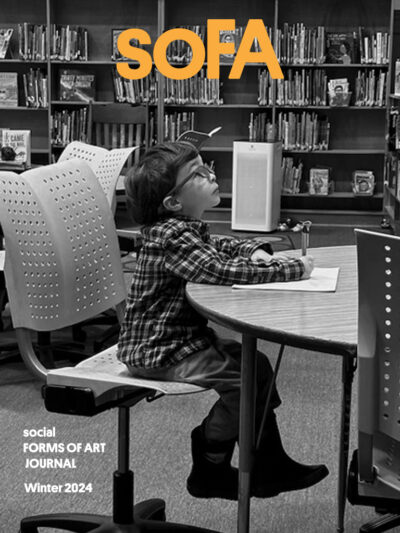
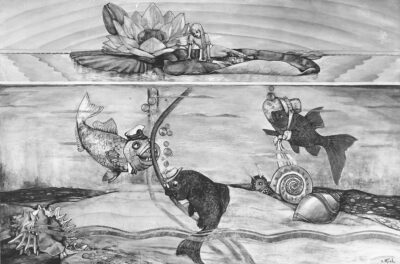
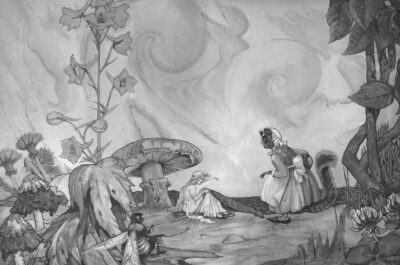
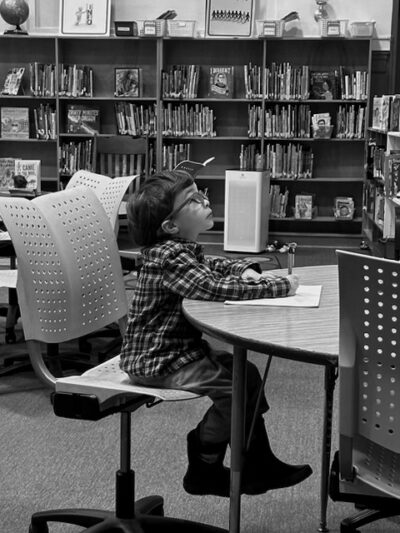
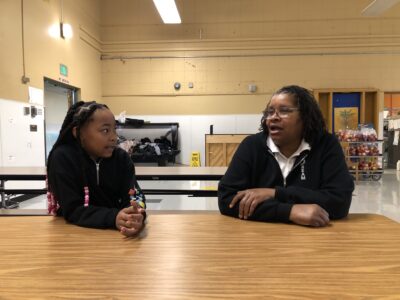
Image from Luz Blumenfeld’s interview with Marlo: Marlo and the Sparrow. Image courtesy of Beth Schlegel, 2023.
Our winter cover showcases an image from Luz Blumenfeld’s article in this issue titled “Marlo and the Sparrow.” Captured by Beth Schlegel, a Media Specialist at Dr. Martin Luther King Jr. Elementary School, this photo reflects the collaborative efforts between King School and Portland State University’s MFA Art and Social Practice program, jointly operating KSMoCA (Dr. Martin Luther King Jr. School Museum of Contemporary Art). It symbolizes our interconnectedness with time, narrative, and people: Marlo engrossed in a historical painting, Beth observing an elementary student, and Luz Blumenfeld, the article’s author, presenting this interview alongside Beth’s image. As we delve into Marlo’s story, let us remember the significance of collaboration, support, and the beauty we create together. We often overlook the beauty that surrounds us, crafted through our collective efforts. May our practice inspire you to notice the beauty in your own life.
This question is often the starting point for an idea, project, new friendship, and in the case of this issue, an interview. This collection of conversations reveals the many curiosities we are following as artists as we go deeper into our own social practices. What did you learn at school today? How do we preserve our history? What new futures are possible? are amongst some of the inquiries this issue seeks to explore.
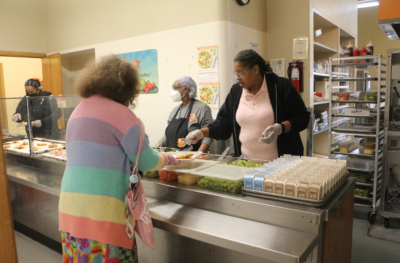
Questions about the classroom are aplenty in Simeen Anjum’s conversation with substitute teacher Sophie Von Rohr about the current state of Portland Public Schools following recent protests. Midori Yamanaka explores the format of workshops as a type of performance art with Daiya Aida, the director of education and outreach at the Yamaguchi Center for Arts and Media in Japan. Meanwhile in the lunch line, Clara digs in with Dr. Martin Luther King Jr Elementary’s beloved lunch lady, Ms. Ruby Sims. And just down the hall, Luz wonders how an 89 year-old painting at the King School Library commissioned during the Works Progress Administration inspires a kindergartener named Marlo.
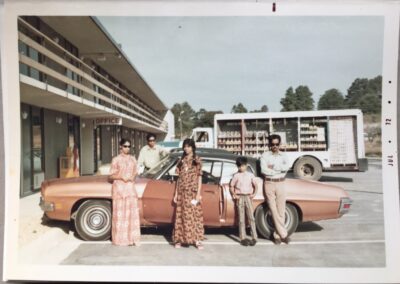
Where do you search for joy when you are in need of reprieve? Is it in the water, the open road, or in sports? Gili Rappaport and J Wortham discuss the queerness of nature and water as a source of grounding and community. Nina Vichayapai talks to Samip Mallick about the power of archives for South Asian Americans reclaiming the whitewashed narrative of the American road trip. Over tea, Olivia DelGandio speaks with queer elder Rose Bond about her experiences playing on an all-lesbian softball team in the 1970s and her involvement with the gay liberation movement.
Sometimes questions lead to answers. Sometimes questions lead to more questions. In these interviews, questions have led to new connections, great conversations, and for many of us, new avenues in our practice. We hope you enjoy exploring our curiosities with us in this issue of SoFA and feel inspired to follow some wonders of your own.
Sincerely,
Your SoFA Journal Editors: Simeen Anjum, Clara Harlow, Nina Vichayapai
“I feel the ocean this way. I’m put back together once I enter it, and every time I enter, there’s a homecoming and I feel the need to say a prayer.”
– J Wortham
J offered “blessings for a new year that is dripping with honey and covered in all the deliciousness that you need” as opening line in an email thread related to their oral history project of Riis Beach, part of the fellowship “I See My Light Shining” that is a collaboration between the author Jacqueline Woodson, Columbia University and Emerson Collective. For years, I followed their work as staff writer for The New York Times Magazine, co-host of the podcast Still Processing, and editor of the visual anthology Black Futures, and felt even more inspired as I learned of their practice as sound healer, reiki practitioner, herbalist, and community care worker. For months after reading their recent piece “Want to Love Your Body? Try Swimming Naked”, I imagined in queer spaces – What stubborn attachments are dissolving fluidly right now through this sacred, collective glimpsing and sensing? I had to ask if I could learn more from the person who shares as service, who offers directly, concisely, and explicitly towards a vision of healing justice and liberation. I felt blessed when my teacher Taravat Talepasand connected me with J for this interview.
Gili Rappaport (they/them): You wrote “You can’t dissociate in the ocean” in your recent piece “Want to Love Your Body? Try Swimming Naked” in The New York Times Magazine. Do you think that being in nature, and the ocean specifically, is a kind of gift that we are being offered as humans to mend the disconnection that we face from our conscious awareness, our thoughts, our feelings, our memories? And how does that relate to being queer?
J Wortham (they/them): This is a beautiful question. There is so much synchronicity between queerness and nature. So much of nature is queer, which is to say that it does what’s best for it. The binaries of the modern world have been pushed upon us both through categorization and compartmentalization. But when you actually look at how nature functions, it has a natural fluidity to it. It has its own orientations. It’s antithetical to hierarchies. There is so much collaboration, cointegration, sentience, intelligence and sensorial information that doesn’t make sense to the humans that study these systems, plants, and bodies of ecology, so they go unrecognized. It feels inherently queer that the intelligence and order of the natural world defies expectations of how things are supposed to work – both that it is quietly existing, and that it is thriving in its own ways without being detected, observed, controlled or perceived. When nature is left to its own devices, it figures out an ordinance that works for it.
Gili Rappaport: What about the history of queer sites along waterways?
J Wortham: There is a long, fascinating history of queer spaces existing alongside bodies of water in nature. Every time I travel, I look into those places. When I was searching cruising spots out in Long Island and the area that is now commonly known as the Hamptons, there were pockets that were less well known to me there and all along the rivers in New York. In pretty much any city, town, or place that I’ve been curious about that had water in the landscape, there was a history of queer encounters. I find that really beautiful, harmonious, and exciting, and it makes sense: there’s a metaphorical fluidity, sexiness, and evolution that happens alongside the water.
Also, something that came out of reading Esther Newton’s book Cherry Grove, Fire Island: Sixty Years in America’s First Gay and Lesbian Town (2014) is that bits of land alongside water also provided privacy and anonymity, which is not the same thing as isolation. There was a need and a desire for a place away from societal rules and regulation to experiment, have fun, and find freedom. That’s also interesting when we start thinking about it from a racialized lens.
Gili: How do you connect this research with Work of Body, the book of essays that you are currently writing on dissociation?
J: First, I want to express that my connections with water aren’t universal, and they may not be true for people other than me: a lot of people feel uncomfortable alongside or in water, and there is ancestral trauma, especially for many Black and Brown people whose peoples have endured pain and historical violence on and alongside bodies of water.
For me, water is a stabilizing and grounding force. I find a lot of re-homing in water. As Toni Morrison wrote in Beloved (1987): “She is a friend of my mind. She gather me, man. The pieces I am, she gather them and give them back to me in all the right order.” This quote speaks to collective shared memory as enslaved people, and the ways in which black people cared for themselves before the Civil War, and helped return to each other.
I feel the ocean this way. I’m put back together once I enter it, and every time I enter, there’s a homecoming and I feel the need to say a prayer. If I’m somewhere and there is a body of water, I want to visit it. I sometimes want to do a ritual alongside it. I feel at home, like there’s a part of me that’s returned to myself. It’s hard to find out a lot of information about my history but I would love to know if there were fisherpeople in my lineage.
This relates to dissociation because I am someone who spends a lot of time outside of my body, and not always aware that I’m outside of it until I’m re-entering it. That process can be slow or fast, and it’s so beyond me. Being around water is one of the ways that I feel consistently located within myself. I find that interesting because the ocean as a body has so many parts, and it’s also this incredibly massive thing.
This summer, I took ocean swimming classes in Martha’s Vineyard and Cayman Islands. I learned how the ocean has a language and rules. Safety there is imperative. Learning to swim in the ocean is different: currents and shifting temperatures can indicate important things about depths or tides. So you’re listening differently, breathing differently, seeing differently. It feels like learning a new language. It is the opposite of dissociation.
A big part of why I wanted to write that essay, besides wanting to write about queerness, water, and beaches, and because it made sense with my research at the time, is because I always am trying to understand the deeper relationship between myself, water, queerness, and my ancestral orientation. I don’t know that it’s ever going to be clearly delineated. It just is.
Gili: What you’re saying about the fisherpeople reminds me of something else that you wrote in The Magazine: “An oracle once looked me dead in the face and told me I crawled here from the ocean floor”. It reminded me of when a medium told me that I had been wandering the desert for thousands of years.
On the topic of queerness, ancestry, and identity, what’s your relationship with your name change and geography of home? I heard you say on the podcast Thresholds (2023), “I wasn’t beholden to anybody. And at a certain point I was like, I’m not even beholden to myself. So who am I trying to people-please? Because nobody out here is checking for me. And that was really freeing.” How have you benefited from having a name change when you were living in the Bay Area, and then returning to your home community in New York?
J: I trust the timing of my life and the great unfolding. It is what it is. I feel a lot of peace around it. Sometimes when I talk to friends in my life who’ve been clear on their queerness from a young age, I feel envious. I wonder what my life would be like, had that been my path. I can also look back on my own life, my childhood, and see all the ways in which there was actually just so much queerness present, which didn’t maybe follow a classic, clear arc, but I’m actually not even sure that there is one.
I was a little bit of a later bloomer, but it was hard for me to access queer community. When I was younger, even though I was trying, I felt outside of the matrices of queerness and queer desirability. When I first moved to New York, I would always try to go to queer parties and queer bars. But I wasn’t really tapped into Black and Brown communities. Instagram wasn’t as popular, so I found it hard to find things. I was constantly going to places and put in these predominantly white environments, trying to appeal there, and feeling so inadequate. It convinced me that I didn’t actually belong or that I wasn’t actually queer, or queer enough. That kept me from feeling like I could be more fully expressed. This dovetails my larger life journey of not looking outside of myself for approval, validation, and acceptance: not needing others to tell me the names that I can name myself. In hindsight, it was a slow dawning awareness, and then figuring out how to own it in a way that made sense and felt comfortable for me. So it did benefit me.
It’s nice to be able to talk about it without shame and embarrassment, which I had for a long time. I love the bell hooks quote about queerness, “not being about who you’re having sex with, but about being at odds with everything around it”. It’s queerness in the way you live your life, orient yourself politically, think about your role in the world and your contributions, and create new paradigms. That feels fitting. I’m trying to press up against the edges of my own queerness and see where it can go and how it goes there. And who can come along with me.
Gili: What is the role of clothing in a place where clothing isn’t required? And how does that relate to a show like Ralph’s Beach Parties at Riis Beach, NYC?
J: There is something incredibly powerful and radical about the ways in which clothing and adornment work for all people, and especially queer people. People who in our everyday lives try to figure out how to dress in a way that attracts the kind of attention we want, or detracts the kind of attention we don’t want, to dress for our genders, and to have playfulness. To participate in true identity construction as much as we want and need. And there’s also a lot of freedom in taking it off. That’s the intersection when I think about a queer nude beach.
I haven’t been to Ralph’s shows. But my guess is, from being on Riis Beach and seeing how fashion works there, it’s fun to wear neon thongs and pasties. It’s all meant to be comedic and funny, to make other people laugh or gasp. Even if there isn’t an organized fashion show, it’s always a fashion show. It’s the way in which we signal to each other and have playfulness. In New York in particular, there’s a culture of dressing for other people, to give other people an experience that defines their day. It’s one of my favorite things about living here, the community, and the ways in which we try to make each other laugh or smile just by how we show up in the world.
Gili: Also, speaking of shame and embarrassment, have you had to overcome any of those feelings around public nudity at queer beaches?
J: I’m rarely nude at Riis beach in New York. I worry about surveillance so It’s not freeing for me the way it is for other people. After growing up with so much internalized fat phobia, body anxiety, and disordered eating, I finally feel really happy with the way I look and feel naked, which is unusual in the scheme of my whole life. But if I end up in naked photos, I want to have agency over that.
In Oaxaca, there seemed to be different standards of surveillance and documentation: there’s more respect and acknowledgement of the space being sacred and special, and not privy to the nonstop documentation that governs so much of our modern lives. It was the first time that I thought, “I might actually be able to experience what so many other people get to experience when they’re in the water and when they’re swimming”. That was a big revelation for me and what I ended up writing about actually more than anything else.
That’s the exciting thing about being a writer: having lines of inquiry and curiosities, following them, and paying attention to what else is happening and coming up. I try to let the circumstances dictate the story. This is a great privilege of still writing at a magazine in 2024, which is rare and feels kind of endangered. Freedom of inquiry feels like a real privilege.
Gili: In the magazine piece mentioned above,you shared some personal erotic accounts: “In the dunes of Provincetown, Mass., where a girlfriend and I tried covertly to have sex, several times, only to have a park ranger chase us away, several times, with the increasing exasperation of someone trying to clear a road of errant livestock.” How do you navigate the agency aspect of sharing accounts with others? I imagine a tension between the need to paint a picture of reality, and the privacy of what you share, with whom, and how you share it.
J: I think a lot about the privacy of the people I’m writing about. I appreciate what Melissa Febos has written in her book, Body Work: The Radical Power of Personal Narrative (2022) about the ways in which we can practice care, consideration, and collectivism in reckoning with the power of being a writer. We will always write in a way that is biased towards ourselves, so how can we be aware of those biases? It feels jarring sometimes to see something intimate or personal in print that you’ve shared. When it feels necessary, I talk to the people I plan to write about.
I find it empowering, important, and necessary to share stories that feel meaningful because I believe in service. I believe in the reparative personal work that we do in talking about it and normalizing it, and it is also helpful for other people. I could be wrong: there could be people who feel that it’s an overshare, not interesting, or a little over the edge. The feedback that I’ve gotten has reinforced that it is helpful when I talk about sobriety, body shame, dysmorphia, dissociation, and queerness.
Also, there still aren’t enough direct, concise, explicit examples. I remember being in my twenties and reading sexy, explicit, disgusting books about women, bodies, and rage and the authors were always white. I never really understood why that was, so it became a personal mission to incorporate that into my own work. It was freeing to do that. I have pulled back some because I am aware that not everybody needs to know every single thing all the time, and there’s a way to write about sex and intimacy that isn’t necessarily just describing acts explicitly unless it’s helpful to the story. So that’s the learning curve that I’m in right now: trying to find that balance between the two.
Gili: Given all of your experience writing for The New York Times Magazine, editing the anthology Black Futures, and also conducting the oral history project, do you have any advice for people who are interested in being archivists, journalists, or working in that kind of socially engaged way?
J: Some of the most engaging and rigorous conversations I’ve been having lately involve concepts of care and mindfulness when asking people to share personal information, whether that be oral histories, or journalism, or really anyone that you’re asking to be vulnerable. To be really mindful of the power dynamics that exist when you’re someone with a recorder and publishing power. So many of the people I reach out to are from historically ignored communities, so sometimes there’s suspicion, and sometimes there’s such excitement that someone cares that people give a lot. It’s up to us to be responsible and protective as much as we can be.
Also, these are two very different roles: archivists and journalists. There are different considerations for both depending on what you’re doing, recording, archiving, and documenting. Being credibly aware that it is an extractive process and that people aren’t always aware of the repercussions and consequences when sharing intimate details of their lives. That is something that I think about quite a bit, and something that I try to let people know in advance. And that we can go slowly.
Something that I’ve also learned over the years from feedback is that people will feel they were misrepresented or the full story wasn’t portrayed, because it never is, and it can’t be. And while that is something that I do think it’s important to try to be aware of, it’s not always something that we can be responsible for. It is important to try, when possible. When I’m working in historically disenfranchised communities, the last thing I want to do is replicate the systems of disenfranchisement that already exist. We all get to choose our practices, the ways we want to work, and how we want to show up and cover our communities and the things that we care about. I try to remind people that the paradigms of how personal and vulnerable information is received online, which is how most people are receiving this information, can make it really challenging to be vulnerable and authentic. It’s something that I don’t want to haunt me as I get older, and it’s something that really weighs on me. I feel a need for care around it now.
Gili: Yeah, thank you so much for sharing so vulnerably about this need for care. Do you have any other questions before we close out?
J: This book of interviews that you’ve been conducting for the past few years (collected in the anthology I See What You See, KSMoCA May 2024) sounds amazing and necessary. I’m glad that you’re doing it. I hope to meet you and your collaborators, and hear more about the project as it evolves.
Gili: Thank you so much J!
J Wortham (they/them) is a sound healer, reiki practitioner, herbalist, and community care worker oriented towards healing justice and liberation. J is also a staff writer for The New York Times Magazine, and co-host of the podcast ‘Still Processing.’ J is the proud editor of the visual anthology “Black Futures,” a 2020 Editor’s choice by The New York Times Book Review, along with Kimberly Drew, from One World. J is also currently working on a book about the body and dissociation for Penguin Press. J mostly lives and works on stolen Munsee Lenape land, now known as Brooklyn, New York, and is committed to decolonization as a way of life.
Gili Rappaport (they/them) is a naturalist using their skills as an artist, designer, and educator to deepen relationships with nature through social and visual forms. Their interdisciplinary practice cultivates intergenerational, inter-species connections that move within a range of outdoor sites: beaches, wetlands, rivers, forests, gorges, sky bridges, heritage trees, backyards, and graveyards. They co-authored Field Guide To The Northeast (The Outside Institute, 2017–2021) and co-organized Ralph’s Neon Oasis Beach Party at historic gay beach Jacob Riis (Gateway National Park, 2023). In 2024, Anthology Editions will publish the book they designed with Ralph Hopkins, They Call Me The Mayor at Riis Beach: Ralph’s Beach Parties 1994—2000, and KSMoCA will publish their anthology of interviews I See What You See: Art + Social Practice Conversations. The Front Room at Contemporary Art Museum St. Louis, King School Museum of Contemporary Art (KSMoCA), Jordan Schnitzer Museum of Art, Parallax Gallery, The Switch Gallery, and Dream Clinic Project Space have all shown their work, and KSMoCA and and Special Collections and University Archives at Portland State University has their work in their public collections.
In the Fall of 2023, I was a graduate research assistant for Dr Martin Luther King Jr School Museum of Contemporary Art (KSMoCA). My research was focused on a historical piece of art in the museum’s permanent collection; three oil paintings by Portland artist Charlotte Mish depicting scenes from the fairy tale, Thumbelina.
The paintings were commissioned by the WPA for the school in 1939. Through my research, I found that many Portland public schools received WPA works of art, many of which are still visible today.
The first Thumbelina painting (in the series of 3) depicts the scene in the story where Thumbelina sits on a lilypad weeping to herself as she has just been kidnapped by a toad who wants her to marry his son. The fish in the water below hear her crying and decide to help her escape by chewing the root of the lilypad so that she can float away on it.
In the second painting, a field mouse is ordering Thumbelina to sew her own wedding dress. After escaping the first arranged marriage, she finds herself in another.
The third and final painting in the series depicts Thumbelina riding on the back of her friend, the swallow. They are escaping her last arranged marriage and flying toward a magical kingdom of flower people in the distance. Photographs of Charlotte Mish’s paintings, Thumbelina No. 1, 2, and 3, taken c. 1940. Images courtesy of the Multnomah County Library WPA Archive.
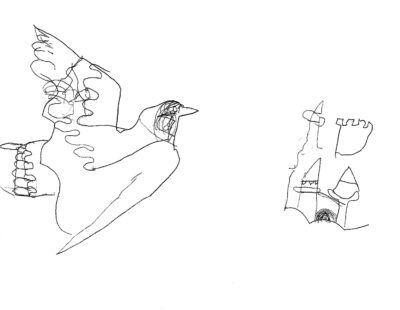
As part of my research, I spoke with Dr. Martin Luther King Jr School’s media consultant, Beth Schlegel, to see if she remembered any children who had shown interest in the paintings. She introduced me to Marlo, a kindergarten student at the school, who I interviewed about the drawings he made from looking at the paintings.
Marlo in the school library drawing the sparrow in Charlotte Mish’s painting. Portland, Oregon. Image courtesy of Beth Schlegel, 2023.
Luz: I heard that you were drawing the bird in the painting.
Marlo: Yeah.
Luz: What do you like about it?
Marlo: The wings.
Luz: Do you know what story the paintings are from?
Marlo: No.
I read the story of Thumbelina to him. The summary of which is that a tiny girl is born inside a flower and is later kidnapped by several animals who want her to marry their sons or friends. Thumbelina does not want to marry the toad or the mole, and escapes with the help of a sparrow. Together they fly to a flower kingdom where she meets a prince just as tiny as she is who asks for her hand in marriage and offers that she become the queen of the flower people.
Luz: Why did you want to draw the bird?
Marlo: Cause it looked… good.
Luz: Do you like birds?
Marlo: Yeah.
Luz: Do you see any birds by your house?
Marlo: Yes.
Luz: What birds do you see by your house?
Marlo: A crow.
Luz: We do have a lot of crows here. What do you think about crows?
Marlo: They’re black.
Luz: Yeah, they’re also very smart and they–
Marlo: Eat worms!
Luz: Yeah and they can remember people’s faces.
Marlo: I know.
Luz: You know a lot about crows, huh?
Marlo: Yeah.
Luz: What else do you see in the paintings?
Marlo: Uh… a castle right there!
Luz: Have you either seen a castle in real life?
Marlo: No.
Luz: Me either. Do you think that’s where the flower king from the story lives?
Marlo: Yeah.
Luz: I think so too. Why do you think the paintings are so high up?
Marlo: So they don’t get knocked down.
Luz: That’s a good reason. They’re really big, huh?
Marlo: Yeah.
Luz: Do you like to paint?
Marlo: Yeah.
Luz: What else do you like to paint?
Marlo: Uh… I want to paint… the clouds.
Luz: It looks like the person who painted these also liked to paint the clouds. I see clouds in two of the paintings. What shapes do you see in the clouds in the second painting?
Marlo: It looks like… a bunch of beaks.
Luz: Like birds’ beaks?
Marlo: Yeah.
Luz: (laughs) I could see that. Do you ever see pictures in the clouds in real life?
Marlo: Sometimes.
Luz: Do you remember any of them?
Marlo: No.
Luz: Sometimes when I look at the sky I think that the clouds look like ice cream.
Marlo: Me too!
Luz: Do you like ice cream?
Marlo: Yeah.
Luz: What’s your favorite flavor?
Marlo: Uh… vanilla!
Luz: I like vanilla with rainbow sprinkles.
Marlo: And I like it with caramel!
Luz: Yum.
Marlo: And also rainbow sprinkles.
Luz: I think they’re pretty and they also taste good.
Marlo: Yeah.
Luz: Do you think that Thumbelina would like ice cream?
Marlo: Yeah.
Luz: She’s so tiny. We would have to give her a really small amount. What do you think we could give her ice cream in?
Marlo: Uh… definitely this. (points to an acorn in the Thumbelina book)
Luz: Like a little nut? That seems like a good size. Maybe she could have some ice cream with her friend, the swallow.
Marlo: Yeah.
Luz: Those paintings were put up there in 1939, a really long time ago!
Marlo: I know.
Luz: Have you seen any other things that are really old?
Marlo: Uh… yes.
Luz: What else can you think of that’s really old?
Marlo: Uh… it is… when Michael Jordan died.
Luz: (laughs) Michael Jordan… is really old?
Marlo: Yeah.
Luz: How old do you think birds live to be?
Marlo: 10.
Luz: I know that some birds live to be 80 years old, which is such a long time.
Marlo: I know.
Luz: If you could paint something up there, what would you paint?
Marlo: Uh… that bird.
Luz: Would you want all 3 of the paintings to be of the bird?
Marlo: (laughs) Yeah.
Luz: If you ever got the chance to ride on a bird’s back like Thumbelina, would you do it?
Marlo: No, because maybe the wind would blow me off.
Luz: Oh yeah, that does sound dangerous. I would be scared. She looks pretty brave, huh?
Marlo: Yeah.
Marlo’s drawing of the sparrow and the castle. Image courtesy of Marlo, 2023.
Marlo (he/him) is a kindergartener at Dr Martin Luther King Jr Elementary School in Portland, OR. He likes to draw, especially birds.
Luz Blumenfeld (they/them) is a transdisciplinary artist and writer with a background in Early Childhood Education. Third generation from Oakland, California, they currently live and work in Portland, Oregon. Their practice is about looking and noticing, research and history, and personal archives. Luz’s work has taken forms such as an unofficial artist residency at the Portland State University pool, teaching preschool, making things public through publications, an open invitation to play with soft sculptures, a radio program about field recordings and the immateriality of memory, and more.
“It was important to me that whether it be through our softball games or these events we planned, we spread joy.” -Rose Bond
A central part of my work is exploring queer history, learning from elders, and finding and sharing stories that may otherwise be lost. So when Cayla McGrail invited me to an event they were planning meant to encourage elder lesbians in Portland to consider archiving their personal collections, I saw it as a great opportunity to make connections with a community I was interested in working with and learning from.
At the event, I met Rose, who shared that she’d been a part of the Lavender Menace softball team in the 1970s and had a large collection of material from that time in her life. I approached her later to ask if she might be interested in sharing more about that experience with me. She agreed, and invited me over to her apartment to share tea, stories, and photos.
Olivia DelGandio: Can you tell me a bit about your coming out experience?
Rose Bond: Well, I didn’t think I was gay but I did have this friendly neighbor who seemed to know everything like gay bars and gaydar. She said she could walk downtown and guess who was gay. I was like “what? how?”
Olivia: You were in this queer relationship but didn’t think you were gay?
Rose: No, I could appreciate or be attracted to people regardless of gender but I didn’t have the vocabulary. I thought I’d marry a really nice guy and be a really good parent. Maybe I wasn’t very self-reflective, but there really weren’t many women I was attracted to. I went to an all girls high school and nothing was sparked there, so, you know.
Olivia: How did you meet this woman?
Rose: I moved in next door to her during college. It was a crummy apartment down by Portland State and just randomly, our two apartments were joined by a balcony. It didn’t take very long to start.
Olivia: That’s funny, I met my partner in pretty much the same way.
Rose: And did you know you were a lesbian?
Olivia: I think I felt similarly to you. I didn’t really have any lesbian representation growing up so I didn’t know what was quite possible.
Rose: Yeah, pretty similar. At the time I was working this work study job where I’d make posters and go around and put them up on campus so I always knew what events were going on around Portland State. At some point my boss, Carol, who knew I was gay, sent me out to get this alternative newspaper but I think it was a ploy on her part. I took the paper home when I saw that the centerfold was about gay liberation and women. It was written by someone named Holly Hart. She was sharing info about a gay liberation group and threw out a bunch of names of people that were meeting next to discuss these topics. Turned out she made all of the names up just to get people interested and come to the meeting. My girlfriend said we should go and I said, “whoa, I don’t know if I’m just gay. I think I’m just having a good time with you.” So anyway, we both went over to this little house in Southeast Portland, and that was the first gay liberation meeting. There were about seven women present, none of which were the names from the article.
Olivia: That’s so funny. How did things go after that first meeting?
Rose: Well after that, we had regular meetings. We’d meet at a coffeehouse called the 9th Street Exit in
Centenary Wilbur Church. We started to really get to know each other and go out to these lesbian
centered bars. It was your typical butch femme scene. I had long black hair and I was wearing tie dye
and bellbottoms. I could play pool really well and the older dykes were sort of like “what are you?”
They didn’t know what to make of a long haired butch. Roles were so de
ned as butch or femme. I
was intent on not being put into a box. I wanted women’s identities to exist in a wider range.
Olivia: When did you finally admit that you were gay and not just having a good time with this girlfriend?
Rose: It was during that time of gay liberation and having girlfriend after girlfriend that I was like oh, there’s a gender thing happening here.
Olivia: What else was going on at that time?
Rose: We started a softball team called the Lavender Menace. [Rose shows a photo] This was our first team. We sang and made a performance out of our games. We would take pop songs and change the lyrics to make them girl friendly. I saw it as a sort of political theater.
The Lavender Menace softball team projected at one of the team member’s home, early 1970s, photo taken by Olivia DelGandio, courtesy of the team collection.
Olivia: Were the majority of you lesbians?
Rose: All of us were.
Olivia: Wow. And what year was that?
Rose: The first team started in ‘73, I think.
Olivia: How old were you at the time?
Rose: Early twenties. We would go around regionally, up to Bellingham or Mount Vernon and we were totally out, we were the only ones wearing long pants. Everybody else was wearing shorts, you know, just because that’s what girls did.
Olivia: Do you think most other teams were queer?
Rose: A lot were, but they weren’t out.
Olivia: Interesting. How did you get involved with the team in the first place?
Rose: My girlfriend at the time, Clarice, was an organizer.
Olivia: Had you played ball before?
Rose: I played in Catholic school and then I went to St Mary’s Academy where I played sports until I was a junior. After that, I became kind of anti-sports until joining the Lavender Menace.
Olivia: Were you guys good?
Rose: The first year we weren’t that good but the second year we got good. Some women felt like they couldn’t play because maybe they were married to a guy or had a job they couldn’t risk losing or a family that wouldn’t approve. But we were like a magnet, we brought so much joy to every game, every tournament. We would go out in these small towns, in places like Mount Vernon, Washington, and we would dance. And everyone there would dance with us. We spread joy.
Olivia: What did your family think?
Rose: My mom would say, “you know, I had a girlfriend, too.” She probably could hit both ways, but she also really liked men.
Olivia: That’s so funny. So your mom had to be totally fine with it because she got it.
Rose: Plus there were nine kids, so it didn’t really matter, right? They had enough to worry about.
Olivia: That’s great. So all of this came out of gay liberation and then the bar scene?
Rose: Yes. There would be one popular lesbian bar and then it would go out of business and another would open and that’s where we’d all go. There was one perennial bartender that would go from place to place with us.
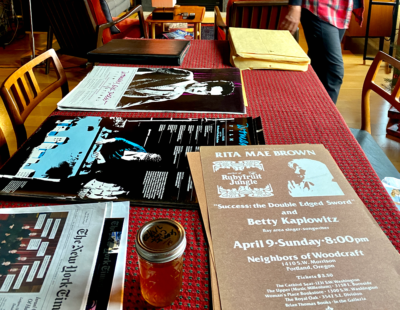
Olivia: I wish I could experience that. It feels so different from the bar scene now. I feel like there are so many gay bars for men but not a lot of lesbian options. Rose: It was great and I would meet so many people that way. We did a lot of events and readings and such. I used my art experience to make the posters to advertise what we were doing. I was also part of putting together a women’s film festival. That was cool because we got to really dig into film and find the women directors, I mean we really had to dig.
Rose’s collection of posters and materials from events held during the Gay Liberation movement in Portland in the 70s, photo taken by Olivia DelGandio at Rose’s home
Olivia: When was that? Rose: That was when I was starting to make films in the early 80s. I had met women through film, most of them were straight but they were feminists and wanted to see more women represented in art so that’s how the Women’s Eye View festival started. It was important to me that whether it be through our softball games or these events we planned, we spread joy.
Rose Bond (she/her) is an animator and media artist who has been honored with numerous awards and fellowships from prestigious agencies such as the American Film Institute, The Princess Grace Foundation, Bloomberg L.P., and the National Endowment for the Arts. In 2013 Bond presented her animated installation, Intra Muros, on the Media Façade of the Museum of Contemporary Art in Zagreb, Croatia. She is currently working on a proposed media installation for the Smithsonian’s Arts and Industries Building.
“While when I was young I gave myself the grace to spend a lot of time alone as a way of self-discovery working and taking photographs, it is also true that there is another type of loneliness that comes with age and is hard on a different level. The older you get it is more difficult to move to a place and make friends and that is another layer to the experience of loneliness that you can experience in your life.”
-Marcus Muccianti
Midwesterner in the Northwest. This is the most accurate description of Marcus Mucciante, a former environmental scientist from Chicago who left everything behind to start a new chapter of his life in Portland through the practice of photography.
What would a person from Chicago and I, a Costa Rican person, have in common? probably not much at first glance. But with Marcus, our paths crossed to discover a story of loneliness, self-discovery, and the practice of photography as a way to connect with others and with oneself. This is about unlikely friendships and photography.
He’s now one of my best friends in America. He feels like a very serious person. Lives in Northwest Portland. I am playful and silly, while Marcus has a serious demeanor and is from a cold, windy place.
Manfred Parales: Interviewing a friend can be a fascinating experience but also wow, what did you think when I told you, Marcus, it’s time to make your story a piece of art, I’m going to interview you. What was going through your head?
Marcus Muccianti: I was wondering what this was for? What was it about? Why did you choose me? I always have my own conclusions on why somebody does what they’re doing then I tried to think of a flurry of the questions that you’re going to ask me.
Manfred: Chicago is where it all started. What was your life like there and how that shaped your personality.
Marcus: It definitely comes from my childhood so opening up has always been a hard thing for me. So, yeah, there’s gonna be a bit of a facade there.,, It took some time for me to warm up to people. I grew up in a suburb just west of Chicago called Oak Park. When I was whatever age it was, and I had enough money, I moved out to Chicago and I lived there until I moved here to Portland. I see the differences between Chicago and Portland, aesthetically it’s different, geography of the area is different. Now Chicago is a place that I can never see myself returning to, honestly. Now I do love living out in the Pacific Northwest.
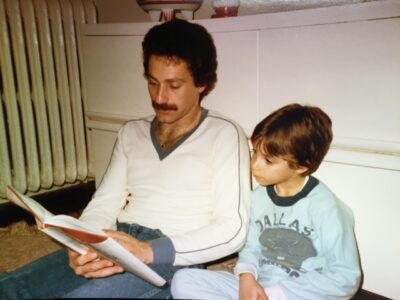
Marcus and his father in the family home in the early 1980s. Photograph courtesy of Marcus Muccianti.
Manfred: I do love living out in the Pacific Northwest too. When was the first time that you heard about Portland? And why did you decide to move from Chicago to Portland?
Marcus: Honestly, the one memory I have of Portland is watching a TV show on our PBS network called Weird, it was like Weird Something, and they’d go across the country and find weird foods, and they had mentioned the donut shop Voodoo Donuts. I remember hearing about that like 10 or 15 years ago and saying I want to go out there. So, it piqued my interest about Portland but Portland wasn’t my first choice and it wasn’t the place I wanted to move to on the West coast. That was the Bay area.
I feel like I want to be a part of a gayborhood and an area that welcomed me. A place predominantly gay. You have the gay bars.I thought it’s like a very welcoming place and you don’t have to worry about being gay.
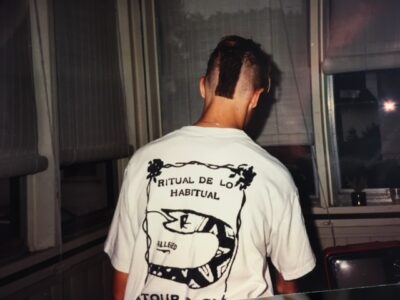
Marcus at college. mid 1990s. photography courtesy of Marcus Muccianti.
Manfred: Before coming to Portland did you try to live in any other place in the United States or abroad?
Marcus: No. Before moving to Portland I took about two weeks to visit both Portland and Seattle. And then after that I made my decision.
It made it a little bit easier because I did get a job offer here in Portland prior to moving. So I knew I had some financial stability moving here. Also I decided against Seattle because it felt a little too cosmopolitan. And I kind of wanted to get away from that, being from Chicago. So Portland had a totally different vibe than what I’m used to.
Manfred: One of the experiences when moving from one country to another, or in your case from the Midwest to the West Coast, is experiencing loneliness. How has your relationship with the experience of loneliness been when being new to a place?
Marcus: I moved here not knowing anybody. I did enjoy it in a way. I like having my solitude and exploring a new city on my own. That’s one of the reasons why I also didn’t move to Seattle. I was dating someone who lived in Seattle. I started dating him in Chicago, he moved to Seattle. When I was visiting both Portland and Seattle, he was there. I didn’t want his judgments to cloud where I wanted to move and how I felt about a city. I wanted to really kind of explore it on my own and make my own judgment calls on the city. There was a bit of loneliness in not knowing anyone but it allowed me also to explore on my own.
Self-portrait. 2020. Photography courtesy of Marcus Muccianti.
Manfred: The idea of your loneliness in a new city was something that empowered you. Was it an opportunity to bring to life a new phase of you?
Marcus: I was able to create my own experiences without somebody else clouding those for me or saying“Oh, this is what I love about this place because it reminds me of that.” I could experience those things on my own for the first time. I think I cherish those moments cause I didn’t have somebody else.
Manfred: In this process, what was something you learned, discovered or were surprised by during this new period of your life?
Marcus: Realizing how white Portland is when you’re here. I was in a restaurant in the Pearl District and I was looking out. I was eating alone. I was looking out and saw a black person walk by. That was my first understanding that Portland was a white city. That moment made me ask Why did I notice that just now? I didn’t think or know how white this city is compared to Chicago, which is more culturally and racially diverse than Portland and just now I noted. It made me wonder if instead of bringing more diversity to this city and just adding to the problem. It was a huge shock to me to find out that Portland is so white. Not as diverse as Chicago in that sense. Another thing that surprised me about Portland, in a more curious twist, was the amount of crows. The amount of crows in Portland is crazy.
Portland. 2021. Photography courtesy of Marcus Muccianti.
Manfred: Even though loneliness can be a means of empowerment there are times when it feels very heavy. How have you dealt with those moments?
Marcus: When those moments hit, that’s when I would go out in nature. Nature for me was a place where I can kind of gather my thoughts and be at peace where I was. I was particularly enjoying my new job here in Portland but it was really stressful and that was my only outlet.Getting in my car and going out into nature was something that helped me deal with that loneliness. Even though I was still physically alone in those moments I felt at peace being in nature.
Manfred: Talking about nature, there is an interesting intersection in your life where paths cross again. You studied environmental sciences but you have long dedicated yourself to photography, a path that we also share and which you have explored throughout the United States. What is the story behind that?
Marcus: My first job out of college was a contractor for the US Environmental Protection Agency (EPA) and a lot of what I did was travel and do oversight for contaminated sites. These sites were kind of barren and abandoned areas typically. My photography was based on these interesting abandoned places.
Whenever I was on a job site and I was suited up with a mask or my air tank I always can visually see a photo in my mind. After I would take all of that off, I would kind of try and go back and get those photos. Photography has always excited me. It was something that I could see in my mind’s eye, a photograph.Sometimes it didn’t work but it’s something that has always been like a common thread throughout my life that I’ve really enjoyed. Wherever I am in my life, regardless if it’s happy or sad, photography is something that I can rely on. I bought my first camera in 1996 on a road trip to Toronto and I’ve been taking photos ever since. I have been taking photography for almost 30 years.
Utica, IL. 2006. Photography courtesy of Marcus Muccianti.
Manfred: Do you have any interesting stories about photography?
Marcus: Here’s an interesting fact. I was going through some of my parents’ cabinets. They have old documents from when my brother and I were kids. My mom also held on to a bunch of photos that my grandfather took. My grandfather also loved photography which I didn’t really know about until later in life.
He also visited a lot of the same places I did in Chicago, like some nature places just outside of the city. It’s nice to have that connection and maybe feel like it was some kind of artistic genetic thing. I own some of my grandfather’s cameras and Polaroids.
Manfred: After these years, what is your reflection on loneliness?
Marcus: While when I was young I gave myself the grace to spend a lot of time alone as a way of self-discovery working and taking photographs, it is also true that there is another type of loneliness that comes with age and is hard on a different level. The older you get it is more difficult to move to a place and make friends and that is another layer to the experience of loneliness that you can experience in your life.
Manfred: Speaking of expectations versus reality, what advice would you give young Marcus?
Marcus: The advice I give myself is to continue to reach out and make those connections. I think I was really flippant in thinking that the people who were reaching out were going to continue to reach out. I’ve lost those connections.Very recently I’ve started reaching back out to those people I originally made connections to, hoping to rekindle that. Understanding now that it was something I probably should have worked a little bit harder on. don’t take those moments for granted.
Washington State. 2023. Photography courtesy of Marcus Muccianti.
Manfred: If the Marcus of today could give any advice to the young Marcus 20 years ago, what advice would it be?
Marcus: Let’s start with gaining a smarter and better sense of self. I think moving away from my family lets me be who I truly am which can be scary too. After moving I lost friends in Chicago. It’s hard to keep that connection with long distance. It’s pretty difficult.
Manfred: By the way, did you ever try that place, Voodoo Donuts?
Marcus: It’s not that great. It’s probably my least favorite donut place here in Portland. I like Heavenly Donuts. I like the basics. I grew up with Dunkin Donuts so yeah, I like the basics.
Self-portrait in Oregon. 2022. Photography courtesy of Marcus Muccianti
Marcus Muccianti (his/him), a Midwesterner in the Pacific Northwest, embodies a unique convergence of scientific expertise and artistic expression. Originally from Chicago, IL, Marcus’s journey led him to Portland. With over 8 years of dedicated experience in environmental protection and remediation, Marcus has established himself as a leader in the field. His academic foundation was laid at the University of Illinois at Chicago, where he earned a bachelor’s degree in Earth and Environmental Sciences, providing him with a robust understanding of the complexities of our natural world.
In addition to his scientific pursuits, Marcus has developed a passion for photography, exploring diverse genres such as landscape, portrait, architecture, and conceptual art. Through his lens, he combines scientific curiosity with artistic vision.
Currently, Marcus has focused on the real estate sector while continuing to pursue his photographic endeavors. He embraces every opportunity to wander into the landscapes of Oregon accompanied by his camera, documenting his vision of Oregon and the world.”
Manfred Parrales (his/him) In his interdisciplinary practice, Manfred often moves between art history, design, and social practice rather than conforming to traditional subject matter or individual expression of art. As a young Latino creator, he envisions art as a communal endeavor, transcending individual expression. He reimagines preconceived notions of art, constantly exploring new perspectives and creative avenues in a practice that embodies the idea of art as a catalyst for community engagement. This approach allows him to become an ‘accidental educator’, which ultimately makes his art practice an integration of art and life.
“I believe that workshops have a significant element of performing arts. It’s quite challenging because it involves interaction with the audience. It’s not just about following the script; you also have to adapt to the characters of the people who come. ”
– Daiya Aida
YCAM(山口情報芸術センター)は、2003年に地域の文化振興を目指して設立されました。メディアアートを中心とした施設で、教育や社会貢献を重視し、多彩なプログラムを提供しています。例えば、議論と身体実践を繰り返して新たなスポーツをつくる「スポーツハッカソン for Kids」や、調理とおいしさを科学的な視点でとらえる「COOKHACK」、現代社会や自身の身体感覚の理解を深められるものなど、興味深い内容が並んでいいます。会田大也氏はYCAMの立ち上げ当初から関わり、現在は学芸普及課長兼アーティスティックディレクターとして活躍しています。今回は、ワークショップを通じた教育プログラムについてお話を伺いました。
Yamaguchi Center for Arts and Media (YCAM) was established in 2003 with the aim of promoting local culture. As a facility focused on media art, it emphasizes education and social contributions, offering a diverse range of programs. For instance, there are fascinating concepts such as a “Sports Hackathon for Kids,” where new sports are created through repeated discussions and physical practice, “COOKHACK,” which approaches cooking and taste from a scientific perspective, and others that deepen our understanding of contemporary society and our own bodily sensations. Daiya Aida has been involved with YCAM since its inception and currently serves as the Director of Education and Outreach as well as the Artistic Director. In this interview, we discussed the educational programs conducted through workshops.
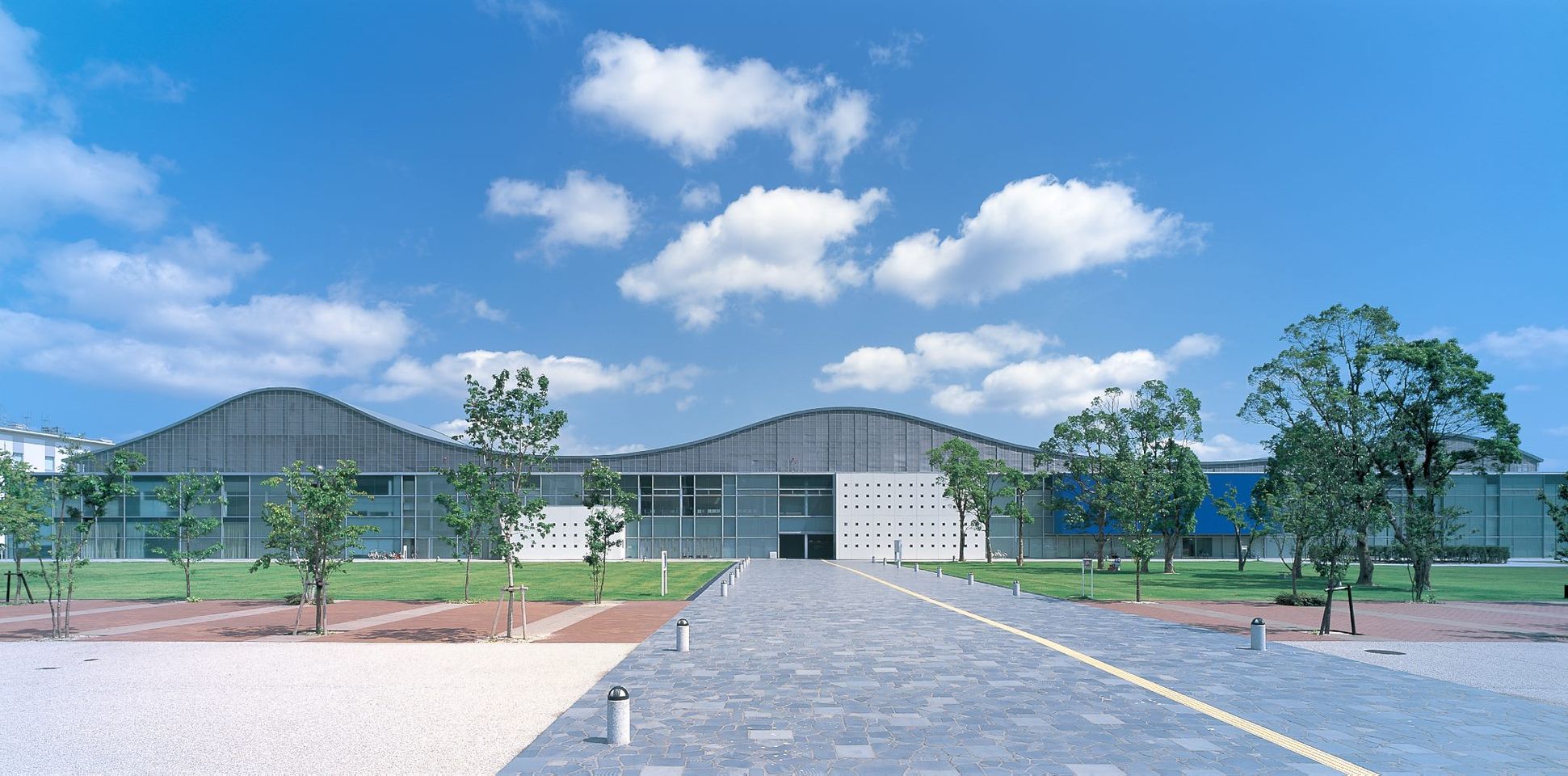
Exterior of YCAM, designed by Arata Isozaki. YCAM is launched as an open collaborative community and a new art center. (Courtesy of Yamaguchi Center of Arts and Media [YCAM])
Midori : YCAMでの教育プログラムは、どのように作られてきたのでしょうか?
How have educational programs at YCAM been developed?
Like in any city, I think media art isn’t something that people are familiar with. When you say you’re going to create a facility for media art, people are like, “What’s that?” and the locals think, “Something bizarre has arrived.”
So, I took what I had studied, such as “Media History” and “The Role of Media in the History of Science and Technology” and simplified it to what you could call “Media Literacy Education” in a flat way.
Specifically, it involved designing workshops and creating participatory programs, as well as educational lectures and such. That was the job, including those elements.
Midori : 対象は地元の人ですよね。
Your target audience is the local community, right?
For us, we didn’t see any meaning in narrowing down our audience. We thought it would be fine for people who came from far away to participate. As for age, we were prepared for really anyone of any age to participate. Media is a field that has emerged within a shorter span than a human lifetime. So when it comes to new technology, whether you’re a fourth grader or 60 years old, you’re starting to interact with it at the same time. Having life experience doesn’t necessarily give you an advantage. Midori : なるほど。確かに、むしろ逆ですよね。
I see. That makes sense, actually.
YCAMで11年働いた後、場所と目的は異なるにせよ、東京大学でもプログラムを作られたんですね。
After 11 years of working at YCAM, you created a program at the University of Tokyo as well?
My task at University of Tokyo Graduate School involved teaching doctoral students the theoretical aspects of creating workshops, having them actually create one, and then evaluating the content they developed. The broader goal is to nurture leaders who can operate internationally using ICT. This aims to equip individuals who have traditionally focused their studies and research in academic settings with the ability to implement their findings in society.
In the context of the Fukushima Daiichi nuclear disaster, the failure of Japanese robots during the fuel debris removal project contrasted sharply with the high utility of robots developed by the American DARPA (Defense Advanced Research Projects Agency). This discrepancy highlighted the difference between achieving results in controlled laboratory environments and producing work that is truly valuable in real-world scenarios. It was through this example that experts in robotics began advocating for the education of researchers capable of contributing meaningfully to society.
Midori: 学生たちは、どういう枠組みでワークショップに参加するんですか。
Who actually takes these workshop classes, and how are they structured?
The workshop courses I designed targeted a diverse range of students across 9 departments and 16 to 17 majors. We had students from various backgrounds, including those involved in robotics research, pure logic and mathematics, education, and even nursing. The goal was to incorporate workshops into their research papers as a form of societal implementation. My role was to teach them the fundamental structure of workshops and how to adapt them to their research, ensuring they could handle it themselves.
It was a unique group, and it’s hard to say how successful it was. However, I believe the students learned a lot about the challenges of implementing research outside their field. It’s not enough to run workshops they’ve designed on their own. My colleagues and I will evaluate based on the design and script provided. Should the submission fail to meet the specified standards, it must be resubmitted for further review.
Perhaps, but I’ve always believed that workshops require careful planning, similar to constructing a building or writing a comedy sketch. It’s important to understand the participants’ psychological state, manage timing, and ensure information is clearly communicated. This is why we emphasize a script writing practice, to help students visualize and implement the workshop flow effectively.
Midori : スクリプトがあると、逆にやりにくくなったりしませんか?
Does having a script make it difficult to deviate?
Teaching how to balance between following and deviating from the script was part of my job. In reality, those who don’t prepare a script often struggle more.
Even if they manage to do it, they often can’t finish within the allotted time. It’s not good for a workshop planned for three hours to stretch into four or five, as participants have other commitments. Having hands-on experience allows us to insert impactful phrases at the right moments. If you run out of time to deliver your punchline, it defeats the purpose of the workshop.
Thus, time management is crucial. A script helps you adjust; if you deviate for two minutes, you need to know how to compensate later. The aim isn’t to rigidly stick to a script like a cellphone store clerk, but to have a blueprint. Even if you stray from it, you can find your way back, offering a degree of freedom. That’s the purpose of scripting, and it’s something I wanted them to understand and utilize.
I think of it like a script for a play. It’s not that a play won’t be interesting if it doesn’t follow the script exactly. But when you have a framework, you can call in support members and give them instructions on what you need in the moment. Everyone can refer to the same script.
I also think that workshops have elements of drama. Like saying, “Let’s go with this kind of vibe this time,” or “Let’s play this character here.” (laughs)
I believe that workshops have a significant element of performing arts. It’s quite challenging because it involves interaction with the audience. It’s not just about following the script; you also have to adapt to the character of the people who come. That’s why having a solid framework helps to easily accommodate a broader range of participants than anticipated.
After serving for five years at the University of Tokyo Graduate School, you returned to YCAM. Before that, just for one year, you worked at the Aichi Triennale, which is held in Aichi Prefecture every three years since 2010, and is one of the largest international art festivals in Japan. How was that experience?
My interaction with the volunteers. The roots of volunteering in Aichi Prefecture trace back to the 2005 World Exposition, which inspired many citizens to volunteer. The Aichi Triennale had about 1,200 registered volunteers in 2019, forming a massive organization. It was fascinating to teach them about Visual Thinking Strategies.
Fram Kitagawa, a well-known art director for many incredible art festivals and Triennales in Japan, mentioned “While artists, artworks, and curators in festivals change rapidly, volunteers, or rather the residents, remain constant.” Daisuke Tsuda, Artistic Director for the Aichi Triennale, has mentioned and referred to this many times during the festival’s preparation period. I also strongly agree with this sentiment.
Visual Thinking (Strategy), is an art appreciation method developed for children at the Museum of Modern Art in New York. It involves sharing the experience of enjoying artwork with others without prior knowledge of art or the piece itself. This fosters imagination, critical thinking skills, and improves communication abilities.
Even without full facilitation skills, having 1,200 volunteers aware of this methodology shifts from a one-way teaching approach. I felt that this could be a way to explore the possibility of an art festival where interactive dialogues unfold everywhere.
It might sound odd coming from someone who works at a media arts center, but to be honest, I’m not particularly interested in the preservation of the media arts genre itself. Of course, when considering the scope of human society, history, and the history of civilization, I do believe that media plays a crucial role and holds significant meaning. It is through media that humans have changed their methods of remembering and altered their approaches to politics. For example, considering what the Maya civilization, which lacked a writing system, was all about and what it meant, including such aspects, I think there’s a lot to be considered. It would be ideal to be able to depict these things, but it’s not something I can achieve alone. Whether art directly benefits society is debatable; it might end up being useful, but I’m skeptical about works created with that explicit purpose in mind. That’s my candid opinion.
The issue of “freedom of expression” was highlighted at the Aichi Triennale. I believe it’s relatively rare for artists to create their works with the intention of “serving society.” In my opinion, artists often create because they are compelled to, not because they want to serve a societal purpose.
However, when integrating these works into society, there’s a notion that they need to be “useful” in order for funds and energy to flow towards them. Museums and similar institutions play a role in designing how society and art connect, and how to create context for this connection.
From the 2019 Aichi Triennale website, that Mr. Aida was involved as the curator of educational programs. The “The Inconvenience of Expression Exhibition” which dealt with various social issues including hate speech and social taboos, faced an onslaught of protests, leading to its cancellation just three days after opening, on August 3. On October 8, after measures were taken to prevent crime and chaos, the exhibition reopened and remained open until the end of the Triennale on October 14. It was covered by the New York Times and the Biennale Foundation, among others, and attracted global attention as one of the defining art scenes of 2019.
As someone who originally is an artist, I do believe that an artist’s moment of expression can indeed be twisted by societal demands or be contextually misplaced as “I didn’t say that.” However ideally, it should happen as little as possible. My stance is that we should protect the space where artists can freely express what they think, say what they want to say, and showcase their expression.
For this, funding and opportunities for exhibition are necessary. Balancing the autonomy and independence of the artist’s expression while positioning it within society is what I consider my mission.
Daiya Aida was invited as an artist to the Sapporo Snow and Light Project held in 2018. In the photo from left to right are the invited artists: Liza Maria Bickel, Domas Schwarz, Daiya Aida, and Midori Yamanaka, who served as an interpreter during the artist talk.
Daiya Aida (he/him) is an artist, curator, and educator based in Japan. For 11 years since its opening in 2003, he has been responsible for education and outreach at the Yamaguchi Center for Arts and Media (YCAM), overseeing the development and implementation of original workshops and educational content spanning media literacy and art education. Since 2014, he has served as an assistant professor at the University of Tokyo’s Graduate School of Interdisciplinary Information Studies, specializing in the Global Creative Leaders Program in Social ICT. Following his role as the Learning Curator for the Aichi Triennale 2019, he assumed the position of Artistic Director at YCAM in 2020.
山中 緑:日本生まれ、日本育ちのソーシャルプラクティスアーティストで教育者。現在は、オレゴン州ポートランドをベースに活動中。アートとしての国際交流やコミュニティでの協働における創造性の拡大を模索。多様な社会における学び合い/育ち合いを探求している。代表作には、日本の書道をベースに相互のインタラクションを生む“What is your name?”、コーチングメソッドを活用し、会話を記録した”Art of Conversation”など。アート センター カレッジ オブ デザインでグラフィック デザインの学士号を取得。現在はポートランド州立大学大学院にて、アートアンドソーシャルプラクティスを実践・研究。 https://www.midoriyamanaka.com/
Midori Yamanaka (she/her) is a social practice artist and educator born and raised in Japan, currently living and working in Portland, Oregon. Her practice explores expanding creativity in international exchange and community based collaboration. She explores mutual learning and growth in a diverse society. Her representative works include What is your Name?, which creates mutual interaction based on Japanese calligraphy, and Art of Conversation, which records conversations using coaching methods. She holds a BFA in Graphic Design from Art Center College of Design, and currently is studying and practicing Art and Social Practice at Portland State University.
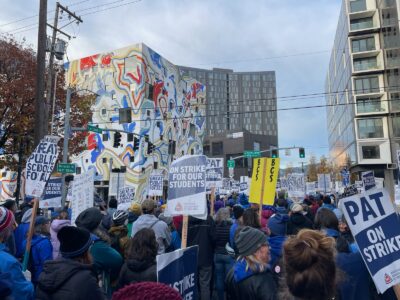
“They weren’t budging. It’s easy to say teachers should sacrifice, but when the buildings are unsafe and students are suffering due to class sizes, it becomes clear that teachers are negotiating not just for themselves but for the learning conditions of the students.”
-Sophie von Rohr
Portland Teacher Strike, 2023.
Sophie, a substitute teacher at a Portland Public School, is a mutual friend of mine. Growing up in a family where both my mother and grandmother, along with her mother, were teachers, I was deeply influenced to pursue a degree in elementary school teaching. This familial connection has instilled in me a profound appreciation for the teaching profession. To me, it’s more than just a job; it’s a calling. The prospect of a dinner invitation from my friend sparked excitement, as I looked forward to delving into numerous questions with Sophie. This interview captures my initial meeting with Sophie, covering topics ranging from the nuances of the Pacific Northwest school system, the challenges confronting teachers, the laws and systems educators are advocating for, nostalgic reflections on our childhood school experiences, the dynamic changes in sex education, and for me, trying out couscous for the first time.
Simeen Anjum: introduce yourself and tell me about the class you teach?
Sophie von Rohr: Well, as a substitute teacher, I cover various subjects. Currently, I find myself in a rather interesting role as the long-term substitute for sex education. It was a bit unexpected; they needed someone for an extended period, and knowing me from a previous long-term assignment, they reached out. So, I arrived, and they informed me it’s sex ed. Surprisingly it’s been quite enjoyable. The students are mature enough that I can engage in playful banter without them taking it too seriously. If they were in middle school, it might be a different story.
Simeen: How do the students like this class?
Sophie: They find it amusing. Honestly, I think I’m the most uncomfortable one in the room. However, I use that discomfort as a gauge – if it’s not weird for me, then it can’t be weird for them. Plus, the curriculum is excellent. Unlike some of the sex ed experiences where we were shamed out of even thinking about sex, the public school curriculum here covers a lot of ground. It delves into science, identity, gender identity, consent, and various topics that make it easy to teach and teach well. The students seem to recognize the importance of what they’re learning, treating it more like a valuable lesson compared to other subjects I’ve taught. In classes like biology some students may not see the immediate relevance, thinking, “Why do I need to learn this?” With sex education, the connection to real-life situations, relationships, and personal well-being makes it more engaging for them.
Simeen: That’s great. I wonder how you ended up being a teacher. Was this always your plan?
Sophie: Well, you know, it’s funny how life takes unexpected turns. I have tried my hand at various jobs. I have a degree in literature which, unfortunately, didn’t open up many career paths. Someone suggested, “Why don’t you become a teacher?” Initially, I thought it was just advice given to those who are unsure about their career path however, during the onset of COVID, a unique opportunity arose. The principal of the school I attended in second grade, who is a friend of my mom’s, reached out. They needed substitute teachers, and she offered to guide me through the licensing process. At that time, I was back and forth between New Mexico and Oregon, living in both places during COVID. In New Mexico, the requirements for substitute teaching were significantly different. You essentially needed a GED or high school diploma, In Oregon you usually need a full teaching license. That’s how I got into it.
I had this idealistic notion that because schools were closed due to Covid and the various societal shifts happening during the pandemic, that there would be a push to invest public money in catching kids up when schools reopened. Unfortunately that wasn’t the case. The reality has been disheartening. It seemed like a logical step at the time and looking back it’s one of those situations that almost brings me to tears. What seemed like an opportune moment was, in fact, one of the toughest chapters in education.
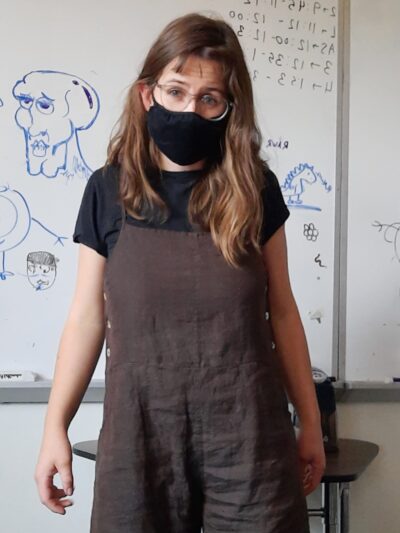
Sophie in their classroom, 2021
Simeen: Can you tell me more about what it is like being a teacher in America? And here in Oregon?
Sophie: I don’t believe the compensation aligns with the demands, especially considering the requirement for a graduate degree. When you factor in the costs of obtaining that degree and compare it to the entry-level teaching salary it raises concerns. Admittedly, my perspective is more localized and not nationwide. Transitioning from roles like farmer, barista, and seamstress; the prospect of a teacher’s salary seemed appealing. However, reality quickly set in. Despite earning more, the expenses associated with the profession, such as insurance, taxes, and union dues, significantly reduce the take-home pay. Beyond the financial aspect, the sheer number of work hours is a major concern. In my experience, working 80 hours a week was overwhelming and led to exhaustion and burnout. While my situation might be an extreme case, it highlights the unrealistic expectations placed on teachers.
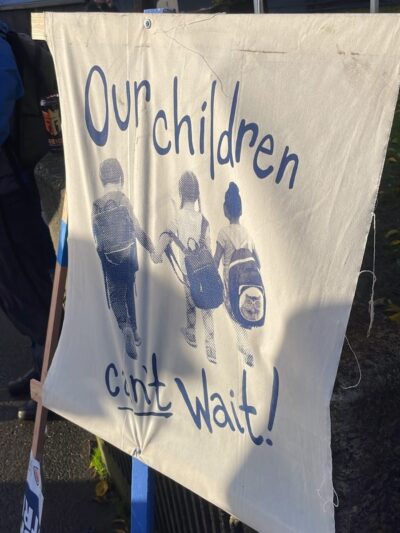
Moreover, the challenges extend beyond financial and time commitments. The expectations on teachers have become disconnected from reality with many not fully grasping the complexities of the profession. Post-COVID desocialization and the erasure of norms around school behavior have added new layers of difficulty. Issues addressed during the strike included not just pay but also the rising cost of living. The unpredictably long duration of the strike, lasting a month, has had an unbelievable impact, resulting in a significant loss of school time.
Simeen: I remember the strike. My coworker’s kids’ school was shut down because of the teachers’ protests and she would instead give them homework in the house. Instead of a traditional school timetable, she created a home school timetable for the kids that also included different chores around the house and taking the dog out. It was very creative. Can you tell me more about the strike? What was it about?
Sophie: The protest aimed to push the district into addressing various issues, such as maintaining our school buildings; ensuring they are well-maintained and safe. There’s a need for funding in different areas. For instance, we advocated for class size caps; urging the district to establish limits on the number of students in a single class. That was the ultimate thing that the district just couldn’t agree upon. That seemed like the hardest issue.
Simeen: What is the maximum class size?
Sophie: I have no idea. It’s a critical question—how many kids are they willing to cram into a classroom? The union would propose a range of potential solutions, and the district would counter with a theoretical plan that appeared outrageously expensive and impractical, creating the illusion of an impossible situation. It seemed absurd to present a solution that wasn’t feasible. I wasn’t in the room during these negotiations, but it felt like they were playing games. Part of the eye-opening aspect was witnessing their willingness to let our schools and students fail. Their lack of urgency shocked me.
They weren’t budging. It’s easy to say teachers should sacrifice. But when the buildings are unsafe and students are suffering due to class sizes it becomes clear that teachers are negotiating not just for themselves but for the learning conditions of the students.
Simeen: I am curious. What do you mean by learning conditions?
Sophie: Well it’s mainly about the old buildings that require maintenance. There are numerous issues. I recall early in the strike one of the requests which didn’t get resolved was the union asking the district to ensure school buildings are between 60 and 90 degrees. Which in itself is a huge range. If a building exceeded 90 degrees or dropped below 60 degrees, classes would have to be canceled.
The district refused to agree citing concerns about potentially having to close school buildings. The reality is if school buildings are over 90 degrees, classes should be canceled. Issues like this highlight that these buildings are not conducive to learning or working. In the middle school where I worked ceiling tiles would frequently fall down and there were issues with rats. It’s stuff that you can live with, but it’s not great. And this is just one of the many bigger issues.
Simeen: That is really an important issue. You were talking about how the students have become desocialized. Do you think about the difference between now and when you were in school? What was the relationship between you and your teachers and how are things different now in school?
Portland Teacher Strike, 2023
Sophie: It’s interesting to compare my own school experience with what my students are going through. I attended private schools and my experience in school doesn’t compare at all with what the kids I teach are dealing with. But one thing I always say is that kids nowadays will go to school and then skip class and hang out in the hall. Then when you catch them in the hall and they’re just like “I don’t care”. Like you know what I mean? When I was a kid, when kids skipped school, they would go somewhere else. We wouldn’t just stand there in front of the adults and say “Hey I’m not going to class”.
Simeen: Right, even back in my school days, if we bunked classes we would be scared of getting caught by adults.
Sophie:There’s also a noticeable amount of trauma among students today. I don’t see as much of it in Portland Public Schools due to the various avenues and opportunities available. There’s all these cultural clubs and after school programs, different opportunities for kids to be with other kids and get involved and stuff. I feel that we kind of have a big window on the world out here. Teaching in rural New Mexico exposed me to students dealing with challenges beyond what I had been trained for as a teacher. Many were dealing with issues like substance abuse, the loss of their parents or other family members and a lack of exposure to the world outside their small town. During COVID, this was really magnified as these students were already in isolated situations. I had several kids that attempted to commit suicide that year, it was just a lot. It was a lot of things.
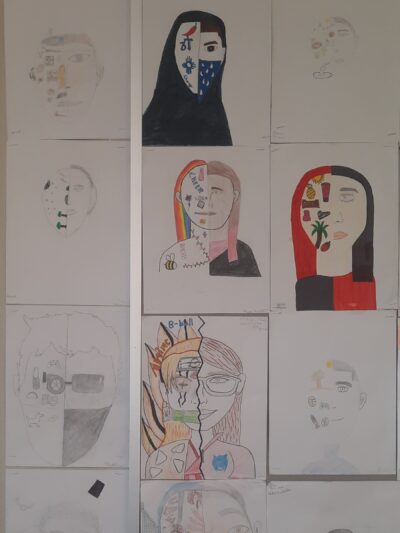
Artworks by Sophie’s Students (7th & 8th grade), 2021
Simeen: For me, as someone still learning American values, there’s this idea of being professional, maintaining personal boundaries at work, not getting too involved. But I guess for you as a teacher, especially in situations like these, sometimes you need to break those boundaries. I am sure that it does get personal for you at times, right?
Sophie: I’m still navigating that. As a teacher, you do find yourself in situations where things get really personal. I’ve improved with practice and being in a more supportive environment. It’s not like being the sole person dealing with everything; there are support systems in place. In Portland Public Schools, despite its issues, there is a structure that provides relative safety for kids. In the rural school I worked at, the situation was more desperate due to a lack of resources. Like there would be just this one teacher who happens to be the only person there with no training as a psychologist or a crisis counselor or anything.
In this community, kids were also receiving a lot of pretty oppressive messaging about race and gender at home which can sometimes manifest in the classroom. But I don’t see kids perpetuating the same kind of hate speech and racism in Portland. It doesn’t seem like it’s “cool” to be racist in Portland. In the other school that I worked atI heard kids explicitly say that they thought racism was cool.
Simeen: That totally makes sense. Children certainly get influenced by whatever is happening in society. I recall a similar situation in India, where the current political climate is getting increasingly majoritarian and authoritarian. In the news, there are divisive narratives based on religion, normalizing hate speech and violence targeted at minorities. In his classroom he had put up a copy of the preamble of the Indian constitution which states that India is a ‘Sovereign Socialist Secular Democratic Republic’, and to his surprise he found that one day the word secular had been crossed out on the poster.
Sophie: It’s quite complex that the children in that class not only engage in hate speech but also understand the meaning of the word “secular” enough to purposefully cross it out.
Simeen: True. Because they are surrounded by discussions and debates on TV challenging the word secular in the Indian constitution and presenting secularism as something that is ‘harmful’ for the country.
Sophie: That’s also why I mentioned whether racism is perceived as ‘cool’ or not because in different communities what you hear and what you believe is acceptable to say aligns with what your friends and parents express. In some places kids might openly admit to being racist and consider it acceptable. However, in Portland, you wouldn’t hear kids saying that. It’s because of the influences kids receive from their parents, teachers, and friends are very different here
Simeen: I agree.
So, speaking about cool and uncool, if you had the superpower, what is one uncool thing that you would like to make cool for your students, and one cool thing that you really wish was uncool?
Sophie: I really wish TikTok was less cool. The trends are so addictive. I wish they would make it so much less cool. Sometimes I’ll tease my students into putting their phones away.I try to win them over by saying, “Oh I’m addicted to my phone too”. Grappling with phone addiction at school is an ongoing conversation. But if I had the superpower to make the phones less cool I definitely would.
And I wish it would be cool to be more honest and vulnerable. But I guess teenagers are just always going to probably be how they are. It’s like you can’t show your true self. Especially when I am talking about sex-ed in class, I say let’s have a conversation about this, you know? Like, what do you think? They’re just like, “I don’t care”.
Simeen: Make it cool to care?
Sophie: That’s kind of what I think. Yeah, maybe care about this for a second, see what happens, you know? That would be really cool. Make caring cool again!
Simeen’s first couscous, made and shared with Sophie after this interview. Portland, OR. 2024
Simeen is a social practice artist originally from New Delhi, India. She recently made Portland city her new home where she is pursuing her Master of Fine Arts (MFA) as a candidate in the Art+Social Practice program at Portland State University.
Sophie is a substitute teacher working for the Portland Public School district, currently doing a stint as a sex education teacher. They are interested in consent and care-based teaching and believe that the classroom is a relational experiment and a place where social transformation may actually still be possible. They are also a union socialist who is committed to creating healthy, joyful working conditions themself and all education workers!
“Everyday I’m serving 500 meals! Everybody’s gonna love the orange chicken tomorrow…”
– Ms. Ruby Sims
The school lunch calendar lived front and center on my family’s fridge when I was growing up and it was the only way to mark time that mattered to me. The school lunch calendar always gave me something to look forward to. Sure, it might be creamed turkey day today, but there was always another chicken nugget and mashed potato day right around the corner.
As a lifelong “hot lunch” kid, I remember with fondness the wafting smell of lunch preparation snaking around the hallways of my elementary school. It was a smell of anticipation and of the comfort, consistency, and community to come. I always felt school lunch got a bad reputation. In cartoons and movies, I watched in horror as characters were robotically served sludge by nameless women in an assembly line. That wasn’t the school lunch experience I knew. Lunch was the best part of the day and the cafeteria staff was a big part of that.
That’s why I was so thrilled to meet Ms. Ruby Sims, Dr. Martin Luther King Jr. Elementary School’s beloved lunch lady. Ms. Ruby has a warmth and playfulness that instantly makes you feel a sense of belonging within the school community. This welcoming energy meant a lot to me as I had recently moved to Portland and begun working with King School third grader LayLay Crane through the King School Museum of Contemporary Art (KSMoCA) mentorship program. On a dreary Monday morning LayLay and I sat down to chat with Ms. Ruby, but inside the Cafetorium on grilled cheese and tomato soup day it was just as cozy as I remembered.
Ms. Ruby during lunch service at Dr. Martin Luther King Jr. School. Portland, OR, 2024. Photo courtesy of Clara Harlow.
LayLay: What jobs have you had?
Ms. Ruby: Okay, how much time do you have? I’ve been in food service for about 30 years, but in different aspects. I’ve managed restaurants and worked at coffee shops and bakeries. I was a police officer when I was in my mid 20s in Dayton, Ohio for about three years, but then I got out of it and started pursuing my passion, which is really cooking.
LayLay: What’s your favorite food to make?
Ms. Ruby: My specialty is baked goods. I love creating cakes. My grandchildren have put me to the test making cakes. They’ll come up with a flavor and challenge me to make it, so I love doing that. I’ve been baking probably since I was like 12.
Clara Harlow: Wow, what are some of the flavors your grandkids have come up with?
Ms. Ruby: One flavor was strawberries and cream because I preserve and make my own strawberry filling. I make a silver white cake with cream cheese frosting and strawberry filling – that’s my Strawberry Queen. I have a Blackberry Dream too. That’s a good cake for a wedding or something. I start with a silver white cake and I preserve the blackberries. I cook them and then I put them through a sieve to take all the seeds out so it’s a satiny kind of feeling. Then that goes in between the cakes with cream cheese frosting because that’s my favorite. Clara: Yeah me too.
Cafetorium at Dr. Martin Luther King Jr. School. Portland, OR, 2024. Photo courtesy of Clara Harlow.
LayLay: What’s your favorite part about working at King School?
Ms. Ruby: My very favorite part is lunch service. I get to see all the kids coming through the line and everybody recognizes me and I can act silly if I want to, like sing along in the line or sing “Happy Birthday” if it’s a kid’s birthday. Have I sung “Happy Birthday” to you yet? When’s your birthday LayLay?
LayLay: October 19.
Ms. Ruby: Oh, I missed it, I missed it!
LayLay: Well, when I was in KSMoCA on my birthday, I did tell basically everybody in the cafeteria that it was my birthday and you said Happy birthday.
Ms. Ruby: Oh, okay.
Clara: And you know, you have a half birthday coming up.
LayLay: I do?
Clara: Yeah, in April
Ms. Ruby: Well okay, we might be doing something for that half birthday!
LayLay: Yeah, that sounds good.
Paper doll drawing of Ms. Ruby by LayLay. Portland, OR, 2024.
Ms. Ruby: Yeah I just love seeing all the kids and getting them excited about trying new vegetables. We have a new vegetable that we put out every month called the Harvest of the Month. This month we’re doing root vegetables. So we had carrots, turnips, rutabaga and sweet potatoes roasted together. I thought it was good but you know, I couldn’t get the kids to try that.
LayLay: I remember the brussel sprouts.
Ms. Ruby: Oh the brussel sprouts, those are coming.
LayLay: I like the flavor, but they were too soggy.
Ms. Ruby: Oh, were they? I like to make mine crispy, but you must have lunch later in the day, huh?
LayLay: What’s your family like?
Ms. Ruby: I’m the eighth child out of 11 children, so it’s a large family. I was born in Tennessee and then we moved to Ohio. When I was like 33 I moved out here. My family is so large I kind of needed a break. I needed to spread my wings and get away from family a little bit, but I miss them a lot. Lots of cousins. And then I have two children and I have five grandchildren.
LayLay: What did you want to be when you were a kid?
Ms. Ruby: So when I was in school, I always wanted to be a fashion designer. I wanted to go into business and have a tall fashion shop because I experienced a lot of problems with the new fashions that were coming out that were too short for me, so I started sewing. All through eighth grade and high school, I made my own clothes.
Clara: Wow that’s so cool.
Ms. Ruby: I want to get back into that with my grandchildren after I retire this year. I want to get back into some of the things that we used to love to do.
LayLay: Okay, who’s your favorite to work with in the cafeteria?
Ms. Ruby: Oh there are so many, I wish I could pick all of them!
LayLay: You could, you could pick all of them.
Ms. Ruby: I like my staff that I’m working with now, but Shavonte is my absolute favorite. She’s in there right now making grilled cheese sandwiches for us to have for lunch today. She’s the one who serves the hot foods when you come in, she’s the first one that you see. Take a look in there, she’s making sandwiches right now, and then you’ll know who Shavonte is.
[LayLay leaves to go meet Shavonte]
Clara: So you grew up in Dayton, Ohio? My dad used to go there for work when I was little. He works for the National Park Service and they had a Wright Brothers site in Dayton, Ohio. I think they grew up there.
Ms. Ruby: Let me tell you something, I was a park ranger before I was a police officer.
Clara: Oh really?
Ms. Ruby: Yes. I worked as a park ranger before I was a police officer. Then they were kind of phasing out the park rangers and that’s how I got into being a police.
Clara: Oh, you have had a lot of jobs!
Ms. Ruby: I’m not gonna be without employment. You know, I’m very creative and good at coming up with things to do.
[LayLay comes back from the lunch line]
Ms. Ruby: Did you meet her? Did you introduce yourself?
LayLay: No, I just told her you said she’s your favorite and asked if she felt special and she said a little bit.
Ms. Ruby: It’s a lot of work sometimes, so it’s hard to feel special in it. There is a lot of work, but she is the absolute best. I mean, she gets it done and we’re friends.
LayLay interviewing Ms. Ruby. Portland, OR, 2024. Photo courtesy of Clara Harlow.
LayLay: How much food do you make in a day here?
Ms. Ruby: Oh my goodness, that’s a good question. Let’s see, we serve three meals a day because we do after school meals, about 200 breakfasts, 240 lunches, and 60 after school meals. So how much is that?
LayLay: 200 plus 240, so 440.
Ms. Ruby: Plus 60 for after school.
LayLay: 500!
Ms. Ruby: So, everyday I’m serving 500 meals! Everybody’s gonna love the orange chicken tomorrow…
Clara: Is that the most popular food at the school?
Ms. Ruby: Orange chicken and popcorn chicken.
LayLay: My friend says you grab the chicken from Panda Express and put it on a plate and you make the rice.
Ms. Ruby: No, I don’t grab anything from anywhere else. I put our lasagna together and make like 10 pans of that. I don’t get anything from a restaurant, not even the pizzas. We make pizzas every Thursday. A lot of them, it takes about 30 pizzas to feed the whole school.
Ms. Ruby in action during lunch service at Dr. Martin Luther King Jr. School. Portland, OR, 2024. Photo courtesy of Clara Harlow.
LayLay: So who’s your favorite custodian?
Ms. Ruby Sims: I think Earl is my favorite custodian. I’ve known Earl for the longest and he’s so personable and he likes my baked goods. He’s always asking for cookies. I make treats sometimes and bring him some.
LayLay: Okay, who’s your second favorite custodian?
Ms. Ruby: Well, he’s not here anymore. You probably don’t remember him, they called him Mr. Steve and he retired. He was at King school for about 35 years.
Clara: Wow, how long have you been at King School?
Ms. Ruby: I’ve been here for 13 years.
Clara: Whoa!
Ms. Ruby: Yeah, yeah and I’m glad I’m here because I love this school.
Clara: What do you love about it?
Ms. Ruby: I love interacting with the kids, it’s just so fulfilling when they strike up a conversation with me or want to know about something and just getting to be silly with them. You know, being everybody’s grandmother.
Ms. Ruby Sims (she/her) is the Nutrition Service Lead at Dr. Martin Luther King Jr. Elementary School. She’s worked at King School for 13 years and will retire at the end of the 2023 – 2024 school year. She looks forward to the many more baking and sewing projects with her grandkids to come.
Malaya “LayLay” Crane (she/her) is in Ms. Moog’s 3rd grade class at Dr. Martin Luther King Jr. Elementary School in Northeast Portland. She likes basketball, the color pink, and her favorite school lunch is orange chicken. She was Clara’s mentee at the King School of Contemporary Art in Winter 2024.
Clara Harlow (she/her) is an interdisciplinary artist, designer, and preschool teacher from Omaha, Nebraska. Her work operates as an invitation into themes of intimacy, play, and alternative ways of measuring time through experiential events and interactive objects. You can most likely find her at the local swimming pool or making pigs in a blanket for her next themed party.
“Archives are where our stories are created. They are how we understand our own past, how we understand and connect with each other today, and the basis for how we foresee the future.”
– Samip Mallick
My family has a sizable collection of road trip photos taken shortly after my parents immigrated to the United States in the 80’s. If ever there were a house fire, these photos would be the first thing I would grab. In these aged film photographs my Southeast Asian family are often the only people of color in sight. As I grow older, I realize that the preciousness of these photos is partly due to the rarity of seeing a family of color boldly stake their claim to leisure on the open road. Despite personal experiences with road trips that I and many other families of color share, an overwhelmingly white narrative continues to dominate the idea of who gets to freely travel America’s roads.
This disconnect between road trip reality and myth is precisely what prompted Samip Mallick to start the Road Trips Project. This archive shares submitted photos and stories of South Asian Americans on road trips. Accompanying the often sunny photos is a map of the route taken by the individual or family, along with memories of the trip. Clicking through the thoughtfully compiled archive brings me right back to the feeling I get upon looking at my own family road trip photos–a deep sense of nostalgia and hope for the road trip canon to be reframed around images like these instead of the whitewashed version of American travel familiar in the media. To understand his motivation in creating this specific and incredibly important archive, I spoke to Samip to learn about the origins of the Road Trips Project and the importance of archiving the South Asian American community.
Radhika Balakrishnan with her father, mother, cousin, and two brothers on a family road trip from Chicago to Orlando in July 1972. This image is part of SAADA’s Road Trips Project, Photo courtesy of Radhika Balakrishnan.
Nina Vichayapai: To start, could you give a background on what the South Asian American Digital Archives (SAADA) is?
Samip Malick: SAADA is an organization that works to create a space of belonging for South Asian Americans: a community of more than 6 million people that has typically been overlooked and excluded from the American story.
We do our work by collecting, preserving, and sharing stories of South Asian Americans, stories that date back for hundreds of years, and that help South Asian Americans to recognize themselves as an essential part of the American story and to write South Asian Americans into the American story as well.
Nina: One of those storytelling projects is the Road Trips Project. How did the Road Trips Project begin?
Samip: The Road Trips Project was inspired by a tragic incident that took place in 2017. Two Indian immigrants in Kansas were at a bar having a drink after work one day, and a white man walked into the bar and shot them. He killed one of them, Srinivas Kuchibhotla, and seriously injured the other, Alok Madasani. Before shooting them, he said, “Go back to your country.” That refrain, “go back to your country,” is one that many immigrants of color hear, often before some act of bigotry or violence is done against them.
The Road Trips Project works to interrogate what it means to feel othered or foreign in a country that either you’re born and brought up in, or that you made your home by choice. And it really helps to think about what it means to be able to travel across one’s own country, safely and without fear of harassment or intimidation or violence.
The Road Trips Project shares stories, joyful stories, of South Asian Americans traveling across all 50 states of the United States. In doing so, it helps to reframe an American tradition, the tradition of the road trip, which claims that Americans should be able to get in their car and drive across the country at any point, and really helps us think about what that means for communities that have been excluded from that narrative, and that have also been targeted or excluded from being able to feel safe in country they call home.
Nina: Do you have a favorite story or moment that came out of this project?
Samip: One that sticks out in my mind is a story of someone who was traveling in the American South who walked into a bar, expecting the kind of othering or response that I was describing, but ultimately found themselves incredibly welcomed in that situation. There are stories that go against the narratives or stereotypes that one might feel but that really, ultimately, are about acts of bravery—the bravery to claim this country as one’s own.
Nina: Can you explain more about what goes into managing this particular project? How are stories collected, mapped, and shared?
Samip: People submit stories and photographs of themselves traveling on road trips across the country. Typically, they’ll submit a photograph and along with that photograph, they’ll share where they started the road trip, what their destination was, where and when the photograph was taken, who they are with on the road trip, and an anecdote or a story either about that particular location or about the road trip as a whole.
These photographs are often dripping with a kind of nostalgia—they have this sepia tone or colors that are so reminiscent of the 80s and 90s. The stories are also reflective of people’s memories and their occasions with their family or their friends or even on their own. All these stories are aggregated and shared online through the Road Trips Project website.
Nina: What does the Road Trips Project mean to you? What do you think is the value in offering this project to the world?
Samip: I think the value of the Road Trips Project is to help people really think about the freedoms that they take for granted: the freedom to travel in your own country and what that means, and how that freedom is determined by things as fundamental as your gender identity, the color of your skin, where you were born, or how you speak. To think about who is excluded from those particular freedoms and about how to make them more inclusive, how to make sure that the stories that we tell about ourselves in our history are inclusive of people that are otherwise excluded from them. By creating this project, our hope was really to reframe a fundamental American mythology and tradition. When you hear about stories like Jack Kerouac’s writings about traveling across the country, or so many others, those stories are not typically of immigrant communities, communities of color, or South Asian Americans. Through offering the Road Trips Project, our effort is to help write South Asian Americans into that story.
Nina: Through the work that you’ve done over the last 15 years, can you share why archives are important to the South Asian American community?
Samip: Archives are where our stories are created. They are how we understand our own past, how we understand and connect with each other today, and the basis for how we foresee the future. For a community like the South Asian American community that hasn’t been typically reflected or represented in archives, has meant that those three things have been missing for us. I think archives have been fundamentally important for us to really see our own past, present, and future but also, more importantly than that, understand how we are a community to begin with, and how we connect with one another.
Samip Mallick (he/him) is the co-founder and executive director of the South Asian American Digital Archives (SAADA), which he has guided from its inception in 2008 to its place today as a national leader in community-based storytelling. Mallick’s background includes degrees in computer science and library and information sciences and work related to international migration and South Asia for the Social Science Research Council and University of Chicago. Mallick currently serves on the Library of Congress Connecting Communities Digital Initiative advisory board. He also previously served as an archival consultant for the Ford Foundation’s Reclaiming the Border Narrative initiative and on the Pennsylvania Governor’s Commission on Asian Pacific American Affairs.
Nina Vichayapai (she/her) is an artist whose research excavates for signs and representations of belonging in the globalized world around her. She explores what it means to belong within the American landscape for underrepresented communities. Born in Bangkok, Thailand, she graduated from the California College of the Arts with a Bachelor of Fine Arts in 2017. Nina currently lives in the Pacific Northwest.
The Social Forms of Art (SoFA) Journal is a publication dedicated to supporting, documenting and contextualising social forms of art and its related fields and disciplines. Each issue of the Journal takes an eclectic look at the ways in which artists are engaging with communities, institutions and the public. The Journal supports and discusses projects that offer critique, commentary and context for a field that is active and expanding.
Created within the Portland State University Art & Social Practice Masters In Fine Arts. Program, SoFA Journal is now fully online.
Conversations on Everything is an expanding collection of interviews produced as part of SoFA Journal. Through the potent format of casual interviews as artistic research, insight is harvested from artists, curators, people of other fields and everyday humans. These conversations study social forms of art as a field that lives between and within both art and life.
SoFA Journal
c/o PSU Art & Social Practice
PO Box 751
Portland, OR 97207 Email