Winter 2026
Letter from the Editor
Second Year Crew: Sarah Luu, Gwen Hoeffgen, Domenic Toliver and Adela Cardona Puerta
In this Art + Social Practice Conversation Series, we returned to a question about context: What lies around the work? What shapes it, survives beyond it, and who gets to tell its story?
In Winter 2026, these questions are especially pressing. The world is more fractured. There are rising violences, an eroding democracy, and growing inequalities. And yet, relational practice has never felt more vital, as socially engaged work also demands that we ask: who preserves memory, who narrates histories, and how can we make sense of what is missing?
Across the conversations found in this collection of interviews, there are several emerging themes. Storytelling, memory, and alternative archives, including objects, recipes, photographs, and community pillars, become acts of resistance. Socially engaged practice, gathering, and care-centered frameworks are used as tools for dialogue and challenging power imbalances. We also are introduced to how spaces can allow for people to feel safe and supported, and how alternative pedagogies can show what’s included, left out, and repeated in histories. Sometimes, the lessons come from unexpected teachers, including animals, land, or rituals that invite reflection.
In this year of the horse, these interviews remind us that understanding collective struggle, reclaiming erased histories, and imagining more relational and just ways of living are inseparable. They invite us to hold contradictions, to stand at the edge of the unanswerable, and to work with curiosity, care, and imagination.
We hope you enjoy reading Winter 2026, SoFA Conversation Series.
Meet Me at the Parking Lot of Ideas
Clara Harlow + Midnight Variety Hour
Everybody wants to play with Midnight Variety Hour. Midnight Variety Hour (MVH) is a Portland-based performance collective of dancers, musicians, and filmmakers predicated on the liberatory potential of play. Together they’ve invented a signature sound (like a soundtrack to a dream you never want to wake from), signature moves (hip thrusts sourced from cinema), signature costumes (the widest brimmed sunhats you’ll ever see), and even a signature scent (with notes of digital waves and AstroTurf). Simply put: whatever they’re selling, we’ll take ten!
But Midnight Variety Hour is not just fun and games. Their process-based work leaves audiences eager to be included because it actualizes a future that we desperately dream of: one of resourcefulness, resilience, collective care, and good humor. A future where each person’s skills, visions, and shortfalls are not just useful, but treasured material we could tinker with forever. With buoyancy and rigor, Midnight Variety Hour shows us what we want is not as farfetched as it seems. In fact, it might be happening right in your backyard–or at your local comedy club, public-access television studio, or dive bar. For this conversation, they let me play along.
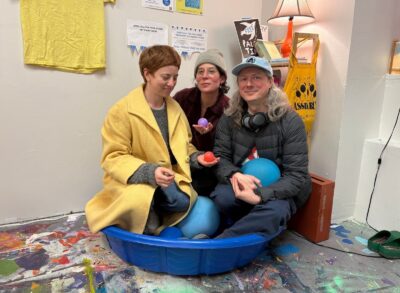
Much to my delight, Midnight Variety Hour insisted on a group photo in my kiddie pool during their visit to my studio. Photo by Clara Harlow.
Clara Harlow: I thought we could game-ify the interview a bit, so I wrote down 12 questions on slips of paper that I was curious about, and here’s some more paper if you have any you want to add. I was thinking we could lay them all out and take turns choosing a question and bouncing off it and seeing where we end up.
Sean Christensen: This is a funny question: What’s a typical rehearsal like? I think there’s a lot here, because of what we do.
Fern Wiley: Yeah, let’s do it.
Sean: So, when we all very first started working together, our time together was almost entirely play without a specific aim, except to kind of lose ourselves in a thing and create as we go. And then at a certain point, we did start getting asked to do events and we did actually lock in on something, and start working on a version of repetition on a specific idea. I think that’s the closest to rehearsal that we really get.
Lee Wilmoth: Sometimes there can also be a little bit more structure to facilitate that play, like with the one-minute sculpture things [inspired by sculptor Erwin Worm’s prompts inviting the public to hold specific positions with props for one-minute].
Fern: Yeah, if we haven’t seen each other for a while, and we’re wanting to do generative play, we might ask everyone to bring in an object and see what happens. That might be a starting place for us to come together and start being in a conversation with each other. I remember coming back together from pandemic times and bringing a seashell and a ball of string. I think the bell came to that practice, and we just started playing, and so much has grown from that.
Sean: Oh, yeah! And sometimes something as simple as the group showing up in a space sharing objects or wearing [clothes] in a color palette–planned or serendipitously–has synthesized whole ideas together. That reminds me of when we gathered in one of our backyards once to talk over our future and got so inspired by the yard, some window blinds, and reacquainting [ourselves] with a structure we built, that we ended up making one of my favorite video pieces. Those moments feel like we have a shared language.
Lee: We’re all very interdisciplinary in the collective, but Fern and I have more of a movement-focused background. And in addition to having a very active Instagram thread, where we’re constantly sending each other visuals or videos or pieces of ephemera that inspire us, we’ve also brought in movements to do with the collective. Sometimes that movement sparks other movements in a performance or music, or video, or something like that.
Fern: Sometimes it’s like, Guys, can I tell you about the weird dream I had the other day? Yeah, it’s a lot of that.
Clara: So it’s sort of like designated playtime. Maybe there’s a seed there, some kind of prompt, and then you see what happens.
Fern: Yeah. It’s very fun. And then certain things stick and we get excited, and then those end up being things we keep building.
Lee: It’s been 7 or 8 years, and so I think we also have to name the psychological safety within the play. That us taking risks, or encouraging each other to try other things, I would argue, very much comes from the fact that we know each other in ways that I think helps that rehearsal play process to feel pretty comfortable and safe.
Sean: Yeah, there’s a lot of trust there.
Fern: I think that gets to this question of What does your collaboration provide that’s different from your individual practices? And I think it is that courage to take risks. That I feel supported by the collective. We all bring different skillsets or places we feel more comfortable, and the thing I love about our collaboration is that we support each other in stepping into new spaces. Like, I’m making more music now, which is something that I never thought I would be doing in front of humans, so that’s been really cool. Sean has been stepping into more movement.
Sean: Yeah, which is still really scary. But at the same time just witnessing my collaborators here also stepping into territories that are less comfortable for them has a reciprocal effect that can really make me want to try more things outside my comfort zone. I think the space between “knowing” something and “learning” something, is my favorite space of curiosity to create, and that is what we encourage in MVH.
Lee: Oh yeah, and I think that there’s a generative ideation perspective. Like, I know for myself, when I work in a solo movement capacity, I can sometimes get a little bored of my ideation process. And so, obviously, when you just have more minds in the room that you’ve worked with for so long, you know their skill sets, but you also know that they’re kind of down to let you fuck around and find out a little bit. I think it just creates more of a dynamic, expansive creative process than when I’m working by myself–just like with any collaboration–but because that is at the core of the Midnight Variety Hour, that collective aspect is just inherent. Which sometimes is our problem and we have to decide What are we gonna do for this performance? We have like 8 years worth of archival ideas, are we done with this one? Do we want to bring this back? We brought a zine back last year that the three of us started in 2019.
Clara: That honestly sounds like a good problem to have!
Sean: No, it’s true. And I mean, I would add that sometimes we’re so inside of whatever we’re doing for a while that it may even go unnoticed to all of us that no one else has seen whatever we’re doing. So if we get asked to do a performance, and we are like, What do we even want to do now with this available space that we’re being given? It can be funny cause it seems like we should do something new, but we haven’t shown anybody anything that we had been doing.
Fern: Exactly! [All laugh] Makes me think of this question of How do you get unstuck together? I’m thinking about a moment of stickiness for us when one of our beloved group members had to step down. We went from this foursome that had all really been part of the collective from the very beginning to this triangle, and we were like, What are we now?
Sean: Yeah, What is this?
Fern: Like really having to reassess what was next for us. And something that I think helped us get unstuck was to look to our archives, and look at what was beckoning for attention, and we found stuff there that made sense for the three of us, like the zine.
Sean: Oh, yeah. It’s really funny. If that person hadn’t stepped out, I don’t know if I would have questioned so much how each of us as individuals got comfortable with a certain personality role amongst the group. Because the person that left, I think we would all say, was the silly person, the one that’s got all the humor and all the wildcard theatrics. Once that was removed I was like, What do we do? Will this be humorless now? Fun’s over! It’s serious art from now on. But thankfully, I think we all realized that we’re all very silly also. It was cool to have that reset as much as we wanted that person to be there.
Clara: Yeah, that’s interesting. I was just talking to my sisters about this. Family is also a place where you form your identities in relationship to each other. It’s like, You’re the that one, so I must be the this one. Then as you’re becoming adults, you’re negotiating some of those historic roles and hopefully moving into new ones, and trying to let go of those attachments to those past roles for ourselves and each other. Like how can we keep seeing each other in new ways and locating each other here right now, you know?
Lee: Yeah, like giving ourselves permission to notice the opportunities within that change that felt scary, but then acknowledging it’s also good for this person to leave, they’re listening to what they need. And this actually did create a lot of capacity for the three of us to get a little unstuck. It shook us up in a good way.
Fern: I’m in a counseling master’s program right now, so I’ve been learning all of these frameworks for looking at individuals within the context of their family system. And we learned this theory last term used to look at a family’s level of resilience. The model asks questions, like Does the family have shared beliefs that support them to see opportunity in adversity? Are they organized in a mutual support system? Do they have support systems outside of the family that can help them? Is the communication open and clear and are emotions freely expressed?
I was sitting in class, looking up at this lecture slide, and I thought about us. We are a resilient family. I was like, check, check, check. This is why we’ve been able to sustain 8 years through a pandemic, through illness, through injury, through loss, through relationship changes, through shifting life demands, because we’ve been able to be really flexible with each other.
Lee: We had a residency at the Sou’wester Lodge in spring of 2024 as part of their Arts Week, and a month before I had broken my ankle and had surgery. I ended up performing in my boot, and I sat and we adapted to the moment.
Fern: I think a big learning I gain from being part of this group is that we practice the skills needed to be resilient and adaptable humans in a collective, and I think that those skills are so important in the world right now, and I hope that that comes through to the audience when they see our work.
Lee: And that’s actually a really good segue to this question: What questions are you currently asking in your shared practice? So, I think one of the things that came up for us is What is play for us? We’re understanding it more as a very liberatory practice. We take play very seriously, especially because we are a group of adults. A lot of feedback we’ve gotten after our shows, performances, whatever, is that people are like, I want to play with you guys, I want to be in this thing. What you’re presenting feels so freeing, it feels liberatory. We’re in so many oppressive moments and systems, but the fact that you guys are organizing as a collective and have been for so long around these particular practices is inspiring.
One of the ways we’re playing with this aspect more concretely, is Saturday School. So, I grew up going to this thing called Saturday School, which was essentially a theater camp in Ann Arbor. The big, big city of Ann Arbor. At one point, I got in my local paper for Saturday School, and my mom sent me this newspaper clipping, and I was like, Yo, you guys, look at this! It sparked this idea that we should make a workshop and call it Saturday School. For this exact reason, right?
We’ve been together this long, it sounds like we’re at a place where we really can speak to and codify some of these practices, mindsets, and behaviors in a more educational, workshop-y, still very emergent, improvised kind of thing. So Saturday School is something that we want to explore more of this year.
Clara: Gosh, I would love to go. Please, please let me enroll!
[Lee grabs the question: What are some of your primary influences?]
Lee: Meredith Monk is a big influence for us, I would say. She’s quite beloved, an interdisciplinary performance artist and vocalist. Weird, tender.
Sean: Yeah, [an influence] in every direction. I am a big big fan personally of Monks’ [experimental performance/video piece] Turtle Dreams, which operates in the Robert Ashley camp of opera meets cable access video art. I had been dying to explore these modalities in music making with MVH for a long while. That’s sort of where we aimed in our recent music performance in-progress at Performance Works [NorthWest] curated by Stephanie Trotter.
The three of us attended one of Monks’ pandemic Zoom workshops. It felt so magic to be guided by the real Meredith Monk and then see your tiny faces on the laptop together. Just a lot of grinning warmth.
Fern: Totally. I’d say Agnes Varda too and David Byrne and dance stuff.
Sean: Like the videos of Byrne dances, prompted by Toni Basil. Who I feel deserves more cred for that magic.
Lee: Yeah, postmodern dance, Yvonne.
Sean: Oh yeah, Yvonne Rainer. I was like, there’s somebody so obvious to me that I couldn’t… I mean Rainer is also so interdisciplinary. Made some truly incredible movies too.
Fern: Pina Bausch, too
Lee: with more humor.
Sean: I think Pina’s pretty funny.
Clara: Do you have any non-art influences?
Sean: Maybe Balloons
Clara: [Laughs] Me too!
Fern: The wind?
Lee: Shells, bells, candles.
Fern: AstroTurf.
Sean: A lot of household objects. Clock faces.
Lee: The heat of stage lights. In addition to facilitation, I also do a lot of human-centered design thinking work, so that ended up showing up in our last performance. I talked about the time-love continuum, pulling from design methodologies for change and innovation, like prototyping, testing, and iterative feedback and that totally showed up in our performance.
Sean: Oh, and maybe early TV as a form of community. That was in many ways MVH’s first playground where Fern and I, with other earlier collaborators, started forming MVH.
Lee: Cable access. We’ve done a lot of videos. Much of our video work has been shot at Open Signal [Portland Community Media Center].
Clara: Yeah, I’ve watched some of that! The Signature Moves one. It’s kind of like your alphabet.
Sean: Yeah, thank you. That’s exactly right.

Film still from Midnight Variety Hours’ dance instructional video, Signature Moves. Photo by Maura Campbell-Shun.
Lee: I loooove when Fern and I come up with choreography, whatever we even want to call it, and then whenever Sean does that movement, I’m always like, oh my god, it’s so great! And again, the interdisciplinary thing of working with non-dancers is the best.
Sean: Yeah, just me attempting what I’m seeing so it’s already gonna be an interpretation.
Clara: I can really relate to that, because a lot of my friends in New York are dancers and performers and I’m always so curious about what’s going on in those rehearsals. That’s why I’m glad I get this insight here. I’m always like, Let me do what you do. You tell me what to do, and I’m gonna give it a whirl.
Lee: 100%. Yes!
Sean: I personally really wanted to break out of my shell and into more performative art as opposed to art on paper where I feel cozy. And there was a similar desire between Fern and me that sort of got that going. I met Fern at a crossroads where I was testing my feet, trying to see what my feet could do. Fern had made this amazing performance and sculpture video work that got my wheels really turning, and I wanted to work with Fern in a similar way but bridging more modalities between what we both have a background in.
Clara: Yeah it can be really fun to not have the training in something, you can feel very untethered in it. Recently, I’ve been thinking about what being an amateur opens up for you. When you’re trying on something that’s not your medium or expertise, what possibilities you can access that an expert may not be in touch with. What rules sort of melt away or don’t apply to us when we’re coming in without expectations around what it’s supposed to do or be, you know? So, it’s fun to hear about your interdisciplinary approach, because there’s always someone who’s a little out of their element and down to be in the question of it.
Fern: I love being a beginner, and I feel like we get to do that all the time together.
Sean: Yeah, it’s pretty special. Being vulnerable together and making discoveries.
Clara: Well it sounds like even the entry point to some of your playtime together is similar to Beginner’s Mind methods [the Buddhist practice of having an open mind and lack of preconceptions]. Where together you’re asking, What is this really? This is a shell, but maybe it could be something else…
Lee: Going back to the whole design thinking approach, a beginner’s mindset is crucial for innovation because you can’t be clouded with an immediate solution. You have to be open to all the possibilities, and ideally, be aware of your biases as you’re going along the design process.
Fern: I feel like art is a place to practice life, and the things that we learn in our time playing together, and that I hope people glean from experiencing our work, are things that definitely help me just navigate living and make it more fun.
Lee: And to play! We’ve been really honing in on this idea of play as a liberatory practice thing.
Sean: Yeah, I think it’s probably the central thing to do.
Fern: There’s research now about how experiencing awe and wonder lowers cortisol levels for our mental health.
Lee: And we need that as adults! There are so many places for youth to play, but it kind of goes out the window a little bit [in adulthood].
Sean: There was this indoor play chain called Discovery Zone in my childhood. And THAT name, paired with its encouraged extreme PLAY…
Clara: Yeah definitely, and especially, play that doesn’t involve consumption or productivity or intoxication in some way. Just actually being really present and open to what can unfold with other people. We don’t have that so often because it’s not profitable. And it’s powerful!
Lee: I feel like with social practice, and with what we’re doing, where there’s a lot of play, or almost joy, there’s also so much depth, there’s so much intensity and furiousness in what maybe just on the surface looks kind of light and playful. My background’s in art history, and so I’m also coming at it from this lens, too, of like, Oh, that’s not serious art.
Clara: Totally.
Lee: That’s not deep. There’s not a lot to unpack there. It’s something that I kind of just don’t give a fuck about anymore actually, but I know that I still have these moments of thinking people are just being lazy in their interpretation of what we’re doing.
Sean: I don’t usually get feedback like that.
Lee: Oh, interesting.
Sean: I feel like we get a lot of good feedback about there being something powerful in just the action that we’re doing.
Lee: Yeah, I think I’ve experienced it as a mixed bag, some people are like, Oh, that’s cute. And then other people being like, That was really profound and disturbing and strange. I’m wondering if you encounter that too with social practice?
Clara: Oh, definitely. And I think it’s really interesting because there might be different things happening inside of it versus outside of it. Because a lot of it is time-based or experiential in some way, so there’s these layers of audience and their proximity to the work. And in those moments, if you’re lucky, there’s this thing that can emerge in real time that you can’t really assign language to so easily, but if you were there, you felt it, you know? Like, there’s some kind of magic material that emerges, that just naturally emerges when people are together trying a thing, or feeling open enough and safe enough to be a little bit weird together.
Lee: Absolutely.
Clara: It also makes me think about how we’re defining art, and what or who it’s for, right? Does art have to be serious in order to do something meaningful? Who decides what’s worth taking seriously? I think where I see the most tension is when people are holding on to a certain definition or expectation of art and what it needs to be in order to be worth our time. Like art as something that needs to be shown in a certain space or connected to a market to be legible or legitimate in some way. But I’m more interested in what can happen when you don’t want to operate so neatly within that. And often that’s not even really a choice for a lot of artists, you know?
Sean: Right, it’s important to remain conscious of who is deciding what “serious” means in art. It’s an establishment mentality, or attempt at ownership for financial gain and that restricts so much creativity.
Lee: Which is kind of where I think, intrinsically or intuitively, we’ve all landed. The inherent nature with all of our art practices is something that has been kind of out of the marketed system, to a certain extent.
Fern: But we’ve also been having fun kind of poking at that space by creating products.
Clara: Yeah, I love that, too. There’s nothing like a pretend commercial.
Sean: Or repurposing a product in a new placement.
Lee: Like, we collaborated on a perfume called Midnight Variety Hour, our signature scent, that went with the signature moves.
Fern: We have lots of objects and merch in mind. We have what we call our parking lot of ideas, where we put things, and right now we have a lot of interesting objects in the parking lot.
Sean: Yeah, it’s really full.
Fern: Almost at capacity. We need valets.
Midnight Variety Hour (MVH) is a performance collective of interdisciplinary dancers, performers, musicians, and filmmakers. Through the build-up of layers, patterns, imagery, and sound, MVH engages in immersive world-building that distorts time and space. Distinct sections of improvisation emerge through the tension and release of accumulated instrumentation, movement, and video.
Current members include: Sean Christensen: sound and vision, drawing. Fern Wiley: movement, object inventing and reinventing, sound. Lee Wilmoth: movement, voice and sound, facilitation. Each individual artist within the group has focused disciplines, but through encouraging each other to step into the less familiar, they discover connection and authenticity, finding prompts in the circumstances and dissolving the concept of the individual by uplifting the collective. MVH values acts of play as liberatory practice.
Clara Harlow (she/her) is an interdisciplinary artist and educator interested in the question of how we can make today different than yesterday. Her work operates as an invitation into themes of celebration, exchange, and alternative ways of measuring time and value. Through unconventional parties, workshops, and interactive objects, Clara is invested in how we can turn the dilemmas of the everyday into an opportunity for experimental problem solving and collective delight. Her practice aims to create responsive public containers for unexpected joy and connection, but if she can just get you to forget about your To Do list for a little while, that’s pretty good too.
The Horse as an Invitation
“I think that we can learn so many lessons from horses about the ways that people have connected to the land and to other living beings throughout time. Because horses tell stories about slavery, about indigeneity, about work. And I think that my relationship to horses reminds me that collective struggle is always somehow related to the land.”
The world is on fire and horses are on my mind.
What can horses teach us about revolution? I say, as someone who loves and learns from horses, a lot.
Bitter Kalli is an equestrian, land steward, and author of the book Mounted: On Horses, Blackness, and Liberation. For Kalli, connecting horses to revolution is only just the beginning of understanding what horses can teach us. In Mounted they explore their relationship to horses as it intersects with other facets of their experience; from their Black identity, involvement in political movements, connecting to their ancestors, and relationship to queerness and neurodivergence. Kalli’s mycelial approach to the horse as a subject is shaped by how deeply horses have been formative to their lifelong learning. Where lessons happened both on and off of the horses they’ve ridden. From imagining alternative models for friendship inspired by the pony books they read as a child, to observing the use of police horses as tools of state violence during the protests which erupted in the aftermath of the murders of George Floyd and Michael Brown’s which Kalli witnessed in their college years. For Kalli, the horse is an invitation to consider one’s place – in life, land, and time.
I had the opportunity to chat with Kalli about Mounted during a time of transition into the Year of the Fire Horse in the Lunar New Year astrological cycle. This timing felt particularly auspicious. The conversation we shared continues to remind me that the world is full of teachers. I look to these teachers for guidance in the coming shifts, changes, and revolution.
Bitter Kalli + Nina Vichayapai
Nina: So the Year of the Horse is just around the corner. I’m wondering if that holds any significance to you. Are you doing anything to celebrate?
Bitter: Yeah. I genuinely feel like the Lunar New Year is more of a beginning than the Gregorian New Year. I’m friends with a few astrologers who have been studying Chinese astrology. They’re Chinese and they’ve been teaching me about their own research into the fire horse. From what I understand from what Alice Sparkly Cat was telling me is that the Year of the Horse is all about belonging and finding your herd. And questions of who you’re taking care of and who’s taking care of you.
I’m still learning about it. But I definitely think about the horse as tied to labor. We were talking about the fire horse as this symbol of basically reaching the pinnacle of something, and now you’re kind taking stock of the energy you have. You might be exhausted. Where do you go next?
I think with Lunar New Year, Ramadan, and Saturn entering Aries, those are all happening around the same time. Looking at astrological cycles, it feels like a very ripe and potent time for collective work and for uprising also.
Nina: Totally. It feels really timely that the Year of the Fire Horse is happening when it feels like we’re hitting this point in this country of just not being able to take what’s happening anymore. That brings me to something that I’ve been thinking about and wanted to ask your opinion on, which you touch upon in Mounted. I really appreciate how in your writing you never let go of the political side of this intersection of horses and identity. So, how do you see horses as fitting into this moment of political reckoning that we are having?
Bitter: I think that regardless of whether horses are physically present in any particular moment of protest or organizing, horses are always tied with the history of the land and often with the history of the stolen indigenous land that we are on, in what we now know of as the United States. I think that we can learn so many lessons from horses about the ways that people have connected to the land and to other living beings throughout time.
Because horses tell stories about slavery, about indigeneity, about work. And I think that my relationship to horses reminds me that collective struggle is always somehow related to the land. Even what’s happening right now in Minneapolis, it’s so based on people’s relationships to where they live, people’s relationships to their neighbors. They’re fighting against what is literally an occupation of their land.
So I think of the horse as both a symbol and also as a flesh and blood living being that invites us into deeper relationships with histories of place, how we’ve related to landscapes, and how we’ve related to each other through the work that we do.
Nina: That’s so beautifully put. Well I’d love it if you give a bit of background and talk about where your love of horses came from. How did that turn into this desire to then write this book?
Bitter: I have been really fascinated by horses since I was young. I read a lot of children’s literature about animals and somehow pony books caught my attention. I write in Mounted about the specific themes around girlhood and independence and the ways that pony books offered specific models of how I might relate to and also think beyond the frameworks of girlhood that were offered to me. And how I might relate to my connection with animals, my connection with nature and the urban environment.
I started going to this local urban stable in Brooklyn that is located in an area where carriage horses used to be kept. It’s located in a very busy part of Brooklyn. The teachers would have to lead us across the street to Prospect Park in order to have our lessons.So it was very different from the idyllic landscape of pony media. But I did feel like I was living out that pony kid dream in my own way.
And then as I got older, of course that became more complicated as I gained more awareness about politics. I started understanding more about race and class and also started seeing the differences between myself and the white women and girls who surrounded me in the more suburban setting that I started going to in high school to ride horses. I was really seeing the ways that my parents were struggling financially and I also wasn’t always riding consistently. We were saving money to take the Long Island Rail Road out to lessons. It was very different from these other kids who would just drive from their house to the stable and interact with horses from a place of comfort.
Then in college there were a lot of protests against police brutality after the murders of Michael Brown and George Floyd. That was when I really internalized the ways that horses are used as tools of state violence. Seeing news and images of police on horseback and facing down these rows of Black protestors.That image was really impactful to me as someone who had seen and interacted with horses in this very positive light. In an athletic sense, but also in the sense of loving animals and wanting to be a vet. My association with horses was very far from the political organizing that I was involved in or my thoughts about state violence. I held those two things as separate but in that moment they came together for the first time. And I started feeling very conflicted about my own ongoing life in equestrian sports. It continued to be something that I was reaching for and also struggling to access. I was working on campus just to be able to offset the costs.
And again, there was a huge contrast between me and the other people on the team. And I was doing a lot of campus organizing. So again encountering this tension between the different worlds that I was moving between. I ended up leaving the team after my sophomore year. I was also starting to become interested in the alternative histories of how my people have related to horses. Like I know that it isn’t only like this WASPy activity.
I had a sense of like, even growing up, my mom would talk about her childhood in Jamaica and how people would go to the horse races on Sundays. It was a big social event. And when she went back to Jamaica in her early twenties she also rode a horse along the beach. It’s an activity that people do but it’s also part of the tourism industry. So I had these as examples of people outside of the US interacting with horses.
I knew a little bit about Black cowboys and then obviously experienced the urban stable in my neighborhood that I attended. So I started to really search for ways to connect with those histories. I started venturing further into the archives.
In a way I think I was trying to justify or explain to myself my own involvement with horses. I was trying to make sense of and create a narrative of what other stories might be available to me now that I had walked away from the team and didn’t have the day-to-day relationship with riding horses. So that’s what became the book eventually.
Nina: Thanks for such a comprehensive journey through that whole process. I really understand that desire to make something out of that feeling of isolation, as a way to understand yourself and find others out there who have also had these experiences.
I’m curious if either through the process of writing the book or now having it out in the world, have you found more kinship in the horse community with people who are thinking about horses in a similar way to you?
Bitter: Yeah, throughout the years I have built relationships through the process of writing the book. I moved to Philly to be closer to loved ones and also because I was very interested in connecting with Black land stewards here. I started volunteering at a Black-run farm in Philly. I also love the ways that Black cowboy histories are so interwoven with this city.
At the Fletcher Riding Club, where I volunteer, I love being able to just see Black kids on horseback in the park and also giving pony rides in the summer. So I’ve really connected with people and organizations before the book came out. I also have had experiences where people will come up to me at a party and be like, “can I tell you a story of like this horse I connected to at summer camp?” And it’s been really sweet just having these experiences where people see me as “the horse person,” you know?
The other day my friend texted me saying that her friend, who is Gullah Geechee, her grandmother was like this woman who rode horses and owned shotguns and was this really independent and cool person. I’m just getting all of these stories about people’s relationships to horses that I probably wouldn’t have gotten before. So that’s been really cool.
Nina: That’s amazing. It’s sweet how putting something out into the world attracts more people who are seeing something in themself through you.
I’m curious what your research process was like. I learned so much from your book and I can only imagine it was really in depth. How did you go about collecting all the information you shared in the book?
Bitter: It was kind of a slow accumulation of different rabbit holes. I attended this class in my senior year of college with the writer Anelise Chen called Writing the Athletic Body. I spent the whole semester just writing about horses. We were supposed to do different assignments but she let me do my own thing. Somehow I ended up writing about Black jockeys and my own history with horses. I started looking at the history of lawn jockeys in the South, which are these really caricatured images that people have in front of their homes. I started really diving deep into some of those histories.
Then I wrote a piece for Guernica Magazine about the weaver Dietrich Brackens and his weaving of a child on horseback. So at every opportunity I was finding horses and finding ways to weave them into my work.
My research process itself is very associative. I learned a lot about being neurodivergent and accepting the way that my brain works through the process of writing this book. Because it feels like a collage. I kind of just have an Are.na Channel with hundreds of links, images, and notes that I’ve written to myself. Often I’ll just follow threads of wondering if something happened, or wondering if people had a relationship in this place and being curious about how that might’ve been.
I think that my research process tends to be kind of messy but very focused on collecting a lot of fragments until they somehow cohere in some way or not.
Nina: I loved the structure of the book so much. It didn’t feel like you were following a formula. It felt very natural, the way you bounced around from covering things in history, to popular culture, to music, art, pony books, kink… it just felt like such a warm invite into all these things that you’re interested in.
Bitter: Obsession definitely plays a role in my research process too.
Nina: Yeah! Could you talk about that? I should probably share the journey of how I found out about your book. I first learned about it through encountering the essay you wrote, On Obsession as a Creative Practice. You wrote about how your lifelong obsession with horses drove you to write Mounted. I was reading that essay and saying to myself, “Wait, how did I not know about this book?!”
But I’m very curious about obsession and the role it plays in your writing?
Bitter: Yeah, I think I just have a very recursive mind and often end up mulling over the same thing from multiple angles for years. Like in some ways, I feel that I’ve been working on the same projects since I was born. And that some of this feels like a spiritual assignment. I feel these things deeply within myself and I have a need to carry them out in this lifetime. So I feel like there’s this internal compass that I have towards certain things that I know I will be engaging with for the rest of my life. I think that goes back also to what, in a Western psychological framework, we could talk about as like neurodivergence, or autism, or special interests.
But I don’t feel like those phrases capture the feeling of returning and spiraling back to something again and again. That feeling of holding something in your hands and turning it over for years and years. I should say my process is also very visual. I started out as an art writer. I still feel very anchored to the visual as a way to move through my writing and gather ideas. The way that I found an agent was through writing that essay about the weaving by Dietrich Bracken, which ended up becoming the work on the cover of the book. I feel like my relationships with Black artists made this book possible and are very woven through the fabric of this book.
Nina: I really loved your writing on that piece. I would love to read more art reviews and critiques by you. Are there other writers or artists who are exploring horses in the same way as you that you’ve learned about since making the book?
Bitter: Honestly, I feel like my understanding of what a text is is very expansive. I think I’ve learned so much from land workers and horse people who are sometimes writing on the page and also sometimes not. But I think that the work that they do is also creating possibility for my own writing.
I wanna shout out Avry Jxn, who is a photographer and a horse trainer. I spoke with them in 2019. We did an interview for Scalawag Magazine and they have definitely been a huge inspiration to me just watching them grow their practice. They remind me of the political stakes of this work. We spoke on the phone after my book announcement came out and they shared that they know Black people who are actively criminalized for having horses. Who have gotten felonies for having horses like in urban environments or places where the zoning laws don’t really allow for that. The legal framework becomes a way to alienate Black people from the land and from histories of caring for and riding horses.
Also a writer who recently passed, her name was DéLana R. A. Dameron. She had her own horse farm and was a rodeo rider. She also wrote books about Black people’s relationship to the landscape in the south.
After the book, I’ve connected with Chi-Ming Yang, a Chinese American writer who teaches at Penn State. She recently published a book called H is for Horse. And it’s about Octavia Butler’s relationship to horses. Apparently Octavia Butler was also obsessed with horses and some of her first writings as a child were about horses. The book charts the ways that Butler’s relationship with horses informed her writings on interspecies kinship. She also apparently produced so much visual art and writing as a young person about horses. So that was cool.
So those are some people I’m thinking of who write in different ways who engage with the text of the horse and the land.
Nina: I’ll have to look into those. I’m curious to know if there was anything surprising that came up during your research?
Bitter: Yeah, I was really fascinated by the ways that the horse comes up in Jamaican dancehall music. I had an inkling of that, but when I looked further I was like, wow, there are actually so many artists who took on cowboy names! This was actually a significant trend.
Connecting it back to my own Caribbean heritage and realizing how present the horse is, even in places that don’t have this legacy of Manifest Destiny or American cowboy culture and physically colonizing the land.
I definitely learned things about myself in writing the essays about kink and about African diasporic spirituality, and learning things about my own relationship to animality. I’ve been familiar with ideas of the limits of the framework of the human, but learning about how Black people have always kind of stood outside of this Western idea of the human, and how those violences are shaping me.
So I think those were some things that I uncovered through the process of writing.
Nina: Do you have any future books planned or writing that you’re working on? Any new obsessions you’re following?
Bitter: Yeah, I’ve been writing a lot about sugarcane. And the history of sugarcane as central to Black labor in the Caribbean specifically. I’ve been growing sugarcane here in Philly and learning how to adapt it to a northeastern climate. So I’m following the history of that plant and seeing what it shows me.
Nina: That’s amazing. Well, I hope that I can read your writing about that someday.
So my last question, which is a little silly but is related to a project I do around horses and people who love them, could you describe your dream horse? What kind of horse did you picture yourself riding or being in friendship with as a child?
Bitter: Yeah, I was always drawing horses. I remember the horse I wanted, it was so specific. I wanted a Dutch Warmblood horse, which is a great horse for jumping and very athletic.And I was fascinated with Greek mythology. So I would come up with all of these like Greek god and goddess names for my theoretical horse.
Nina: Amazing!
Bitter: My horse was reddish brown with a darker brown mane and tail and four white socks.
Nina: Cute. So good.
Bitter: Yeah. I also had a lot of model horses. So I think I also had a rotating collection in my brain of horses that I might have one day.
Nina: Of course. So cool. Well I’ve loved chatting with you so much. Let me know about any horsey things or sugarcane things coming up!
Bitter Kalli is a writer and landworker born and raised in Brooklyn, NY. They work across mediums including soil, seeds, and printed matter. They are the author of the essay collection Mounted: On Horses, Blackness, and Liberation. Bitter is a child of the Atlantic Ocean. They are based in Philadelphia.
Nina Vichayapai makes art that explores what it means to be at the intersections of margins and peripheries. Through exploring the edges of people, places, and psyche, she celebrates what can be found beyond convention. Her interdisciplinary practice includes anything from soft sculpture, public art, pie making, event organizing, dog petting, and eavesdropping. Her work has been exhibited internationally and locally in spaces such as the Tacoma Arts Museum, the Wing Luke Museum, and the Henry Art Gallery. She has been an artist-in-residence in places such as the Seattle Public Library, Deception Pass State Park, and Caldera Arts. Nina was born in Bangkok, Thailand. She currently lives between Seattle, Washington, and Portland, Oregon.
Me The Balloon And Her, The Rock.
What if instead of being invited in to name a problem, we create something we actually want and live with the consequences of how messy it is to build something that you believe in? – Caroline Woolard
I first was introduced to Making and Being by my classmate Clara Harlow who handed me this hefty, cream tome with blue text written by Susan Jahoda and Caroline Woolard. When I began to read it, I felt one of those aha! moments. Caroline and Susan spoke to the “how” we are together being just as important as the “what” we do and make together, and offered strategies and tools to create a classroom that lives into those values. As I began to prepare to teach a class on Art, Conflict, and Collaboration, Making and Being became my guide. I was very humbled and honored to speak with them about their work together and apart, their understanding of the dopamine-fueled present, and their plans for continued collaboration.
Lou Blumberg + Susan Jahoda + Caroline Woolard
Lou: I’d love to hear more about what you had in mind when you wrote Making and Being and what you feel like has changed in the six years since it’s been out.
Susan: You might be familiar with the project that we did prior to writing Making and Being, which was “Artists Report Back,” where we looked at the relationship between arts degrees, student debt and employment. Once we finished that project, we realized that we’d asked a lot of questions, but we actually hadn’t answered any of them ourselves.
If I can speak for both of us, I think that was the impetus, or the prompt, for us to do a deeper dive into what could potentially be approached differently in art school. What could we offer? How could we reconfigure pedagogy? How could we think about our spaces of learning themselves as being transformative and as we say, not a journey to somewhere else, but a way to model ways of being once you leave the institution?
Caroline: I think you could see “Artists Report Back” as research into the fundamental conditions that have shaped higher education in the arts and artists’ lives who go through higher education, from the 1980s until today. Namely how neoliberalism has impacted people’s relationship to higher education, and the rise in costs and what that does to the subjectivity of the artists.
Like Susan said, it was then, what do we do? And how can we shift some of the expectations and practices in order to, like she’s saying, model where we might go? In that longer arc that’s from the ‘80s or ‘90s until today, not much really has changed. If anything, the inequality has become more visible or palpable, especially from 2020 until today, not only with the acceleration of an atomized individualism where people are forced to be alone, but also with the George Floyd uprisings and the awareness of racism and anti-blackness and injustice. More and more artists are welcomed into a political analysis of their context, artists who might not otherwise question the status quo.
It’s only been made more clear: the difference between the power of the arts to allow people to express themselves and be in touch with feeling and sensation that is often exiled, versus the powers that be that encourage us to seek profit and individualism and domination.
And I think, lucky for us, we don’t seem crazy or like this strange outlier. It’s at the forefront of debate today.
Susan: I can speak to what locally, within the context of my institution, has changed, recognizing of course that institutional change is extremely slow. I’ve noticed through teaching the book—and I certainly do in my graduate courses—that there’s a recognition of all of the contradictions, but they can be and are beginning to be generative.
A lot of the practices in Making and Being have been adopted. For example, crit spaces have changed. Students have a lot more agency, because they use the critique protocol from the book. A lot of our students do collaborative work. They do community-based work. There’s an enormous amount of peer learning and community building within the groups. So on a local level, I feel a lot’s changed since 2019, since we’ve been teaching the book.
Caroline: Oh yeah. And maybe it’s important to say, we started working on the book and who even knows—
Susan: Five years prior to that, it took us five years to write it.
Caroline: So it’s actually been over a decade. And it’s true. I do think a younger generation that’s coming into school is also much more collaborative and interested in care and rest and is much more politicized.
Institutionally, some of these things are being embraced, and yet institutions will always be sick. So, we still engage in many alternative education projects. I just started this thing called pollinator.coop, which is all about peer learning. We will always need spaces outside of conventional institutions so that we can model—on all the levels—the kinds of governance and decision making and ownership that we value in the classroom.
Lou: My experience using it in the classroom has been really positive. I find the undergrads that I’m teaching are often faced for the first time with understanding themselves and their inner world on a somatic level, unless they’ve been into that before. I ask each of them to lead a warmup after I’ve modeled a few of the embodiment practices you detail in the book, and it’s interesting. Many of them choose to lead a drawing exercise and shy away from more meditative or introspective practices. I wonder what you make of that, and how we can get students to be a little bit more invested in that self-knowing and capacity building.
Susan: I think it varies from class to class. Sometimes you’ve got an incredibly receptive group and sometimes you have one or two people in the class who don’t want to participate. You have to acknowledge dissensus, right? And you have to manage that. I think it’s really to do with the groups that you’re working with and slowly building, starting with simple things.
Caroline and I often start with what we call the Aqueous Event. We have everybody sitting in a circle and, using spoons, we pass water around from one person to the next until we have gone around the whole circle. It’s very funny and often tense. And then we ask students afterwards, “Well, why do you think we engaged in this exercise?” This most often leads to a conversation about collaboration, about ways to support each other.
We often ask, what does this classroom want? As if the classroom itself is a sentient being. And then students will come up with all kinds of things, “Oh, music, yoga.” It takes some of the responsibility off them personally, and then you can build from there.
Caroline: It’s interesting actually. I just got a job at Montclair State University, redoing the Foundations courses using Making and Being, and I have been doing less and less of those embodied activities and also less sharing. This is interesting. I don’t think we’ve even talked about it, Susan.
I think there’s so much anxiety in students who did high school during COVID. Their moment of blossoming into themselves was interrupted—let’s imagine they’re trans, they’re queer, they have different political beliefs than their parents. So, because of that, I have actually made my classroom much less vulnerable.
I build with people individually and then they hand in things like the “Welcome New Student” worksheet or the asset mapping worksheet and tell me things about themselves. I will notice if there’s someone interested in performance or music or theater, and I invite those people to be doing more of the leading.
When they’re doing things together, they are group activities, like everyone trying to hold a pole and lower it together, trust falls, basic physical things that feel silly. Also because these are not performing artists, so, if they have any training, they have thought about themselves as vulnerable visually, not through their bodies. So, anyway, I don’t ask for that much vulnerability and I actually don’t expect it because of the moment that we’re in.
Some of my students will just leave the room if I make them talk to each other. I have to have adaptations for those people. They are not able to do that right now. So I give them an alternative assignment.
It is sad. I’m going to be totally honest. I think our ability to be social and to go unaccompanied, without a device, is so severe. People call it the next tobacco. There will be lawsuits. There’s reasons that children should not, and we should not, be on our devices at the level at which we are, because it creates anxiety.
I talk to my students about the things that naturally release dopamine instead of your device, things like live human contact, art making, long walks, meditation. These are slow releases of dopamine, and we have to learn them. It will not be an immediate high like you get from your little scroll. But the difference is that if you want to be an artist, you can get this with yourself and you’re not reliant on something else. And it’s very creative, a lot of the things that release dopamine are related to creativity.
So first it’s, let’s find the dopamine or the high of being quiet with yourself, and experiencing art that is not Disney. And then later we can go to the high of being with a human being. I feel like it’s going to take a whole year of Foundations, and then people may revert back.
Susan: I think what you’re saying though is about sensing and learning to meet people where they are. And that’s a pedagogy in itself: meeting people where they are, and then attending to their needs.
We teach different groups. I completely understand what you’re saying, Caroline, and I really admire that circuitous way around to get to the somatic. I’m mostly working with graduate students and juniors and seniors.
Lou: I’m really curious to hear more about the dopamine that we get from working with each other, and your strategies for collaboration amongst the two of you, having worked so long in collaboration. The class I’m teaching now focuses on conflict and collaboration and how to address disagreement and be honest with your opinions—I have a background in conflict mediation and I’m really curious about that piece of ourselves. I wonder how it’s been for you and your evolving collaboration over the years and the many different iterations that it’s taken.
Susan and Caroline: Where do we begin? laughs
Lou: Could you start with how you started working together?
Caroline: Do you want me to tell that story?
Susan: Yeah, you tell that story.
Caroline: It was around Occupy Wall Street time. I had just been given my first class as an adjunct at The New School. I think I was 26, had no MFA, and felt terrified. I had been running Trade School, a peer learning thing with my friends, but that felt like our own learning experience, not something that people should pay for. Erin Sickler put me in touch with Susan and was like, “Here’s somebody who’s similar to you. They think about political economy, they care about collaboration, they do social practice art, et cetera.” And then you, Susan, helped me with my syllabus. Then there was a lot of silence. And then I think you invited me to the Pedagogy Group that you were starting. Maybe you can take it from there.
Susan: Yeah, just slightly post Occupy, the collaborative Ultra-red, invited me to a retreat on collaboration and collectivity. I went as a representative of the journal Rethinking Marxism because I was the arts editor. It was during that meeting that another artist and I thought, “Wow, there is nowhere for teachers, especially adjunct professors, to meet, to share resources.”
So we started this group in New York City called the Pedagogy Group, and we met every Friday, sometimes for four hours. It was really amazing. It was invigorating. Caroline joined the group. And then, in our own side conversations, we realized that we wanted to start an additional project.
And then, Caroline, you came up with the idea for BFAMFAPhD. You put out a call for people to meet. The group started out large, and then became three or four people. That’s when we began to work on Artists Report Back, which then morphed into the Making and Being project.
But I think you’re asking a slightly different question, which is how we’ve worked together all of these years, and how, as our lives have changed, our relationship has changed.
After Making and Being, our relationship changed. You had a child, you moved to Berlin, and began working on some other projects, and so we shifted. Although all along, I think our personal, loving relationship has always been in place. Our relationship changed into a much more kind of domestic engagement.
We now live diagonally across the road from each other. We both moved to Kingston, New York together at exactly the same time. We lived in the same house together last year for a year, and certainly went through some complicated things with our partners, as our own families have expanded.
We have had to navigate what it means to bring other people into our relationship, and in what ways do they want or not want to participate on the level in which both Caroline and I love being and engaging with people. We’re both social beings in many ways and like to work in groups and collaborate, and our partners aren’t necessarily like that. Laughs
So in the expansion of our relationship we’ve had to navigate some other complexities, but we make time every week to be together. In fact, this right now is our time to be together, to talk, to experiment with our little art projects. We’re emerging, I think we’re in a state of becoming something else at this moment.
Caroline: I think intergenerational friendships are really helpful for a number of reasons, one being the zoomed out view you can have when you’ve lived more decades than the other person. We were at such different life stages, and I guess we still are, but we met in a moment where Susan referred to my stage as the ascendancy stage, which was very helpful.
That helped me see, this is not necessarily forever—I was trying to get an MFA, which I eventually did while having a tenure track job, while trying to apply for other tenure track jobs, while trying to have an art career as an individual artist, while trying to collaborate. And Susan was like, “Oh, that’s the ascendancy, you little whipper snapper.”
I think the last five years have been very tumultuous for me. I think, Susan, you’ve been supportive as I’m trying to learn in these different ways, and on some level I feel like you raised me up into being an educator, and then it was like, “Oh, we’re both educators, for real.” I’m here too.
And then I became a parent, which Susan already was, and she could help me see how this happens and be more like an auntie to my kid, and wildly move to Kingston. We’ll probably start a residency that’s for artist educators here, and we both live here.
But I think in terms of specific conflicts, we recognized very early on, I think, without naming it, that we have similar childhood traumas that make us very interested in collectivity and in trusting something beyond the family. It gives us a sensitivity to each other and to people that not everyone shares, as a survival mechanism that’s also a superpower.
We also have a kind of compulsive workaholism that works very well together. We will prioritize working over having fun together. We had a long history of, I’d say on some level, enabling each other, but also producing wonderful things. It’s always complex, our superpowers.
We also manifest our sense of safety very differently. I’d say for Susan, it’s around control and order. Susan’s also a Virgo. We often would talk about it that way. So all the folder systems: Susan. I’d say, “Just put it out there in the world!” And Susan would say, “No, make it perfect.”
My survival style is more chaos. I feel most alive in chaos. I would be the one doing public events and outreach and bold, crazy ideas. And Susan would be saying, “Let’s make sure it’s coming down to the ground.” We used to call me the balloon and her, the rock.
I remember we would have a conflict around how we wrote. I would just burst out with, “Here’s this,” and Susan would be carefully making a paragraph for hours. And I would come in and just redo. It was an erasure of labor and we would talk a lot about that.
We had a lot of practices that were about collective writing. We eventually actually sat and wrote together, and if anybody was reading anybody else’s writing or edits, we would read the whole thing before making any comments. Otherwise we would get so trapped and you wouldn’t even feel the person’s full idea.
It took a lot of time also. I don’t know how I would do that with a young child today, to be honest. Then fast forward to when we were more, you said domestic. I think we shifted from a professional relationship to a familial friendship. That’s something I can say I really need and want right now. Living together, it was almost a year and a half, and there were so many tensions around that fundamental experience of home and family that brings us together, but comes from a distrust of, could a home be safe?
But we never named all these things. We just went into it together and so many things exploded. Especially around money. We almost moved in together forever and fused our finances forever, so it got very extreme in terms of the stakes of the fantasy of being chosen family.
Then magically, I think because of our love for each other, we’ve been able to work through that, and like Susan’s saying, accept that actually our partners want very different things than we do. In truth, there are ways that my healing journey and Susan’s healing journey overlap, but fundamentally I am about an intensity of expansion that can be very difficult, I think, for you, Susan. And Susan is fundamentally about a slowness and order and a daily care, and they can work together very well, but not necessarily domestically. But we make time for each other, we love each other and probably will make another project with this residency.
Susan: One thing I can add—we used a practice called “Threeing” in the writing of the book and the collective work, BFAMFAPhD, where we recognized who was really good at what. We learned to yield to each other’s strengths and to acknowledge the person who had confidence and skills and capacity and allow that person to lead. Then others could shift into a supporting role rather than engaging competitively. Yielding, I think we are good at that together.
Caroline: Yeah, that’s true. I would call up Susan and say, “I want to take this call with the press. Can I be in Firstness?” And she’d be like, “Yes.” I think we figured out a lot of things and now we’re in a new era.
Lou: I’m always so curious about long-term collaborations and how they function together. I think some of the most powerful work can happen when you’re comfortable naming what’s hard and naming what’s difficult and being willing to move through that together.
As I was preparing for speaking with you, I was perusing the BFAMFAPhD website, and one of the values really stood out to me: “Looking for strategic opportunities to advance cultural equity in the arts and to build a community of rigor and care rather than reproducing a cynical, ironic, or antagonistic stance that can deny our capacity to create change in the world.” I felt like that had a lot of story or feeling behind it, potentially.
I wonder if you can speak to how we avoid that cynical, ironic, or antagonistic stance, especially in the growing polycrisis that we’re living in, where it can seem sometimes easier every day to either cast off art and go to the front lines or throw up your hands and become a nihilist. At least those are some of the poles that I feel. I wonder how that’s speaking to you now.
Caroline: I read about this idea of “cringe culture,” which I didn’t even know about, the idea that a younger generation than me would cringe at the idea of being earnest or vulnerable. I think that it is a protective measure that is important to honor when a person or a student does not want to know their desires or share them. And yet I don’t think you can make art without doing that.
I think that writing came from pushing against institutional critique, which assumes that naming problems leads to transforming them, when in fact what we see is that there’s actually an excitement from the institution (I used to think of it as a fantasy) of asking to be slapped.
What if instead of being invited in to name a problem, we create something we actually want and live with the consequences of how messy it is to build something that you believe in? For every artist that is going to say, “No, I resist this. I don’t want this,” let’s hope there can be artists who also say, “This is what we want and this is what we’re working toward and this is what we believe in,” and that is vulnerable.
Obviously this is a political issue as well, as we see the left doesn’t know what it wants. We’re starting hopefully to formulate what that agenda might be. But if we can’t say, “This is what we want the day after we win,” then we’re in deep trouble. It’s about prefiguring the worlds that we want and inviting artists to try and name their values and stand behind something.
Susan: I think that was reflected in a very purposeful, conscious writing in Making and Being where we added the negation section to each of the chapters as a kind of invitation. I think it’s a really difficult moment for so many of my art students, the terror of living in this moment and thinking about futures and the dismantling and instrumentalizing of higher education. I teach in a three-year program where we emphasize teaching, but there are fewer and fewer tenure track jobs, so students are sort of swimming against the tide. What does it mean to teach a professional practice course or a survival guide for artists, courses like that, when we don’t even know what the territory is, the land that we’re standing on? It often feels like painting the deck chairs on The Titanic.
I’m also realizing and recognizing that this moment requires different forms, but we don’t really know what those forms are yet. It’s a very complicated, difficult time. Even the question of what it means to be a bystander and when do you step in, and all of those things that are so difficult to navigate at this moment.
Caroline: I guess I’m always like, “No, we’re not painting the deck chairs on the Titanic.” We know what we’re doing and actually it has always been radical to care for the arts, and I really think that. This impulse to create and maybe do it collectively will always be there, and we’ll find different places to do it if higher education is not the place for that. It never was for many people.
Susan: And maybe that’s in a sense what we are doing, by thinking about this residency program. That’s where we are at, what we are thinking through, or finding our way through.
Caroline: I feel like the project of higher education is not over yet, and there will be some closures of art schools but I think we still have another few decades. I don’t think it’s as dire as it might seem.
I also think that more and more students want to be in art school, and that’s a testament to their own courage to stand up against whatever people might be telling them about their future, that even with this media landscape that says you’ll never get a job, people are like, “No, I still want to feel, I still want to express myself.”
Even in a place where, I forget the exact stats, but it’s something like a quarter of our waking life we spend on big social. It is terrifying, and people know the anxiety that this creates and also how boring the media diet is, what it does to the ideas and forms that you might produce. I have hope for endless generations of people who want to create and move toward being together.
And I also believe that in this era of artificial intelligence, we will be more and more valued for the slow dopamine, for the human-to-human intelligence, for the ways that we create connection with ourselves and each other and the material world that cannot be replaced by AI. I think in the long run, the value of presence and tactility will actually go up and we are in that field, luckily. I feel great. It’s okay. I try to tell that to my students.
Susan: Yeah, I think you’re right. I mean, statistically, our enrollment has increased in the last two years. We’ve had the biggest freshman class in the arts. I think last year more people in the humanities got jobs than in the sciences, specifically computer sciences. So, that turn that you’re referring to, I think, optimistically that it could be a right turn. It could be good.
Lou: I have one more earnest question that I love to ask people, to fight against the fear of cringe. I’m always curious what people’s relationship to hope is. You mentioned that you have it. Is it something that you feel that you need? And if so, what’s bringing it to you these days?
Caroline: Hm. What do you think, Susan?
Susan: I feel hope. I think it’s operative on different levels. I feel hope in my personal life and in my relationships, and I am optimistic about the project that Caroline and I are about to embark upon.
Hope re: the world. I don’t know how to really answer that. I think I have to overcome my own familial trauma. That’s a big obstacle. What I am terrified of, in historical terms, are the signs of authoritarianism and fascism, and my family lived through that and died through that. I’m very sensitive to that and it looks like that to me. So I’m navigating that.
Caroline: There’s something about “hope” that feels like the wrong word because to me it is about a mentality that’s future oriented, that’s about a better future.
I’d have to read and think more about the temporality of hope, but if there’s a word or if hope can mean action in the present, to affirm your connection with other people, beings that are human or non-human, and a practice of love and mutuality, then I think hope is a discipline that I practice daily as a way to be alive. It’s hard for me to imagine not working with Susan in community, collectively as a practice of a more inspired present.
And, yes, I am a person who from a very young age was like, “Fuck you. I’m a believer.” There’s a way. It doesn’t seem like it, but there’s a way, and we’re doing it right now: by trying to respond to people when they reach out, trying to care for each other in the ways that we can, modeling that something that seems impossible is possible and showing that.
Even if we don’t have words for things—my kid has two moms, and my name to him is “other mama.” We don’t have words for it. There are still practices that connect us to a lineage of power and liberation. It’s a cyclical practice, not just toward a better future, but toward the possibility that we are here, that we are alive, and that our ancestors, the lineages that we want to call upon, are with us, you know? There is a fantasy, that energy of pleasure and desire, couldn’t that be channeled in the art world or in the work that we make?
Susan: Thank you for saying all of those things and articulating them in the way that you did, and offering or giving permission to talk about the daily pleasures, the engagement with all living things and with each other and with food, and those practices which are so affirming and loving.
Lou: When I’ve asked people this question recently, it’s very often come down to our intimate relationships and the small ways that the seasons change and the garden continues to grow, providing a life force, even as the larger structures feel hopeless or hard to combat. Thanks for sharing.
Susan: And I think there’s also some guilt associated with articulating those things because you wonder what you should be doing and what your bystander status is. What moment do you step in, what are the actions that you should be taking? So it’s complicated.
But I think it’s important to say, to talk about the things that are affirming, the local, the personal.
Caroline: I’m so glad you reached out to us.
Lou: Thanks so much for taking the time. I really appreciate it.
Susan: Take care.
Caroline Woolard is a founding co-organizer of Art.coop and Head of Strategy at Pollinator.coop. She is the Area Head of Foundations in the Department of Art and Design at Montclair State University and the co-author of two major reports: Solidarity Not Charity (Grantmakers in the Arts, 2021) and Spirits and Logistics (Center for Cultural Innovation, 2022) and three books: Making and Being (Pioneer Works, 2019), a book for educators about interdisciplinary collaboration, co-authored with Susan Jahoda; Art, Engagement, Economy (onomatopee, 2020) a book about managing socially-engaged and public art projects; and TRADE SCHOOL: 2009-2019, a book about peer learning that Woolard catalyzed in thirty cities internationally over a decade. Woolard’s artwork has been featured twice on New York Close Up (2014, 2016), a digital film series produced by Art21 and broadcast on PBS.
Susan Jahoda is an artist, educator, curator and organizer whose work includes video, photography, text, performance, installation and research based collaborative projects. Her projects have been included in national and international exhibitions in London, Paris, Basel, New York, Seoul, and Moscow amongst others and have been supported by residencies at Triangle Arts Residency, Brooklyn and New Inc, the New Museum, NYC and by grants from the National Endowment for the Arts, and The New York Foundation for the Arts. She is the co-author of Making and Being: Embodiment, Collaboration and Circulation in the Visual Arts and has organized exhibitions and screenings including Documents from the Greenham Common Women’s Peace Camp, Interference Archive, Brooklyn. She is currently a Professor of Art at the University of Massachusetts, Amherst. She resides in Kingston, New York and New York City.
Lou Blumberg is an artist, facilitator, and educator with ties to San Francisco, New Orleans, and Portland. With a belief that a better world is possible, their deeply personal practice deals with conflict and its impact on our relationships and lives; surveillance and safety; and joy in despairing times. They are part of the MFA Art and Social Practice program at Portland State University and a co-organizer of Techies 4 Reproductive Justice.
Miscellaneous Projects
Simeen Anjum and Daniel Tucker
“I realized I had a choice: I could do a really short project and move on to something else, or I could be responsive to the moment and engage with opportunities for the project to be politically useful to people trying to have difficult conversations in their communities.
I think that was the moment I decided to put in the work to make this project live in a way I never anticipated.”
During my summer internship in Philadelphia, where I was learning about museum education and exploring the city’s vibrant art scene, I discovered the work of Daniel Tucker. Daniel is an artist, arts organizer, and educator, among many other roles. He is also a very celebrated community member and valuable resource in Philadelphia, where he is currently documenting local art histories and collaborates with a variety of people and organizations. His practice spans multiple projects and disciplines, reflected in his website, Miscellaneous Projects, which fittingly highlights the range of his work.
In this interview, I speak with Daniel about organizing and gathering as tools for socially engaged artists. We discuss several of his projects, including Organize Your Own: The Politics and Poetics of Self-Determination Movements, which toured nine venues between 2016 and 2019. Daniel also shares insights on creating frameworks that allow the public to actively engage with his work.
Simeen Anjum: Can you tell me more about what you are working on right now? I am curious about the different curation practices you use in your work.
Daniel Tucker: I am developing a book with University of Pennsylvania Press as part of my curatorial residency with the Press, supported by the Sachs Program for Arts Innovation as well as my upcoming fellowship with the Center for Experimental Ethnography. It focuses on interviews with visual artists in Philadelphia who are over the age of 60. It comes out of my longstanding interest in local art histories as well as the realization that many incredible artists and arts organizers that I have met in the city have passed away in recent years. This is a way to try and document their work while they are still active. The way an academic press typically works is that they work with academics who have already written a book. But in this case I am working with the press from the inception of the project. In this residency what I’m doing requires a production budget in order to be able to convene the participants and interview them and then to photograph them.
It will ultimately all feed into this book but I’m trying to produce it in a way that honors the work that these people have done and convene them as a roundtable interview for a meal. So they’ll have a meal together and I’ll conduct this interview and have the photographer Ken McFarlane document them. So I am making a kind of a gathering out of the interview process.
I also have a fellowship at the University that’s through an organization called the Center for Experimental Ethnography. Over the fall semester, I’ll begin developing the project, and then in the spring, I’ll continue conducting interviews in collaboration with a class of students. The course itself will be organized around this project and larger themes running through my work and is called Grassroots Archiving & Curating Engagement.
Simeen: That sounds really special, especially turning an interview into a feast. And it also makes me wonder about your relationship to Philadelphia, if you already know these people that you’re interviewing and have worked with them in the past. Do your projects in Philadelphia ever overlap?
Daniel: Yes, in some cases I know the people and I’ve met them through my work, but then in other cases, I don’t know them. I might have seen their artwork, or heard about their contributions. And in a few cases, I don’t know them at all. I convened an advisory group of people to help me think through the list of interviewees, so that I was able to get some input outside of my own experience and perspective. So there’s a couple of different pathways that people have come to be invited to participate in.
I have lived in Philadelphia for a little over 11 years. When I came here, I came from Chicago, where I had lived the majority of my life before then, and I felt a really strong rootedness in that city, and I had done a lot of projects that were focused on local art and social movement history there including AREA Chicago and Never The Same (in collaboration with Rebecca Zorach). When I moved to Philadelphia, I gave myself the permission to not really focus on being a locally-oriented practitioner. I tried to learn as much about the place as I could but I didn’t want to act like I knew much about it.
And after I had lived in the city for about 10 years, I realized that I actually do finally know quite a bit about the place, and I can do a project of this kind. I also realized that despite there being many universities and art history departments, there was no one who was doing this kind of local art history project. And so I felt motivated to pursue this project and document these histories.
Simeen: Was this your first project or inquiry into the city—documenting the local art histories?
Daniel: Yes, I would say it is the first officially focused on Philadelphia. As I said, I had done similar projects in Chicago. For many years I also organized lectures and panel discussions at various universities like the UArts Museums Forum and Conversations@Moore series and now the Crafting Kin series on socially-engaged art I am developing at Swarthmore College with Paloma Checa-Gismero and through those, invited important contributors to the local arts ecosystem to talk about their work and their histories. Besides just being an audience member at other people’s programs and exhibits, those lecture series are the way I had familiarized myself with the local context.
Simeen: Getting people together and hosting such spaces where people can talk and discuss is also an important part of my art practice. Do you have any tools or learnings you can share to facilitate conversations or host such spaces?
Daniel: A big part of my practice is various kinds of gatherings—conferences, retreats, sometimes one-off panels, or workshops. So there’s a lot of different examples I could draw from.
But in terms of advice, I think the first thing that comes to mind is that there’s a responsibility on the part of the organizer to create a really compelling frame for the conversation or the gathering. To be frank,sometimes people are motivated to participate because they are getting paid, or because they want to talk about a current project that they’re doing. But beyond that, I think that some of what you’re able to offer people when you share their work is that really interesting context for them to explore their work.
And so, the more that you build out that context, the more that is going to be compelling to people. They might think, “Oh, this person sees me, understands my work, and knows how to contextualize it.” Or they might be intrigued by the framing itself, finding it surprising or thought-provoking and feel that they could learn something new by taking part.
I could give an example:
For several years, I would attend different retrospective exhibitions of different artists. And they were artists who maybe had been overlooked in their practice. An example would be the 2021 retrospective at the Institute of Contemporary Art about the video artist Ulysses Jenkins curated by Meg Onli and Erin Christovale. Another example was the Lorraine O’Grady exhibit at the Brooklyn Museum. Around that same time, there started to be more retrospective exhibits that were looking at artists who had had a long career, but their work had not been presented in a museum context—maybe like a solo or retrospective exhibit.
But one of the things I noticed in several of these exhibitions focused on underrepresented solo artists was that the curators would also dedicate space to the community in which that artist participated, sometimes through showing ephemera and documentation from exhibits or spaces they were connected to, and sometimes actually showing artwork by their peers and community. Sometimes also showing collaborative artworks that they had produced.
So that’s just an example where I started to notice something happening in the field that was interesting to me. And I thought for a while, “Okay, this is sort of a subtle trend in curatorial practice right now.” But it had not really been named or framed as such.
So I did a gathering when I was at the University of the Arts that was called From Me to We: Curating Collective History Through Solo Retrospectives, and I invited curators from several of these exhibitions to essentially reflect on this dimension of their curatorial practice. The participants included: Cindy Kang (The Barnes Foundation), Catherine Morris (Brooklyn Museum), Laura Phipps (Whitney Museum of American Art, Lilia Rocio Taboada (MoMA) and moderated by Brittany Webb (who was then at PAFA, and now is at Museum of Fine Arts Houston).
I think it was not a coincidence that everyone immediately said yes. And it wasn’t as if they weren’t busy people with lots of things going on, but I think they felt that I was identifying something that they had put a lot of work into and never really been able to discuss publicly. So they were compelled to participate for that reason.
Simeen: That’s a very helpful example. I think for many of us, we go to exhibitions without always knowing how to recognize such patterns. When you go to a museum or see a show, what’s your process for exploring that space?
Daniel: It’s definitely not a standard set of questions but I tend to look at exhibitions the way I would look at artworks that ‘they are an accumulation of decisions’. I try to understand what those decisions were.
Sometimes there’s help with that, like there might be interpretive text that offers some insight. And sometimes there are more obvious choices you can recognize. I’d say that approach developed from spending time with artwork, seeing an artist’s project and trying to understand what choices they made and why, as a way of evaluating the work on its own terms. That’s something that’s been really important to me.
Simeen: Do you have a favourite socially engaged art project?
Daniel: There was a project that I encountered when I was an art student at SAIC in Chicago around 2001. It was called the Library Project, developed by an art collective called Temporary Services.
I went to this opening reception at their space which was in an old office building in downtown Chicago. There were a bunch of artist books on a table and it was fun looking at what people had made. It was everything from a book that would make spooky noises as you walked past it (it had a motion sensor in it) to a project I really loved by the artist Michael Piazza that was three books that he saw being read simultaneously on the bus, on Division Street in Chicago. I love that something as simple as three different books being read simultaneously could then become the premise for a project where he assembled those books and bound them together as a set. They were just totally random in terms of their content and subject matter and style, but they were brought together because they could tell you something about that bus at that time.
It was like 50 or so different projects of this variety that were artists’ books, many of which were about books themselves. At the opening, Temporary Services gathered all the artists and participants, and we walked together down State Street in Chicago to the Harold Washington Library, the city’s main branch. Once we were there, everyone placed their books on the library shelves and then just left them there. The opening officially ended once all the books had been quietly deposited, without permission, among the library’s collection.
I love that that was just, like, a form that a project could take, where you would have something kind of resembling a traditional exhibition opening. Then all the work would be walked down the street and inserted into this other location. And then years later the librarians had found those books that were not officially a part of their collection, and they had accessioned them into the library and made a special collection for them.
Simeen: Okay, what is the shortest project you have ever worked on and how did you end?
Daniel: My version of short is a month, because most of my projects last several years. At the beginning of the pandemic lockdown, my wife Emily Bunker and I received those checks in the mail that provided financial relief during the pandemic.
But since we had jobs we were not in as desperate of a need for those funds but we knew some people who were freelancers that were in need. It was also the time in 2020 when the presidential primary election was happening. We commissioned about ten artists to make yard signs, in the style of political campaign signs. We had them printed and installed them in our front yard. The project was called Yes in My Front Yard (or YIMFY 2020).
The YIMFY project lasted for about a month, running up until the primary elections in the spring. Each artist was paid to design a yard sign, and we printed enough copies so that each artist received one, plus an extra that could be sold.
We donated the money from these sales to an organization in our neighborhood that was called the People’s Emergency Center, which was doing food distribution and relief during the pandemic. This was very much an early-pandemic project. Social distancing was in full effect, people weren’t attending art events, and many artists were having their projects canceled at the time.
So it was very much in that spirit and that moment. After the election happened, we took down our yard signs, and that was the end of the project.
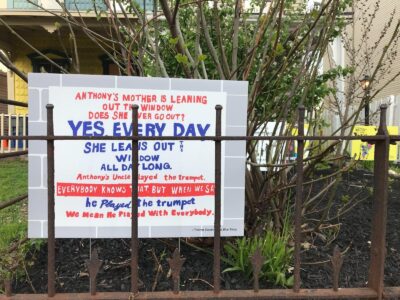
Simeen: My next question is about your project Organizing Your Own: The Politics and Poetics of Self-Determination Movements. This connects to one of our earlier questions about organizing as an important tool for artists. Could you share some insights from that project and talk a bit about how organizing has functioned as a tool in your own practice?
Daniel: This project started at the very beginning of 2016. And it was primarily an exhibition, an event series, and a book.
Organize Your Own grew out of a history that inspired me and that I felt connected to. Specifically, two historical events from around 1966, which was about fifty years before the project took place:
Black Power activist Stokely Carmichael once told his supporters in a speech that it was time for white people to organize within their own communities against racism. He was essentially saying, “Don’t come down to Mississippi to work in our communities. Stay on your college campuses and in your suburbs, and organize where you are.”
The other history I was interested in centered on the Rainbow Coalition, a short-lived alliance that formed in Chicago. It brought together the Black Panther Party, the Young Lords, a Puerto Rican organization, and the Young Patriots, a group of working-class white Southerners who had moved to Chicago and organized in an anti-racist, community-based model similar to the Panthers. These were in many ways similar to the kinds of working-class white folks often discussed in conversations about the 2016 election.
Some members of the Young Patriots had published a book of poetry in the late 1960s and early 1970s and later asked me to help republish it. While I was honored by the opportunity to collaborate with them, I felt that simply reprinting the book would turn it into a nostalgia project, so I proposed creating a broader framework—one that would place the history of their work with the Rainbow Coalition in conversation with contemporary political concerns.
So I invited a number of artists and poets to create new projects inspired by the history of the Rainbow Coalition, the poetry of the Young Patriots, and by Stokely Carmichael’s call for people to “organize your own” communities. That collaboration ultimately became the foundation for the project Organize Your Own.
In 2016, that’s when Donald Trump defeated Hillary Clinton in the presidential race here in the U.S., and there was also, it was sort of the time period where Bernie Sanders had risen in prominence. So it was sort of the first time that there was, like, a socialist that had some prominence on the ticket in many, many decades.
And one of the questions that came out of that election was around what is it that is not understood about the white working class? As a constituency of people who had been a part of not only some of Bernie Sanders’ appeal, but had also then kind of shifted and voted for Donald Trump in his first term.
So to be clear, this project had started before all this unfolded and was not explicitly about the election. In fact the first exhibits in Chicago and Philly were before the 2016 Presidential primary and general election took place. But after the project was essentially finished, people started reaching out and saying “hey, can we tour this exhibition to our venue”. Because we all really feel like we need to talk about racial justice, we need to talk about whiteness, but do it in a way that has some kind of generous and hopeful history that we can draw from that isn’t just totally about white guilt and white privilege, but also serves as a counterpoint to popular narratives about the election and specifically about working class white communities in books like Hillbilly Elegy by now-Vice President JD Vance.
So after having mailed all the work back to the contributors, I recollected all the artwork and then toured it for four more years to nine geographically and culturally diverse contexts across the country including Portland (Oregon), Louisville (Kentucky), San Marcos (Texas), Grand Rapids (Michigan), and San Luis Obispo (California) among others.
I think this was a moment where I realized I had a choice: I could do a really short project and move on to something else, or I could be responsive to the moment and engage with opportunities for the project to be politically useful to people trying to have difficult conversations in their communities.
That was the moment I decided to put in the work to make this project live in a way I never anticipated.
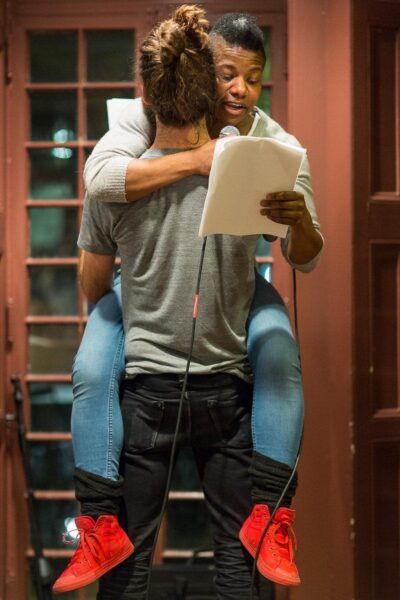
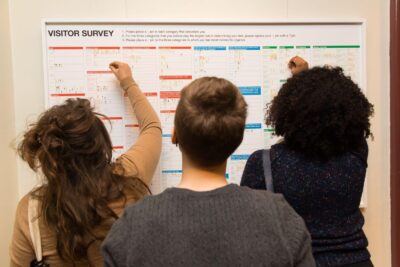
Simeen: What advice would you give to me as another artist moving to a new city soon?
Daniel: If you’re someone who wants to build audiences for the kind of projects that you’re interested in and that you work on then maybe you could spend some time just being the audience that you want to have. Be the Audience You Want to See! Just modeling what it is like to be a good community member who shows up and attends and asks questions of people, when there’s an opportunity to ask questions, and helps stack the chairs when you’re staying around late, and talking to somebody after a program, someone who just puts in that extra effort that is necessary to make community happen. And do that before you start even trying to organize your own stuff or invite people to your activities.
That’s very basic advice.
Daniel Tucker (He/Him/His) helps artists, activists, and organizations to create impactful work. He has done this through creating independent publications, academic programs, dynamic gatherings, and critical exhibitions. He develops projects inspired by his interest in social movements and the people and places from which they emerge. His writings and lectures on the intersections of art and politics and his collaborative art projects have been published and presented widely and are documented on his website.
Simeen Anjum (she/her) is a social practice artist and museum educator. In her practice, she explores new ways of fostering solidarity and community in response to the late-capitalist world that often isolates us. Her projects take many forms, including sunset-watching gatherings, resting spaces in malls, and singing circles in unexpected locations. She is based in Portland, where she works as a learning guide at the Portland Art Museum.
The Mayor is in the House
Domenic Ahmad Toliver in Conversation with The Honorary Mayor of Albina, Paul Knauls Sr.
“They’ll remember forever. You don’t know what it means to them, but they’ll remember.” – Paul Knauls Sr.
What does it mean to build more than a place? To build space. Space where people belong, where stories gather like music in the air?
I sat down with Paul Knauls, former owner of the Cotton Club, a man who helped shape the rhythm of Northeast Portland long before redevelopment changed the cityscape. To some, he’s a businessman. To most he’s the Northeast’s spirit and Honorary Mayor of Albina. Through our conversation I found he’s a keeper of community, someone who remembers how streets, laughter, and late-night conversation could make a neighborhood feel alive.
In my work, I keep circling questions about home, change and presence: who gets to hold it, who gets moved from it, and what stays behind when everything disappears. Paul doesn’t just remember; he shows how a place is built through people, through connection, through insistence that we need each other.
This conversation isn’t just about what once was. It’s about how we make community, how we sustain it, and how memory itself can be a foundation for something today.
This isn’t just history. It’s a blueprint. How we make space, hold space, and leave it alive for the next people to arrive.
Domenic: Paul, I wanted to talk with you cause you’ve seen Portland change over the decades. While the city has been changing and now it seems like they’re trying to fix some of those mistakes, through it all, you’ve remained this thread– someone for people to look to and revisit that era. Why do you think that is?
Paul: I think a big part of it is that I always went straight to the people. If something needed to happen, I asked around, and used my skills. I got people involved.
Dom: So you think the reason that was successful was because you were able to get people in community?
Paul: Oh yes, absolutely. You know I always went straight to the people.
I remember running into a judge in the grocery store, a Jefferson High School football star who later became a federal judge. I told him, “Judge, we’re raising money for a statue of Martin Luther King Jr. on Martin Luther King Jr. Boulevard near the convention center. Next week we’re printing a list in the paper of everyone who contributed. I think you’d like your name on that list.”
He said, “Well, what do you need?”
I told him, “Whatever your desire, sir.”
He wrote a check, printed his name clearly, and I told him that name would be engraved around the base of the statue. If he wanted to include his wife or daughter, we’d engrave those too.
If you go down there today, you’ll see around 800 names engraved around the base. Those are the people who helped make that statue happen.
I’ll never forget there was a woman from the beauty and barbershop. I told her about the statue and said if she could give two dollars, we’d put her name on it. She said, “Paul, you know I’m on welfare. I don’t have much.”
I told her, “Two dollars is fine.”
She said, “I can give you three.”
She handed me three dollars. I gave her a receipt, and her name went on that statue just like everybody else’s.
That’s how we built it. Went around asking everybody.
Dom: That’s smooth though. You gave everyone a piece of the authorship.
Paul: It sounds easy huh, but it wasn’t easy. I was up early doing interviews, talking to reporters, meeting people everywhere I could. Sometimes Channel 12 would call me at four in the morning to film updates while the sculptor was still working on the statue.
After those news segments aired, people would come into the shop and say, “Mr. Knauls, I want to give something to the Dr. King statue.” Twenty dollars here, ten dollars there. I’d write a receipt and tell them to print their name exactly how they wanted it engraved. Before long, we had the money. Big organizations too, hospitals, businesses, corporations. Some gave ten thousand dollars. But it all started the same way. By asking people personally.
Dom: That sounds like why people call you the Mayor of Northeast Portland. Every time I hear about places like Geneva’s Shear Perfection or the Cotton Club, they sound like more than just businesses. More like spaces where people could really be themselves.
Paul: That’s exactly what they were meant to be.
I had one rule: if you started a fight, you were banned for life. Not just from one place, from all of them. At one time I owned four businesses in Portland. So if you came out at night, chances were you’d end up at one of my places. Maybe you’d get a haircut during the day, eat at the restaurant, then come to the club later.
We got to know people from every walk of life.
And if someone caused trouble, I’d tell them: “Tommy, you can’t come in here anymore. And you’re banned from other places too.” Some folks still hold grudges about that. But I had to keep the spots safe. People needed to know they could come there and relax.
It really was like family.
Even now, when I go out somewhere, wherever, people in their fifties come up to me and say, “You influenced my life when I was young.” Some of them played music at the Cotton Club when they were kids.
On Sundays we had jam sessions. Eleven- or twelve-year-old musicians would come in and play with professionals. Imagine going back to school the next day after performing on a real stage with a live band.
That kind of experience stays with them.
Dom: And they weren’t just playing with other kids?
Paul: Oh no. No, they were playing with professionals.
That’s how it worked back then. It was part of what we called the Chitlin’ Circuit, where Black performers toured clubs across the country because they couldn’t perform in the white venues.
We had incredible artists come through the Cotton Club. People who are in the Hall of Fame now. Legends came through. Singers, bands, everybody.
It was a great time.
Dom: What do you think made the Cotton Club different?
Paul: Me.
I greeted every guest at the door in a tuxedo. No woman ever had to walk in and find a table by herself. I would seat her, introduce her to people, and make sure she felt comfortable.
If someone sat down next to a stranger, I’d say, “Melba, this is Sammy. Sammy, this is Melba.” Now they knew each other.
It made the whole room feel familiar.
I also hosted the shows myself. Sometimes groups would show up wanting to perform. One time a group of kids came in — six of them — calling themselves the Three Little Souls. They were incredible. I told their manager, “If you cut it down to three, I can put them to work.”
They came back six weeks later as a trio. The place was packed every night.
Eventually they moved on to bigger stages in Hollywood and television. But they got their start performing in that club.
Those were great times.
Dom: How did you meet Geneva?
Paul: There was a Black-owned bank in Portland called American State Bank. A man named Rufus Booker was the president or owner. I had just moved to town and went in to make a deposit.
A guy there says, “Paul Knauls, I want you to meet a lady. This is Geneva, a lady barber, you’re going to need you a barber.”
I had only been in Portland about two weeks. So he introduced me to her, I handed her my card and I says, “I just bought the Cotton Club. I’ll sign my name on this and when you come in, give this to the bartender and your first drink is on me.” That was it.
I didn’t see her again for months.
About four months later she walked in holding that card. The bartender came back and asked, “Paul, what is this? Is this good?”
I said, “Yeah, that’s the lady barber. She’s gonna be my barber. So give her a free drink.”
That’s how we met. After that we started seeing each other.
After the club closed on Saturday nights we’d go over to the Hoyt Hotel for breakfast. They’d bring the steak out to the table and you’d point to the one you wanted, they’d cook it in the back. Steak and eggs, hash browns.
Those were good days. Eventually we got married. She had worked at Cash & Max’s barbershop for years, about 28 years total.
I already had the Cotton Club and Paul’s Cocktails then. After we married, we bought another business called Geneva’s Restaurant Lounge.
Dom: And the barbershop?
Paul: That came later.
Back when Union Avenue was renamed Martin Luther King Jr. Boulevard, I told myself, “We need a business on Martin Luther King. That’s going to be the hotspot.”
So I bought an empty lot thinking I’d build a barbershop there. Then two weeks later I saw a donut shop for sale, a Mitchell Donut House. So I bought that building instead.
I spent a whole year converting that donut shop into a beauty shop. Plumbing, electrical and I did it all myself. I learned those trades back in high school.
Finally, Geneva decided to move in there.
I asked her what she wanted to call it. She said, “Geneva’s Shear Perfections.” We opened it up in June 1990 and stayed open for thirty years. I finally closed it in May of 2020 when COVID hit. By then I was ninety years old.
Dom: It’s pretty dope you and Geneva got to build together and really collaborate. When you and Geneva were building all those businesses, were you collaborating on everything? Or did each of you have your own thing?
Paul Knauls: We each had our thing but together. Geneva ran the barbershop, and I ran the clubs.
But I always tell people, if Geneva hadn’t been there, I wouldn’t be here. She put up with me working, I worked eighteen hours a day for thirty years. Most of the time when I came home at four in the morning, she was already asleep. And when I woke up, she was already gone to work. Sometimes the only time I saw her was if I stopped by the shop during the day. She’d get off around six, come by the club for a cocktail, say hello, and I’d still be working.
We did that for thirty years.
But we had a little trick. Every three months we’d disappear for three days, Saturday night through Tuesday morning. We’d go to The Benson Hotel, get us a suite, relax, and then go right back to work another three months. Seven days a week. Eighteen hours a day.
Dom: For thirty years?
Paul: Eighteen hours a day. Thirty years. So it was, it was on, she understood me. We didnt need anymore kids either. We had a house full of kids between us too. She had three, I had one.
Dom: Wait, how’d yall do all that?
Paul: So I still had responsibilities. For about twenty years I knew exactly where I’d be every afternoon at 3:30. I was picking kids up from school. If they had a good week, Friday, we’d go to McDonald’s for Happy Meals. But first I’d check with the teacher. If they didn’t behave, straight to the shop.
We had a little room with the laundry, a little laundry room. I had them read for twenty minutes every day in there. I’d hand them USA Today. I would make them read the section about what was happening in each state capital. Start at Anchorage.
They hated that twenty minutes. They thought it was three hours. But that’s how they learned. Just gimme twenty minutes every day.
Dom: They basically grew up in the barbershop, huh.
Paul: Oh yeah. They grew up there.
Dom: That’s funny, because that’s actually something we’re trying to bring back right now. At King, we’re building a small barbershop inside the school. The idea is to teach kids how to cut hair, but also bring people from the community in to talk with them and spend time there.
Paul: Oh, that’s great. Who are you working with to get the barbershop?
Dom: Tarrance Atkins, you know Tarrance over at Influential?
Paul: Yes.
Dom: We also reached out to Champions.
Paul: Yeah, that’s what I was gonna say.
Dom: We’re going to walk the kids over. Basically, we kind of created a barbershop inside the school as a space for community, conversation, and possibilities. The kids will come in twice a week to talk and be heard, and spend time with mentors and community members who show them different futures are possible. Hopefully it’ll become a different way to respond when kids get in trouble too, bringing them into community instead of pushing them out.
So as we’ve been building this little barbershop, I’ve noticed the impact the barbershop has had here, from Deans, and Geneva’s to Jamal’s school, Champions and the Influential. It’s been how you talk about it and seeing how it played out.
And you know they keep asking, is Paul gonna come? Is Paul gonna be there? I don’t know.
Paul: Oh yeah, I’m gonna come. All I gotta do is be invited.
I volunteered at King and mentored a young man for about two and a half, maybe three years. Every Wednesday, I’d spend an hour and a half with him. We did a little of everything — reading, math, hand-eye coordination, even games like jacks. I really loved being there and volunteering.
Dom: What do you think that did? I mean, I mentor too, but I’m only 30, so the kids I work with are still kids.
Paul: Well, they’ll remember forever. You don’t know what it means to them, but they’ll remember. I see them today, and they come up to me and say, “You don’t know what that meant.” One man stopped me and said, “I was at Jefferson High School when you came and talked to us. I’ll never forget what you said.”
I told this one class, I says everybody wants a fancy car so people can look at them like they’re really something, but that’s not really anything. A car loses value. An apartment building gains value. I’d tell them, you can be driving a nice car and still sleeping in your mother’s basement. But if you buy a duplex, live in one half and rent out the other, soon you can afford another building. So I says, “if you’re driving a Range Rover and still have a landlord, you’re on the wrong road to success.”
Dom: Yeah, that’s one thing I’ve been thinking about– you can’t make any money off of paying a landlord for an apartment. That could be an issue with all of these apartments popping up that bring people back. They’re not making any equity. What do you think about those apartments?
Paul: Yeah. Those will bring in some young people. But the people that used to live here, the ones that are trying to help, they’re not gonna leave and come back here. The church is out there, the dentist is out there, the pharmacists out there. Why would they wanna pick up and come back? When they probably own their home out there now. Rather than come back here and rent, you know?
Dom: Yeah, exactly. It don’t make no sense.
Paul: So, I applaud their effort, you know? But it ain’t the same because they don’t accumulate any wealth. You see those homes that they tore down around Emanuel, all those homes are worth a minimum, minimum of a half million dollars now if they were still there.
All that wealth was taken away from the families that would’ve been there. Some would’ve probably sold, but mostly now they just rent. And now, once you got a house, you got some leverage to go borrow some money and send your kids to college.
Dom: Yeah. What would you do?
Paul: What if I was out there? Oh, I wouldn’t come back. If my church is out there, my barber shop’s out there, everything I have is out there and I gotta come back in here and try to redo everything.
Dom: I don’t blame you.
You’ve been to your spot lately? The spare room?
Paul: Yeah. As a matter of fact, not since my birthday. That’s where the after party moved.
Dom: How was that?
Paul: They called and said, “Where are you?” I said, “I’m still at the party.” They says “The after party’s at the spare room.” So I got my granddaughter to take me over there.
When I walked in, the place went crazy and Arma Sylvester started singing. “The mayor is in the house. The mayor is in the house. He’s 95. He ain’t taking no jive. The mayor is in the house”
Dom: Wow, that’s what’s up.
Paul: I went to the dance floor and I started dancing. The dance floor filled up. The song went on for about 10 minutes. I was tired by then. I had to sit down,
Dom: You was dancing? You wasn’t dancing!
Paul: Yeah. I was. Oh, I dance. You know, mostly my hand motions.
The mayor is in the house!
Domenic Toliver is an interdisciplinary artist and educator working across film, photography, performance, and socially engaged art. His practice emerges through dialogue, where responding to people, what’s said and unsaid, becomes a creative act in itself. He approaches his work as an ongoing process of questioning rather than seeking fixed answers, embracing change as both material and method. For him, life itself is a form of art: fluid, participatory, and relational.
Paul Knauls Sr. is the unofficial mayor of Northeast Portland, when asked for a bio, he simply said “Google me!”
Loremakers
Sarah Luu with Adela Cardona Puerta
“I am the official hummus maker of my family. One Christmas, I had made the hummus because my mom needed help, and I followed the recipe exactly as I had seen her do it. When my grandma tasted it, she asked who made it because it tasted like her mom’s hummus, and I was like: I can die now. I don’t need to achieve anything else.”
Adela and I first met through a screen. I was slouched in a rigid plastic chair, shivering cold. The sun was already setting well before the evening, and the skies were cloudy grey. Adela, on the other hand, was calling from the backyard of her grandmother Lucy’s house, where the sun seemed to always shine bright against the ever clear blue skies, where the plants always stayed lush and green. She freely roamed around on the grass, sharing about her work with grapevines, inherited clothing and ancestral dying techniques. I was eager to meet her.
Over a year later, Adela and I are friends more than just two classmates. Both of us work with our ancestral lineages, using our personal archives and ephemeral knowledge to inform our research. I’ve been wanting to learn more about diasporic communities outside my own to gain a deeper understanding as to how displacement can impact how families keep records of their ancestral histories. During this conversation, I learned about a word Adela goes that her sister bestowed upon her: Loremaker.
Loremakers are the curious ones. The ones always asking questions. The ones that see the importance of a generational narrative, especially for the displaced. The ones that know how easy and quick it is to fade away. The ones that will do anything to ensure that doesn’t happen. It was through this conversation with Adela that I realized there could be more similarities than differences, and much of that is uncovered through persistent curiosity. And as it turns out, sometimes, labels do matter. And they can help us get the work started.
Sarah Luu: What was it like to learn about your family history when you were younger?
Adela Cardona Fajury: The part of my family that I’ve always learned more about has been my father’s side. And that’s interesting because my grandma Tita on my mother’s side is not someone you can prompt to talk. She doesn’t talk as easily about her past, but also because I’ve always had more affinity with my other grandma, Gaby. I truly feel like there’s something there that’s beyond this life.
…do you know anything about family constellations?
Sarah: Family constellations? What is that?
Adela: It’s a technique. I haven’t done it myself, but it uses a theater-like reenactment method to put yourself in the position of your family and understand their perspectives within yourself psychologically and spiritually. So I use my paternal last name, Fajury, on my Instagram. There was a moment when I realized that by including Fajury, I’m putting myself in the position of my great-grandmother. Family constellations help with putting yourself on the right spot of the family tree.
When I went back home, my grandma’s dementia had advanced a lot. She has three sons. They’re useless in terms of her care, as the men of our generations and our cultures are allowed to be. So, I was the one that was like, “What the fuck is going on here? Why aren’t you taking care of her?” I put that on my back and that was technically not my thing to carry, but nobody else was doing it until I convinced my dad. He’s the one that people are afraid of. I told him he had to use his capacity to be an asshole for good.
Sarah: I understand that frustration, especially when your grandmother has been a main source for you to learn your heritage and ancestry. Do you feel a sense of urgency in continuing to learn as much as you can through her stories in her current state of health?
Adela: Yes. I don’t think it ever felt urgent until now, though it’s always felt inevitable.
Sarah: What’s the earliest exchange you’ve ever had with your grandmother?
Adela: I was born in Bogotá and none of my grandmothers lived there. I always enjoyed when my grandma Gaby would come over for Christmas and bring these sealed glass jars filled with these pastries called rollitos. They were supposed to be fig rolls, but because figs weren’t easy to get in Colombia, she replaced the filling with guava. I remember her bringing those again one year and I just decided to talk to her about it.
Sarah: How did these exchanges evolve as you grew older? Especially since she didn’t live in Bogota?
Adela: Well, we eventually moved to the outskirts of Pereira. Grandma Gaby lived in that city. I would go to school, do my homework at my grandma’s house, and then I would go to dance class, which would happen twice a week. I’d always been fast to do my homework. I’d finish and go straight to my grandma and be like, “Okay, what story do you have to tell me today?” We would then just talk for hours until I had to go to my dance class.
I feel like there’s always that someone in a family. There’s always one that’s the chismosa of the family, the one that tries to dig. It’s a role that my sister calls…the Loremaker. That’s a term that I recently feel like I’m identifying myself with now because it holds a genetic connotation.
By having a label, there is a definitive role to fill and a responsibility to hold. We see that no one is questioning the history of our family in the ways that, say, you and me are. We’re ones that are trying to piece together a story that can be passed on.
Sarah: I always envied families that have generational scrapbooks and collections of inherited objects…photos and momentos stretched back multiple generations. Often with immigrant families, we are lucky to have tidbits of just the last. Is there anyone else that you rely on to find out about your family history?
Adela: Two of her sisters are still alive, so I rely on them. One of them is my grandma Lucy. I say grandma because she would kill me if I say great aunt. She’s a force! She still takes care of her garden. She still paints. She’s funny as fuck, like she’s one of the wildest. And she was once the best seamstress of her community.
Sarah: Do you think that ties to the themes of your practice anyway? How did she become a seamstress?
Adela: Yes, especially because I use textiles in my practice.
She became a seamstress because she didn’t do well in school due to a neurodivergency that was never diagnosed. And so my great-grandfather was like, I’m not gonna pay for your schooling anymore. You’re going to go work at your uncle’s farm.
Within the town the farm was in, there was a seamstress who took her in and passed down her skills. Because of this history and the fact that she’s still lucid at 100 years old, I rely on grandma Lucy a lot. That’s why I was learning remotely last year. I was at her farm as part of a pilgrimage I was doing with the women of my family that are still alive.
Sarah: Could you tell me a bit more about this pilgrimage?
Adela: It’s how I do my research. Because they’re too old to travel, I travel to all the women in my family that are still alive. So there’s Lucy, who lives in a town four hours away from my home by car. There’s also Manira Chujfi. She isn’t directly related to me but we are connected through the SWANA community in Colombia.
Manira is the same kind of extraterrestrial person that we are. Nobody else was doing or even interested in doing what she was. She wrote a book specifically about “Arabic” immigration in the Coffee Region where my ancestors settled.
Sarah: Did this pilgrimage ever lead you anywhere?
Adela: Well it got me to her book. And in this book, it includes many pictures of the very first of the SWANA families to immigrate to my family’s region. One of the pictures has a family that bears the Fajury name, Mama Adela’s last name and another of the Issa or Iza name, which was Papá Camilo’s last name.
Sarah: That’s incredible. Since Manira isn’t related to you, how did you manage to connect with her?
Adela: I lived extensively in a small town. People know people. I knew of her. I asked my dad if he knew her, and he did. He told me she was an aunt to one of my very distant cousins. Through that tidbit of information, I was able to get her number. She was very sweet upon meeting for the first time, immediately welcoming me into her house and telling me her story over pistachio croissants and Lebanese coffee.
Sarah: And you wouldn’t even meet her if you didn’t even ask.
Adela: Exactly. It was really cool.
Sarah: That’s something that’s so interesting to me. Even though you belong to a different diasporic community, it seems our experiences are often parallel. We both rely heavily on oral histories, heirlooms and photographs to build an understanding of our family narratives. As an experienced loremaker of your family, how do you think others in the diaspora should self-inquire about their own family histories?
Adela: I like to think about the personal and the identities we hold as an invention. And it’s not an ecstatic entity, it’s a narrative entity that keeps creating. In order to create your own narrative entity (and this is also a therapeutic work), you have to go straight to the root because that’s where the source is to inform you on how to build your own story. You’ll be able to pull from the gifts of your ancestors and try to heal their wounds.
For example, my grandmother’s ability to speak four languages could be a genetic link to why I have a gift for languages. And my great grandfather on the Colombian side was an amazing journalist, which was what I ended up doing myself.
Sarah: Do you think it’s important that we engage in critical self-inquiry?
Adela: Yes. Especially when we think about it on a systemic level. Both of us are a part of marginalized communities. It’s important for us and people like us to write ourselves in history because we’ve never been a part of history with a capital “H”. And that, of course, is deliberate. It’s cultural erasure. So we combat it by learning about it locally and intimately.
It starts small, but the more you inquire, the bigger the web is weaved. When you begin to collect small truths from different people, you eventually can piece it together as one.
Sarah: What things do you do to connect with your ancestry?
Adela: Cooking.
Sarah: Cooking! What sort of ingredients shaped your home?
Adela: Parsley, for one. My memories smell like parsley. And this not even me being poetic, this is me being literal. Olives…I could eat a whole jar in one sitting! Also pistachios, garbanzo beans, tahini paste, and almonds.
Sarah: How do these ingredients show up in your cooking?
Adela: Well, like you, no recipes are written down. That’s now how things work. I learned how to cook from my mom, who was taught how to cook from a Lebanese family friend. Because I’m the Loremaker, I try to cook exactly as they did with the exact same ingredients.
Like I am the official hummus maker of my family. One Christmas, I had made the hummus because my mom needed help, and I followed the recipe exactly as I had seen her do it. When my grandma tasted it, she asked who made it because it tasted like her mom’s hummus, and I was like: I can die now. I don’t need to achieve anything else.
Sarah: How has your family supported you in embodying the role of the loremaker?
Adela: In regards to recipes, it was interesting to see my sister’s thesis for industrial design. She did this mock enterprise for different flavors of hummus after doing this whole research on food, pulling from interviews she did with other Lebanese families in our colony back home. As she conducted those interviews, I came with her and wrote down those recipes because no one else had done so before she began her work.
In terms of the rest of my family, I think they just got used to me asking outrageous questions early on. According to my mom, I’ve been asking weird questions since I was a kid. She encouraged it though, always following with, “I don’t know, let’s find out.” My family just humoured me. And my grandma is such a storyteller at her core, she enjoyed sharing stories with me as much as I enjoyed listening to her. But, when it came to me wanting to do a documentary about my family, I ran into a lot of resistance.
Sarah: For what reason?
Adela: It didn’t come from a place of malice, but there was a lot of worrying about whether I was able to represent her in a way that doesn’t make her look like a fool because of how much her mind has changed since her dementia developed.
Sarah: I understand. Is there an approach you’ve been able to execute to combat those worries?
Adela: I realized that the thread of my grandma’s memory and history is rooted in fashion. Clothes are the only thing she could really remember. She perfectly remembers every single thing I wear that is hers. I would call her on video and if I was wearing a top of hers, she would be like, “Oh bring that back. That’s mine!”, in her beautiful roasting humor. So I used what she remembered instead of what she did not to represent her.
With these sorts of family histories, I think it’s always going to be something complicated. We’re always gonna run against our own traumas and our family’s traumas, and that might look like having to have conflict with the people you love.
Sarah: How do you navigate that?
Adela: We have this saying in Spanish: It’s easier to gather bees with honey than shit. I tried it with honey, which in my case meant literally being formal with my uncle like “Hey, I think that you have a lot of history and closeness with my grandma. I really want you to be a part of this process and I want your blessing.”
Sarah: Do you think in this case, you have to go against the wishes of your family just to ensure your history is remembered or given the recognition it deserves?
Adela: It’s something I know I will have to do with my mom’s side. I haven’t spoken about this a lot with people because I’m just barely processing it myself. My mother’s father is black. And there’s a lot of anti-blackness that runs on that side that no one ever talks about that makes it hard to unravel.
Sarah: That just makes your work even more significant, if anything. To dig at that. It’s just like you said about working with your grandmother, there’s something bigger than you that’s pulling you toward working with your family. It almost feels spiritual.
Adela: Yes! And interconnected in many ways that are still waiting to be unraveled.
Sarah: With all of these obstacles, obviously you’re going to have to brainstorm. Is there anything specific you have easy access to that you can rely on to inform your research?
Adela: Not a thing, but a person. My sister, who did her thesis on hummus, was never as interested in our family history as I was at first. But since she became a US citizen and processed this new part of her identity, we’ve been able to collaborate.
Sarah: Are there any sort of past projects or ideas that in the past you couldn’t pursue together but feel ready to now?
Adela: I’d like to do a collaboration about Spanish, especially common sayings and slang. For example, Sana que sana, colita de rana. That’s a spell your mom would say to you. In English, it translates to “Heal, heal the bottom of the toad”. It’s what you say when you’re sick or get a scrape. It makes no sense really when it’s translated but in my culture and native tongue it does.
And I’ve also been asking myself specifically about translation, too. Because I feel I always have to do it, whether for spoken language or neurotypicals. So, it’s like, why am I constantly trying to translate myself? It’s exhausting.
Sarah: Do you think it’s because it’s a way for us to justify our work in some ways? When many people are able to understand it, we feel like the work is worth doing.
Adela: Yes. And I also feel like for me it has to do with a life misunderstanding. And an ongoing feeling of being constantly misunderstood. Picking this up with my sister, it’s a way to say fuck it. We’re not gonna translate ourselves anymore. Figure it out. I’m done.
Sarah: There is this expectation of us needing to translate everything, not just with language as your experiences are. I think the biggest argument is making it accessible, but in some cases it enforces a power dynamic.
Adela: There are two wolves inside me. One is about accessibility and the other is about wanting to not have to translate my culture. Language is the space where you can do both.
ADELA (she/her) is a professional in noticing the beautiful small things in life / Una Profesional en ver las maricaditas lindas de la vida. Depending on the day, she poses as an Artist, Journalist, Poet, Storyteller, Archivist, Gatherer, Sustainability, and Social Impact Director. But truly, she’s a druid, a plant dressed in the body of a human. As a Colombian-Lebanese, Autistic x ADHDer, Queer human, she is constantly inhabiting the borderlines and bringing her roots everywhere, to help other people flow with the rivers of their own stories. Her work touches on the themes of family, legacy, mental health, fashion, community storytelling, identity, creativity, and sustainability.
Some of her gifts include an insane ear for music, as well as weaving words and people together. She’s now in the process of getting her MFA in Art + Social Practice at PSU, in Portland, Oregon.
SARAH LUU (she/they) is an interdisciplinary artist and writer. She gravitates towards photography, ceramics, zines, and printmaking in her studio practice. As a first generation Asian American, her work has touched on themes of her mixed Vietnamese-Chinese identity, intergenerational cycles, culture and tradition. She explores outside those topics by pulling inspiration from her lived experience growing up in San Jose, California surrounded by a vibrant arts and music culture. Her current research revolves around the experiences of the Vietnamese diaspora, focusing on memory in domestic spaces, exploring how the microhistories that live within immigrant family archives and cooking rituals may be the building blocks to create generational ancestral narratives. Her work aims to bridge the gaps between elder Vietnamese immigrant generations and their American-born descendants.
She received a BA in Studio Art, Preparation for Teaching from San Jose State University in 2024 and is currently studying for an MFA in the Art and Social Practice program at Portland State University.
Connection-Making Machines: Teaching Art History
Rose Lewis with William J. Diebold
“Well, you know, we’re all connection-making machines. So if you have thirteen pieces of common information, you can connect them. You may be wrong to do that, but you can do it.“
Many of my questions this term have revolved around the art of teaching, ranging from very practical concerns about constructing a well-paced syllabus to more personal concerns about inspiring a shy student to feel prepared to contribute to a class discussion. I have been very fortunate to learn from a great number of wonderful professors whose approaches to teaching have been especially fresh in my mind. As an undergraduate, I took almost all of my art history courses from William Diebold, studying an eclectic range of topics from Gothic architecture to contemporary exhibition design. William’s course on Iconoclasm was rumored to have the longest waitlist in the department. In our largely discussion-based classes, I always appreciated his ability to seize upon a point that a student was about to make and guide them towards it with a series of questions, encouraging them to deepen their analysis and draw connections between sometimes unexpected topics. I learned to watch for a particular pattern of hand gestures: if his wrists were moving, there was more thinking to be done, and any conclusions would be punctuated with a very specific flourish.
Rose Lewis: In the pedagogy class I’m taking, we’ve been reading bell hooks’ Teaching to Transgress and some Paulo Freire to talk about different systems for invigorating and inspiring students that aren’t necessarily the “banking model” where the professor lectures and the students just take in the information.
I remember, as an undergrad at Reed, really enjoying the discussion-based classes, but then every now and then wishing that there could be a little bit more of the person in the room who knows the most about the subject matter sharing what they know.
I think that your classes did a really good job of striking that balance and that you in particular did a really good job of finding threads within what students were saying that could be productively developed upon to lead to greater depth than the student might stumble on under their own guidance, and so I was wondering how you developed that instinct.
William Diebold: Well, I take that as a compliment, and I’m glad to hear you say that, because those are the things that I always worried about.
I guess I first should say that I was educated at a time where there was no attention whatsoever to pedagogy. I’m a contemporary of Paulo Freire, but I know about him only from reading about him decades later. Virtually the only things I know about pedagogy come from my own teaching and my own learning experience.
I have to say that I’m there with you: in college I hated the discussion parts of class because, exactly, I wanted the person who knew something to say something, and I didn’t actually really want to hear from my peers, for better or for worse.
When I got to Reed, I was made to understand that it was all about discussion. My humanities colleagues and my art colleagues modeled that in talking about pedagogy. Whatever I did right came from paying attention to what the students were saying.
It took a while, but eventually I learned that over the course of a term, everything I wanted to have the students know would come out at some point, and I didn’t really care what sequence they came out in unless they needed to be sequenced in some way pedagogically.
So I think it was Reed that did it, in the sense that this is how you should teach there. And it was perfectly amenable to me, even if it wasn’t what I in fact liked as a student myself.
I mean, it’s a bad answer in the sense that it’s luck plus luck. Let’s leave it at that.
Rose: I think luck is very important.
Our professor now has said that sometimes, if you have a class that meets early in the morning or if it’s a required class, it can be difficult to foster the kind of environment that leads to really productive discussions. I was wondering if you had any secret tips for inspiring people or if it’s just luck of the draw.
William: To the degree there was inspiration, the inspiration would come from the fact that I was interested in what I was doing. Reed allowed me to do whatever I wanted to, basically. It’s an incredibly rare–I would say virtually unique–system wherein nobody said “you have to teach Roman art every four years,” or whatever.
That came out of a very particular situation at Reed where they had only two art historians, and they were smart enough to recognize that there was no pretension to coverage of all of Western art. We were therefore able to teach whatever it is we’re engaged in. Obviously the faculty member being engaged seems like it would help. I was interested in everything I taught. I kept changing my syllabuses as I changed. I was allowed to be engaged because I never had to teach to a preset syllabus.
Even in Hum 110, where there was a syllabus, it was pretty clear that you could do whatever you wanted with that syllabus. I mean, I did feel I had to teach the texts that were on the syllabus, but there was plenty in them to do. Nobody was saying, “you have to teach it this way or that way.”
Rose: How did you handle the fact that the Hum course would draw on so many disciplines, including ones that are not within your realm of interest or background? How would you find, within each text, the thing to be excited about?
William: I was educated to read everything in context. The things that were hardest for me to teach in Hum 110 were the philosophy texts, not because I didn’t find them interesting, but because the philosophers were always presenting the texts as if Socrates was a colleague of theirs at Berkeley and they were reading a paper of his. I was trained to think that Socrates was a guy of the fifth century BC.
As long as I can put any text or any artifact in its cultural context, I try to do that, so that was what I did. I can’t explain to you anything about the arguments in the Nicomachean Ethics, but I know something about what it says to talk about rich people or virtue around 400 CE. Nobody was saying you have to teach it the way the philosophers are teaching it.
Rose: I didn’t always appreciate, while I was actively taking Hum 110, the ways in which the curriculum would connect to things I would be studying later on. I remember revisiting Plotinus when I took your class on the Gothic because his discussion of the mystical virtues of glowing stones related to medieval arguments about the spiritual value of stained-glass windows.
William: Well, you know, we’re all connection-making machines. So if you have thirteen pieces of common information, you can connect them. You may be wrong to do that, but you can do it.
Rose: One of the conversations that I remember the most vividly from that particular class was the essay that we had read–I think it was Erwin Panofsky–making the argument that the structure of Gothic architecture is similar to the structure of philosophical arguments that were being made at the time. That led all of us to wonder whether one could say that the five paragraph essay had some influence on contemporary architecture.
William: That would be an excellent, excellent question. And the answer, in my opinion, is probably yes.
Rose: I’m going to have to bear that in mind when I’m looking at the next new little house that pops up around Portland.
Of the classes more tailored to your own particular interests, the two that I remember the best are the Iconoclasm class and our exhibition design seminar, wherein we were talking about how to grapple with Reed’s history of at one point having hosted a traveling exhibition curated by the German Social Hygiene Museum in the 1930s.
It seems like everything we were talking about there in terms of how you educate the public about topics that can be difficult and distressing seems to get more and more relevant every year.
I was wondering if that kind of research had continued to be a thread that you were following.
William: I would say both those classes grow out of the same interest in a certain way.
When I was being educated in art history, the main questions basically had to do with what was the maker intending to do with the work of art, and what did the original public make of it? At that time in the humanities, there was beginning to be a lot of interest in what audiences think. What does the viewer think? What does the reader think?
Chartres Cathedral was built in 1240, and most of art history at that time was certainly interested in what the beholder thought, but they were basically thinking about the beholder of 1240. But, you know, Chartres Cathedral keeps being beheld.
I’m basically interested in how people make meaning, and those people can be 13th-century people or they can be people last week. Those for me are both part of art history. I don’t have much of a sense of identity with the past. I’m not interested in the Middle Ages because I want to be there or I think I’m like them. I’m interested because I’m not like them.
I would say that iconoclasm is interesting to me because it is a viewer reaction, sometimes at the time, but often not at the time. But it is a reaction. And so I’m certainly interested in that. I would say that exhibitions are also a common site of reaction these days.
My current research is all about the 20th-century interest in the Middle Ages, so it’s about what are people of the relatively recent past making of this stuff that was made a long time ago, and why are they interested in it, and what are they doing with it?
Also, this is totally cynical, but I will say that if you start becoming interested in reception and the entire history of reception, it’s good for art history because there’s a lot of work to be done.
With the intellectual tools we have these days, Chartres Cathedral is pretty well studied in its 13th-century context. There’s not a ton more to learn about it. That’s not to say that we won’t develop new questions, but we don’t have those at the moment. And so I can use the old questions that I’m well skilled and trained at, like what did somebody say about this? What did they think about it? And if I apply those questions to a 17th-century viewer of Chartres Cathedral, that hasn’t been done yet.
I’m actually pretty well trained at doing archival research, and that archival research could be in a 20th-century German archive as well as it could be in a 13th-century French archive, and those for me are both close to equal in interest.
Rose: Absolutely. Even the very recent past can be different as it is shaped by its context.
The exhibition design seminar introduced me to the concept of institutional critique, and it has been interesting to see which institutions are more open to critique than others. We had a discussion in a recent class about Fred Wilson’s work in the Seattle Art Museum, doing something very similar to what he’d done in Maryland. One of the readings said that the shock value and sensation of his first Maryland iteration of it made it more effective than the subsequent Seattle one. It’s almost as though his methods had become subsumed into mainstream curatorial practice to become just a thing that museums do now because it seems trendy. The thought that I had was that this kind of institutional self-critique is still helpful, even if maybe its motivation is just “this will make us seem cool,” rather than “we deeply believe that we need to make these changes.”
William: Right. I mean, that’s a good way to think about it. It is true that museums do it because
it gets them prestige, but it’s better than their not even being aware that that might be a way to get prestige.
Rose: I’ve thought about that often with regard to Reed and the critiques of its curriculum. I think the year that I did Hum 110 was the last year that it was just Greece and Rome. I think the remaining years that I was an undergrad, it was Greece, Rome, Mesopotamia, and Egypt. After I graduated they fully reformatted the whole thing. I was definitely following those conversations with quite a lot of interest because I was still working on campus sometimes, and so I was seeing student viewpoints pro and con.
A tension that I come up against with regard to that kind of thing is that I both understand the importance of broadening and expanding the canon, and I also find myself sometimes feeling that, given that we are in the world as it exists now, I don’t want people to lose the good parts from the canon as it existed.
William: There are many, many, many things in the world, and we can’t study them all. The course is still pretty canonical. I could never make a case for why we did the Greeks and the Romans. I couldn’t ever convince myself that that made any sense whatsoever. I mean, it was fine. But everything else would be fine, too. And in my opinion, some things would have been finer, like stuff written in English, for example. You could have taught writing a lot better if we were reading things that were actually written in the English language.
Rose: Absolutely.
I’m wondering—I imagine the answer is probably no, but I’m wondering–if, given the whole debate around Hum and the ultimate decision to go in a slightly more “progressive” direction, if Reed would be more interested now in investigating the exhibition we were thinking about doing. But I think that probably admitting, “Well, it was a different time, and this was something we were doing then,” is maybe still not something the administration would really want to highlight.
William: I mean, to be fair, I don’t think the administration was not interested. I think it would have been a very difficult thing to do, and it would have been problematic. So I wouldn’t blame anyone for that not happening, and I’m not sure it would have been a good idea either.
Rose: It’s so hard to know how to present that information in a way that’s educational and sufficiently sensitive.
William: Totally, yes, absolutely.
Rose: People talk so much about how we’re having this crisis of media literacy, crisis of understanding, just crisis of interpretability, I suppose. How do you feel that that impacts what you’re doing? Do you feel that that is the case? Or do you have a somewhat more hopeful bent on things?
William: It’s a little hard for me to answer that because I don’t actually talk to a whole lot of people about this. When I was teaching, I did all the time.
I have to say that towards the end of my teaching career, the generational split between me and the students was clearly perceptible to me. They saw the world in ways that I didn’t, which was fine, but I also found it hard to even convey what my position was.
I guess all I’m saying is I’m not sure I have my finger as closely on the pulse of what exactly is going on with media these days.
I’m still totally fascinated by the fact that photography, which has been a manipulable genre since it was invented, still seems to have truth value, when we’ve known for, now, close to two hundred years photography doesn’t have. So that to me is an interesting historical problem.
Rose: The question about photography is a very, very interesting one. One of my classmates is a former photojournalist, and a lot of what they’ve been talking about are exactly these limitations. In journalism, a photograph is supposed to be the truthful, objective thing, but of course, they’re very aware of all of the decisions they’re making about how to frame it, how to light it, what angle, everything. It’s been really interesting hearing them apply those questions to documenting performance work or other kinds of artwork that are more ephemeral. There’s necessarily going to be a very different experience from when you’re primarily experiencing a performance to when you’re seeing the photos or just reading about it afterwards.
When we’re thinking about something like a cathedral or some tangible, physical thing, we can maybe be lulled into thinking, “well, when I’m in the museum standing and looking at the Mona Lisa, I’m having such a similar experience to everyone else who has stood in the museum looking at the Mona Lisa,” when I know that that’s not necessarily true.
William: Right. Indeed not.
Rose: What’s next on the horizon for you now that you’re no longer teaching?William: Oh, I’m busy. I do a lot of research and writing, and frankly, I can do a lot more of it than I ever could because I don’t have to do other things. I’ve got a lot of research projects. It’s the best job in the world to retire from in the sense that I can keep doing all the parts I want. If I were a chemist, I would need a lab, but as an art historian, this room is just as good as any other room. I published a volume last year called Medieval Art, Modern Politics that was a collection of essays with a colleague. I’m working on the 20th-century reception in the Middle Ages, so I stay busy. It’s great.
William J. Diebold is the Jane Neuberger Goodsell Professor of Art History and Humanities emeritus at Reed College. He has published extensively on early medieval topics, including his book Word and Image: An Introduction to Early Medieval Art and articles on Carolingian and Ottonian manuscripts, ivories, and writing about art. His more recent research, on the modern reception of medieval art, has led to publications such as Medieval Art, Modern Politics (co-edited with Brigitte Buettner).
Rose Lewis is an artist and musician based in Portland, OR. Her work is deeply rooted in the DIY tradition of the global punk community and encompasses media including drawing, printmaking, zine-making, show booking, painting in oil and watercolor, writing, electric guitar, and elaborate cake. Find her work at rose-lewis.space.
Let’s Figure It Out Together
Alex Deets in conversation with Elbow Room’s Katie Savastano and Quinn Gancedo
“That’s what we’re doing every day, facilitating connection. And those are always our biggest success stories that I think that a lot of our outside guests don’t get to see or understand.” -KS
I recently met up with Katie Savastano and Quinn Gancedo who, along with Malcolm Hecht, collectively run Elbow Room, a progressive art studio here in Portland, Oregon. Elbow Room’s mission is to offer material support, mentorship, and meaningful exhibition and collaboration opportunities for artists with intellectual and developmental disabilities. Participating artists are given an open studio space and assistance with public exhibitions, as well as access to diverse programming. This includes projects like Video Tones, where artists create video diaries and audio art using digital media, and their workshop, Elbow Grease, which allows participants to develop adaptive woodworking techniques. These projects illustrate Elbow Room’s increasingly varied and unique programming available outside of the more traditional models of a progressive arts studio.
I was given the opportunity to be a visiting artist at Elbow Room in July of 2025, and during my workshop, it became clear just how important adaptability and play are to the spirit of the studio. I had decided on my plan for the workshop in advance: I’d share with participants how to create their own unique emoji stickers based on a funny project that I’d developed out of boredom that summer. As the workshop progressed, we naturally pivoted a few times to include each person’s interests and level of engagement– some artists wanted to hand-draw stickers, some artists wanted to guide me in making the digital version of their ideas. What became evident the longer we hung out was that the group, along with staff, ensured everyone would be able to participate however they were able to. In the same vein, no one was forced to come to the workshop if they weren’t interested (several artists decided not to join us and continued to work on their individual projects). I was struck by how each artist’s autonomy was valued and supported. Elbow Room’s approach reflected many of the principles of my own work in peer support: mutuality, working with someone’s strengths, and remaining person-centered and adaptable to the goals of each individual.
I’ve often wondered what goes into running a community-based, collectively run organization like Elbow Room– from the challenges of the day-to-day to the larger obstacles like navigating funding and the administrative aspects that are rarely seen by the public. What follows is a conversation illustrating how Elbow Room shows up for both the obstacles and the little wins, how everyday really is “a comedy, a tragedy, and a success story” when creating a space for community.
Deets: Could you explain just a little bit about the evolution of Elbow Room, and how you both got into doing this kind of work?
Quinn: Yeah, so everyone that started Elbow Room used to work at a number of other programs in town that have all since closed.
Katie: They were all under the Albertina Kerr umbrella, which is this huge organization here, basically one of the biggest non-profits in Oregon.
Quinn: The last place we all worked was Portland Art and Learning Studios. Most of us met working there, but then that closed when the pandemic hit. Some of us stayed on for a little bit doing remote work, but most of us were laid off. Eventually, we were all laid off.
So in October of 2020, a few of us started meeting on Zoom and began talking about creating something of our own. The main impetus for this was we were thinking about the folks we’d been working with, and that they were all at home probably without art supplies, and without any sense of community. So it was a way to try to keep this community together that’s become very important to all of us.
Katie: A lot of our artists have known each other for a long time. They’d been in programs like Project Grow, Art from the Heart, Port City, and they’d been doing that since 2010, but even before that, really. I think Ricky and Chanel have known each other for almost 18 years. For most of them, these programs had been their social time. So when these spaces began to close, they really had no access to their friends or to any resources for their creative practice. We were all going through this huge grief during lockdown and it really felt like such a heavy thing.
For me, I was having this identity crisis, because in so many ways, working for this huge nonprofit was the worst job and the best job. Every day it felt like we were navigating some huge disappointment or something fucked up happening and we were just like, how do we get out of here? We were all so frustrated working for a large organization, and we’d already been talking a lot about ways we could make our own better program.
Deets: Yeah, coming from working at a lot of non-profits, it always seems like the people you’re trying to support are the last people on the priority list.
Quinn: Definitely. And the people making decisions are usually so far removed. As for Elbow Room, when we started to become more of a real thing, I think the one thing that we all agreed on was that we wanted to do something different from all of that.
Deets: Elbow Room definitely feels like something special and like a very different model than most.
Quinn: I think there’s a lot of reasons for that. One is just that we’re not very professional.
Katie: (Laughs) Yeah, we’re way more DIY.
Quinn: So that’s maybe a big reason for the different vibe. I think because we all started as facilitators and DSPs…
Katie: DSP is a Direct Support Provider. It’s, like, the lowest paid position.
Quinn: Yeah, so really none of us knew how to run a business or administrate any of this, and we still don’t, in a lot of ways. We’re figuring it out as we go.
Katie: I think we’ve figured out a lot over the past five years, but yeah, when we started we were kind of cobbling it all together.
Quinn: I think another thing that makes this space different is in how we’ve known a lot of the artists for a long time, and we’ve built a real sense of community with them. Before Elbow Room, when the pandemic hit, we were doing this as volunteers for almost a year.
Katie: Yeah, December of 2020 is when our first Zoom party happened, and then after that we were doing Zoom for 7 days a week.
Deets: Wow, that sounds like a huge endeavor.
Quinn: It was, but I think that transition period where we were volunteers, and we were on Zoom, contributed a lot to the culture that’s come about here. For one thing, we weren’t their staff anymore, which in some ways changed the relationship we had with a lot of people we work with. I think transitioning back to being paid staff, there’s something that sort of remained of that time.
Also Zoom was a really interesting form for working with people, because we discovered it actually worked for a lot of our artists in really surprising ways. It also brought us into people’s homes in a way that we hadn’t been before. So now we have these really close relationships because of needing to work in that fashion.
Katie: Yeah, it’s amazing to have this more in-depth view of our artists after that time, because now we’re in pretty constant contact with everyone’s families or their home staff. They’ve all become sort of like extended family, or like close knit co-workers, and it just feels way more intimate than it had ever been before.
Quinn: Another aspect of the culture here is that we’re collectively run, which I think contributes a lot to how things feel here. There’s no one that works here that’s not working on the floor directly with people, at least at some point during the week. I think that really influences how things feel in this space.
Katie: It really does. As we’ve gotten to know other progressive art studios since starting this, and going to progressive art studio symposiums, we still witness a lot of day programs with a structure that’s very top to bottom. It feels really exciting to have cut a lot of that out, and to be on the same level as everybody. We’re kind of an anomaly in our field in that way.
Also, I think it’s a big deal that since we started in 2020, none of the staff here have left. Compared to the four years that I worked at Albertina Kerr where I saw around sixteen people leave, that feels like a big accomplishment. Some of the staff members that left Albertina Kerr had worked with our folks for a long time, and each time someone left it was a huge heartbreak. Those people were immensely important to participants, they were some of the few people in their lives that understood them. That adds a level of seriousness to what we’re doing here. It can be very destabilizing for our artists to lose their support people. So coming from that background, it’s important that we show them we’re in it for the long run.
Quinn: And to sustain that, we’ve had a ton of help from community partners, organizations like PICA, the IPRC and Public Annex, to name a few. And various people in the community, they’ve all come through for us to such an extent that I can’t begin to express how true it is that we really wouldn’t be around if there weren’t a bunch of people that, for whatever reason, believed in us and what we were doing.
Deets: I think that’s so important to mention, especially as so many organizations are losing funding. Unless you are a part of these support networks, I think it can be hard to see how important all of these organizations really are to each other and to all of us who benefit from arts programming.
You mention working with PICA and other art organizations, I’m wondering if you can talk about the aspects of running Elbow Room that engage with the ‘professional’ art world. For instance, are there challenges or ways you think about navigating how to co-author artists’ work in a more formal conceptual ‘art’ language? I love that the titles for artist’s work and their shows really emphasize everyone’s personality, and you can tell they are written in the artist’s voice. Then on your website, you have bios and writing about the work seems more formal at times. I’m wondering how you make decisions about that aspect of representation.
Quinn: I think about this a lot. It really depends on the artist. For instance, I was just talking to one of the newer artists yesterday who doesn’t have a bio yet, and she was really excited about writing her own. So it’s gonna be the one she wrote, and it’s gonna look different than all the other ones, and that’s great. But then there are other folks that aren’t really interested in conversations reflecting on their art. I’ve tried to have those conversations sometimes, but that’s just not what some of our artists are thinking about.
So the way I approach it is to try to make it mine. If I’m writing about someone’s art, I won’t try to speak for them. I’ll just say what I see in the art, as an appreciator of it. And if it feels relevant, I’ll talk about process, because sometimes that feels helpful for people to understand the parts of the work that might not be immediately recognizable.
There’s really no clean answer, because ultimately you are representing people, and it’s definitely tricky. But I actually love this problem. I find it really fun to write about our artists, and I know that if what I write feels true to me, and to what I know of the person and to the program, then it usually ends up in a place where I feel really good about it.
Katie: I think it helps that we know our people super well. In other studios, they have maybe a media gallerist or curator, and they really only know the artists that they’re writing about through their art or on a very surface level. We’ve known a lot of our artists for almost a decade, so it feels special to do this sort of process where we get to engage with their work.
On this subject, we’ve recently started to implement ways to encourage participants to feel more like professional artists. We’re trying to do portfolio reviews, with the hope that the more we do this process with everyone, the more comfortable and reflective they can be with their work. Some of the artists, I think, have a bit of trauma from the school systems. Like, once they feel like they’re being interviewed or being sent to the office, it feels like they’re being interrogated. Some artists, when you start asking them questions about their work, they shrink and become sort of frozen, and they can’t even answer the question. It’s an interesting challenge to attempt to disarm that feeling. Often it ends up that I’m just showering people with compliments
Deets: Something I’ve noticed at Elbow Room is how the artists here have a huge range of interests and mediums. I’m wondering how you go about supporting artists with honing in on what piques their individual interest.
Katie: For some people, they’re still figuring it out. For others, it’s really just finding ways to open doors, and they’re already trying new stuff all the time. We try to pay a lot of attention to each person, because everybody’s on a different page. It’s really all over the map.
Quinn: Yeah, I think it also depends on the facilitator that’s working with them. Each of the facilitators here will do it kind of differently. When new people join, I think the first thing that we’re concerned with is integrating them socially more than figuring out what their practice is going to look like if they don’t already have one. For instance, Katie, you do a really good job setting up something fun that everyone can get involved in, like, right now Valentines Day is coming up, and Katie will make Valentine’s cards with everyone. It’s really more of a process of getting newer folks comfortable here, and building rapport and then their practice starts to evolve on its own in some ways.
Most progressive art studios have policies that say that facilitators should be completely hands-off in terms of directing participants’ art. I’ve been thinking about that a lot over the past few years, especially as we get new people. It’s become very apparent to me that, for someone who doesn’t already have a practice, and isn’t conceptualizing themselves as an artist, it can be really cruel to just sit someone in a room and say, “make something.” So we made the conscious decision that, if what someone needs is direction or structure, that it makes sense to offer our artists that kind of support.
Katie: And sometimes it’s good to kind of interrupt the pressure of creating. In other programs, they do a lot of classes with artists, but we really wanted to try to make Elbow Room more of an open studio space for whatever you want to work on. We have visiting artists workshops, which are incredible, and I think are so good for people’s creativity and ideas. But yeah, sometimes people come and their maybe a little overwhelmed, or they’re feeling shy, or not confident in what they want to work on, so I’ll try doing more communal activities, like making birthday cards for people; doing little things that are low stakes so they get the sense that we’re just doing this for fun. It really seems to build their confidence and connect them to each other in meaningful ways. Honestly that’s one of the main things I love doing in regards to this work. To see someone have friends for the first time in their adult life. It feels like a really big deal.
Deets: Oh yeah, I bet! I’ve noticed when I’m here, it seems like some people are just coming here to hang out. Like, there’s no pressure to do anything in particular. You can just be here, and if it’s more comfortable for you to be drawing or something while we hang out, then here’s a bunch of materials.
Katie: Totally. Like, most days Sean’s just wearing a wig and following you around. All of the little shenanigans that happen make everything here feel so fun and just kind of comical. But everyone is also very much working. For instance, you have artists like Sean, who is such a chiller, or Brian Moran, who was sort of grandfathered into the program because he’s such a social person. You might think they’re just here hanging out, but then you step back and you’re like, holy shit, you guys have an entire body of work, and it’s really consistent and cool. It feels almost accidental, but also really impressive. We’re a weird mixture of energies. Like we have the muses- Bokowsky is a muse, Sean’s a muse -and we need their energy because they sort of make the environment work for everyone. Like, Deets, when you had your visiting artist workshop, did you know coming into it that you’d just be talking shit with Tim Kelly the whole time?
Deets: (Laughs) No. But I loved it so much!
Katie: It’s just so cool that this is what we get to do. We have the wildest conversation about anything and everything. And we prank each other all of the time. That’s the stuff I love the most. We kind of become these, like, professional trolls. But the artists are trolling us too. It’s just all so funny.
Quinn: We started the conversation talking about how Elbow Room feels pretty different from other spaces that are similar, and I think there really is something to the idea that, even though other people have joined this community that we’ve made, there’s a core group of people here that were already very much in community with each other, and those relationships predate this program. So Elbow Room, more than anything, it’s about being a form that holds that community.
Katie: And I think that points to what we’re most interested in, to continue to build those kinds of meaningful connections. That’s what we’re doing every day, facilitating connection. And those are always our biggest success stories that I think that a lot of outside guests don’t get to see or understand.
Quinn: I mean, the art can even feel obligatory sometimes. I think we all feel a lot of good energy about the art and we get excited about it, but that’s not really the thing.
Katie: It’s those day-to-day wins. For instance, now when some of our artists finish something they’ve started sharing it with everyone. Like when Robert finishes a piece now he will show it to us, so now everytime he shares something we’re all like, “What!? Robert, this is so good!”
I’ve started noticing other artists doing that on their own, and that feels like such a big win. To watch those connections grow. Honestly, everyday at Elbow Room is a bit of a comedy, a tragedy, and a success story and those little wins, they really become the whole point.
Quinn: Yeah, that’s what the work is.
Elbow Room is a non-profit community art studio and gallery in SE Portland focused on providing material support, mentorship, and meaningful exhibition and collaboration opportunities for artists with intellectual and developmental disabilities.
We center the individual interests, needs, and goals of the artists we work with, and maintain an inclusive and supportive environment for artists to experiment, collaborate, and explore new modes of communication.
Deets is an interdisciplinary artist based in Portland, Oregon. Lately, they’ve been engaging with the Portland community as a peer support counselor, creating spaces for those who have disabilities and mental health struggles to work creatively to move out of isolation and toward connectedness. Their current work navigates creative entry points for building community through hard times.