Winter 2026
Frank by the Christmas Tree with a Heineken (Exhibit A)
Sarah Blesener in conversation with JoAnn Stevelos
“Where is the evidence? The images themselves, the act of taking them, the way they’re placed and redacted, the curation, the gesture of giving them to us, or the eyes that look? It is never just an image. It is a whole system showing its seams.”
These days, I’ve been thinking a lot about how soft my edges have become. I move through the world differently now. I feel more than I used to…. more tender, more open, less caught up in the world inside my own head. Over this past year, I’ve met people who have pulled me to the other side, right at that moment where that opening could just as easily have turned into a shutting. Jo is one of those people.
We met at her home in Albany, New York. I was there on assignment as a visual journalist. We had two days to work together, but something sparked between us in that time. I went back to visit Jo and didn’t leave for months. The journalism story was long over but we kept working on something together, unsure if it would become a project, unsure exactly what we were going after together. But it was the “working through and working with” each other that became the point of all of this.
What I’ve been reflecting on is how much I struggled in our dynamic. I wrestled with letting go of the power structure of “journalist” and “participant” that framed our first encounter. The rules in that system are rigid: you don’t share, you maintain distance, the direction of taking flows one way. I struggled with my own vulnerability, and with what this kind of collaboration asked of me. That struggle, meeting that limitation and failing to overcome it, changed the direction of my life. The conversation that follows is about Jo’s family story – the reason we met, her archive, and what it meant for us to look at photographs for a year together. But this work also became an excuse for us to talk about our relationship: about the beauty and ambiguity of collaboration, about fear and vulnerability, about the questions we have for one another. I’m still learning not to wait for a reason to slow down and examine these dynamics honestly and openly.
Some necessary context: Jo and her siblings filed a lawsuit under the New York Child Victims Act against the Roman Catholic Diocese of Albany. Jo has worked for decades as an advocate and has written extensively about the institutional failures that allowed Father Francis Melfe, known publicly as a priest, but in her house as “dad,” to remain in her life for so long. Before she died, Jo’s mother left her boxes of archives. In them is a world her mother carefully curated, a fabricated reality that both hid the truth and preserved proof that it existed.
Sarah Blesener: Jo, I remember meeting you for the first time and sitting in your living room next to a box of family albums. What was inside them, and why were they in your home?
JoAnn Stevelos: I didn’t have many family photographs until recently. Just a few of my father, grandparents, and some old school photos. The few photographs my brothers had from our childhood were used as evidence in court – we used them to sue the Catholic Church for clergy abuse. During the legal case, our mother died, and my siblings went to her home and found the boxes of albums.
Sarah: Your family albums were used in your deposition?
Jo: Yes, but here’s the thing: the photos didn’t show anything explicitly incriminating. What they showed was that the priest had been in our home for nearly two decades. During the court case, the Diocese tried to deny our story by insisting the obvious: a priest couldn’t be living a double life under our roof while appearing at Mass and tending his parish. It was their version of certainty, offered as fact rather than inquiry. Our attorneys pressed back, asking how often anyone had actually set foot in the rectory, checked on their priests, or documented anything resembling oversight. Unlike the Diocese, we had documentation – in the kind of domestic record-keeping that’s usually ignored as evidence. My mother had obsessively assembled family photo albums over our entire childhood, essentially documenting our lives with this priest. So when the Diocese claimed we were lying, our lawyers had about 30 photos from her albums ready: Frank barbecuing in his purple bathing suit, Frank by the Christmas tree with a Heineken, Frank at our birthday parties holding his son. That’s the thing about family albums—while they rarely show anything explicit, they show proximity.
Sarah: What I find so fascinating in all of this is the double function of the photographs. Your mom is documenting as a way to cover up the abuse, to create this false reality. And we have thousands of images. But her trying to cover up or repress the truth was what led to the truth being able to be seen. The images prove the thing they are trying to deny, the thing that she was trying to pretend wasn’t happening, right? And this curation we are left with… those photos have so many layers of subjective meanings. The albums read as a totally banal, quotidian, normal family album. But when you look closer and open up those other readings… it gets incredibly complicated. You and I have talked a lot about how to listen to what’s not said, what’s left out… what’s in the gaps, silences, and redactions. There are also the archival layers here- how someone chooses to mark, annotate, date, caption and sequence these images into a story.
Jo: The photographs don’t just open; the questions do. Was my mother complicit? What did she know, and when? Even after she knew, she went on curating the albums, assembling a happy family for some imagined audience and then handing those albums to us. Were they meant as proof, as manipulation, or just a kind of voyeurism? Where is the evidence—the images themselves, the act of taking them, the way they’re placed and redacted, the curation, the gesture of giving them to us, or the eyes that look? It is never just an image. It is a whole system showing its seams.
The story splits open in the margins. We were going through boxes—albums, envelopes, loose prints—when we found a tucked-away series my mother had altered. At first, it’s an ordinary birthday: Frank at the table, leaning over a cake, candles lit, us kids lined up behind him in that obedient half-smile. Except his face and hands are blacked out. Not once, but in several nearly identical shots: same angle, same candles, same moment—developed again and again, each time with his face and hands inked over.
The archive she left behind was not designed to tell the truth, but the truth pushes through anyway, one blacked-out face and hand at a time. Those marks rupture the narrative she’s staging, turn into evidence in their own right. And still, she slid that photo into the family album beside all the other “normal” images. The erasure and the performance, side by side.
Sarah: It’s damn fascinating. We talk a lot about this, but every family album is a manufactured reality, right? There are these moments that family photos require to function – hinging on events, dates and culturally recognized moments to mark time – but there is something so replicable in them, so interchangeable. The gestures, poses, and markers would feel almost the exact same if I were to exchange my family album with my neighbors. But if we can read against the grain of this, we can start to see that fiction, those slips, the hiccup almost or where the dream starts to reveal itself as a dream. But within your albums, there are these different textural languages at work – what photos your mom wrote over or on, the marginalia and coding system, the hidden photos behind photos, the missing photos. As an archive, it’s terribly fascinating. As a family album…Jo, I don’t know what word to use…it’s just terrible.
Jo: Terrible and incredible when it’s opened up… And don’t forget the ephemera. Boxes of ephemera. My mother, although her children and grandchildren were estranged from her, bought herself a grandmother’s book– a journal with prompts about what it is like to be a grandmother. She inserted herself into these domestic ways of record keeping as many women do in our culture but again, as a total fabrication, a wish to be remembered in a way that wasn’t at all true.
Sarah: Since we met, we’ve been doing this interesting dance… We’re still looking at the facts and timelines, looking at what doesn’t add up, and analyzing the archive as evidence. On the other hand, we’ve been working with the images as images. We’ve been reactivating the archive and painting and drawing and working through complex feelings with the archive, not just as evidence, but as what we’re calling a tool, right?
So, I’ve been wanting to ask you about this: Sometimes I worry that we edge really close to something either pretty magical or pretty dangerous, like it tips in both directions of having this investigative thrill and cathartic quality to it, and on the other hand its wildly dangerous terrain to walk into. Do you have that same fear? And what if that line between something aiding recovery is the exact same line as opening up a Pandora’s box of something harmful, problematic or simply not helpful? Do you have that feeling with our work? It does feel like playing with fire sometimes, no?
Jo: There’s a dread in going into the archive…the weight of history, the complexity of all that’s in there. It still feels like playing with fire. But the trust we built early on, and keep building, is what makes it possible. With you, I know I’ll be okay. When you say we’re playing with fire, I know it’s really a wire I’m walking: age, decades of trauma work, and then something in a box that sends me straight to the edge. That must be hard to watch. R.D. Laing says, “I experience you experiencing me experiencing you experiencing me,” and that’s what it feels like with us. As sad as we can get together, we can still laugh just as hard.
Sarah: Now that we are talking about our particular dynamic… This leads me to something else I’ve always wanted to ask you. We met in the context of a journalism story, which has a really different container than what we’re doing now. Our relationship now goes beyond any “project.” I consider you an incredibly close friend. But when I first met you, I arrived in the context of my specific role as a photojournalist, and in that role, my boundaries were different. When I work as a photojournalist, I tend to share a lot less. I’m quieter. I’m there to help facilitate a particular environment for someone else. I’m really focused on establishing safety and comfort, first and foremost, for the person in front of me. So, the question I have… we’ve left that context behind a long time ago. We’ve been working together since then, for ten months now. I’m not here as a photojournalist anymore. We’re doing something totally different.
“Do you feel that I’m too held back in our collaboration? Do you still feel that old role there more than it needs to be? Does it frustrate you that I don’t open up or share a lot about my family or give as much as you give? Do you think it affects the work or our collaboration?”
Jo: I’ve thought about that a lot. I remember asking why you didn’t bring in your own family story or images, why we weren’t doing this side by side. Part of me wanted that. But looking back, I’m glad we didn’t. I don’t think we’d have ended up here if we had. We needed one of us to stay more in the role of observer and one of us to do the falling-apart work. You had to be the observer for this to happen.
Sarah: I wonder if it would have helped to just discuss and name these underlying things we both felt – to name those roles and to recognize them as being there, versus pretending they weren’t. I wonder what kept me from doing that, or what kept me wanting to pretend I wasn’t occupying a certain role that I was. I don’t know, I’ve been thinking a lot about that refusal to name all of this and looking back… I wish I had done that.
Jo: Well, I’ve been doing a little bit of this work on my own now – just drawing, doing collage work. Now, I understand how important it is to be able to do some of this work on my own, too. I wouldn’t have had that if I hadn’t seen you doing it on your own. That’s been really inspiring to me. I don’t think collaboration is as simple as “doing something together” – there is an element here of where we are willing to go and inviting others to be a part of that.
To take it back to the archive, what I love about re-working it in a real tactile way – cutting up images and painting and drawing – is that it lets me lean into the complexity and contradictions. We all want to love our mothers, right? Even if they harmed us? I’m not willing to deny myself that basic human need – and I want to be able to love my mother and have the experience as a human of loving my mother, even after all the harm that happened.
Sarah: I think that circles back to what we were first saying at the beginning of this conversation about the way this particular register of information, an archive, speaks to us through what’s not there more than what’s there, right? Through all these images that are missing and what it avoids. Or even how repression functions on a psychological level… these obsessive recurrences keep showing up. What can we learn from the way certain things are framed if we look at them closely? What unsettled us wasn’t the chaos in the archive but its staging…intentionality…choices. I don’t know… the way certain moments were repeated and others avoided.
I’ve been thinking a lot about our conversations around how to use or not use those photos where harm is more explicit. In particular, the aesthetic choices around that – what happens when we frame those images on floral wallpaper versus a white background, has that changed the feeling? What shifts when we lay them on bed sheets versus scanning them? Do we show the images or keep them hidden, and is keeping them hidden an act of care or a second silencing? These conversations kept me up at night. Experimenting – real trial and error here with you – was deeply challenging and so damn important to not be alone in.
Also, what actually disturbs me is not just what the camera captured, but why it was used at all – what prompts someone to lift it, what purpose the pictures serve, what else they’re doing… It’s less the image than its function: how it’s sequenced in an album performing “family,” how it signals a story. And now we’re repurposing those same images as an art project! Running them through an aesthetic lens! They’re beautiful. They’re also the same pictures that once falsified reality, the same ones entered into a deposition. To use them this way feels subversive… and a little strange.
Jo: When I think about where this all sits—the archive, the denial, the evidence, the questions with no real answers—I keep coming back to a Giacometti sculpture I love: Hands Holding the Void. A figure stands rigid, almost frightened, arms out, palms cupped around nothing. The face looks terrified, but sure. As if the void is the only honest thing it holds.
That’s what this work feels like to me: standing in that void, holding what can’t be fully known and refusing to pretend it has shape.
“That’s the hard part of art and the meaningful part…the willingness to stand at the edge of the unanswerable, to look without resolving, to acknowledge both terror and possibility in the space where truth should be.”
That’s where this archive lives. I think that’s why the work matters.
Sarah: There’s something here, where we’re both really interested in looking at where identity becomes unmanageable, right? When the ideas of ourselves, of our worlds, our families or institutions are thrown into crisis, and looking at that as a gap where something new can be seen or found. And I think leaning into that crisis where things fall apart in order for something to arise again… those albums could have been written off either as 1) truth 2) a silly family album 3) complete bullshit and false so simply throw them away. But we are really engaging the unraveling of this story and what that unraveling opens up – whether that’s new images coming to the surface, a new narrative, a new way to think about it, a new relationship to your mom and to ourselves…there is this newness found there that I think ties into your hope work, but also ties into the work we’re doing, and beyond that. For me, this is really the beating center of all of this. I don’t know if you feel the same.
Jo: I feel the same. I can’t imagine this not being art now, because it is the truth. I get to say what these pictures are, and what belongs on the page beside them. We widened the frame. We talked back to the archive, asked who was missing, what was missing, and why. The art is in taking the truth of these photos and folding it into my own narrative—not letting someone else cast me, or curate my life without consent. That feels like power. There’s also the fact that I get to make choices inside the archive now, an agency I never had as a child in those photographs. I keep going back to one image: me sleeping, ten or eleven years old. In the original, it’s just another vulnerable moment my mother decided to capture. When you and I revisited it, you laid a string of pearls in a circle around my face, a kind of halo. It changed everything. Not the history, but my position inside it. For the first time, I wasn’t just the subject being framed; I was a collaborator in how the image lived in the world. That felt like reclamation, a reordering of power, a way to look back at that girl and offer what she never got: intention, care, a boundary. A way of saying, You’re not an object anymore. You get to be held differently now. I don’t think I’ll ever stop needing that.
Sarah: Back in Albany, we talked a lot about how archives seem so final – they seem contained, closed, written. You said something back then about archival work being this act of lifting the archive out of the finite, freeing it almost from the answers and neat boxes it is trapped in. The work being not so much about “truth finding” in and of itself, but maybe opening it up to multiple readings and rereadings, and maybe “freeing” it from the truth.
Jo: Speaking to a more personal side of that finality, I’m glad that I’ve started to find some peace with it all. And I’m glad that I found that I can try to love my mother despite everything. It’s always been easier for me to forgive the men in this situation. It’s been the hardest to work through with my mother.
Sarah: That’s a damn tough one, Jo. But what I’m hearing from that, is that the last thing you’d want is this incredibly nuanced, complex story to be reduced to something that it’s not – for us to try to fit into a neat little box. The story isn’t meant for a neat box. So how do we have space for the contradiction and for the complexity and the uncomfortable things in here? The love that we still want to feel, and do feel, for those who’ve harmed us? For those we shouldn’t love? And when others judge us for the love we have for them?
Jo: Yeah. I’m always asking how we can retain complexity for the people we most want to flatten, or deny it to. That’s where hope and complexity come together for me. If we don’t have hope, if we don’t believe people can ever redeem themselves,what’s the point of being here? For me, redemption isn’t about seeking absolution. It’s the possibility of leaving this earth with some peace in my heart- knowing I had the courage to seek the truth, and knowing I can’t find that truth alone. We need each other for that. We need the friction and the tenderness of shared humanity. My hope is that in this work, other people can find their own path through what they’ve inherited and share it too, so there isn’t just one story of harm, but many stories of how we learned to live with it and beyond it.
And if we deny people the chance at atonement, living amends, or redemption, if we decide certain people are beyond repair, what are we doing here? Forgiveness isn’t a gesture or a letting go; it’s a long, interior argument with yourself. It’s a moral question that sits at the center of trauma recovery and can’t be rushed. The archive has made that question sharper for me. By insisting on the truth in image after image, it gives the work of forgiveness and repair a place to stand. Forgiveness, if it ever comes, will have to live beside grief and fury and love, not instead of them.
JoAnn Stevelos is a writer, public health advisor, and researcher whose work spans memoir, fiction, poetry, and performance, exploring themes of survival, family, radical repair, and hope. A Pushcart and Best American Essays nominee, her work has appeared in The Guardian, including “This story isn’t about the priest who abused me. It’s about my mother.” (2025), “How Do You Forgive the Unforgivable?” at Chicago Story Press, and “Passersby” in The DewDrop. She is the author of the cross-genre collection Dream Alibis, and writes the Substack The Second Silence. Her essay Mugwort received distinction in the 2025 Writer’s Digest Personal Essay Awards. Her essay “The Archivist,” created in collaboration with photographer Sarah Blesener, is forthcoming in North American Review.
Sarah Blesener is an educator, socially engaged artist, and visual researcher interested in the complexity of human relationships and their visual representation. For the past decade, they have worked on investigative and long-form storytelling with outlets such as ProPublica, the New York Times and the New Yorker. Their approach uses guided participatory expression, pedagogy, and collaborative methodologies. Alongside photographs, Sarah uses archival imagery, mixed media, poetry, and painting. They are currently an MFA student at PSU studying Art and Social Practice.
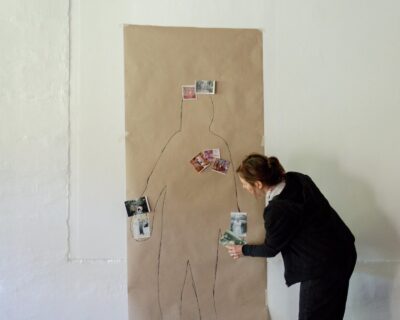
JoAnn Stevelos and Sarah Blesener
The Question Is The Practice
Peery Sloan in conversation with Yvonne Shortt
“I don’t want my board of directors to just be people. I want them to be the bobcat I see, the fox that travels along, the soil we’re using to make our instruments.” – Yvonne Shortt
I first encountered Yvonne Shortt’s work through one of her Be The Museum open calls in Forest Park, Queens, NY. It was and still is a radically transparent, artist-centered approach that flips traditional gatekeeping on its head. No juries, no portfolios, first come first served, and payment before arriving. Her Be the Museum, Be the Endowment, Women Who Build, and her Open Call projects offer artists practical alternatives to extractive funding models, treating money itself as an artistic material for creating sustained, autonomous practices.When we spoke this winter, life felt particularly precarious due to Donald Trump’s fascist policies and violent ICE enforcement. At this moment, Yvonne’s work of building rafts, teaching women to use power tools, creating tiny houses, and paying artists to simply exist in parks feels urgent. Her practice is about questions more than answers, small groups over mass movements, and the freedom that comes from understanding financial systems well enough to opt out of their more harmful aspects. This conversation took wonderful turns from financial sustainability to ethical structures and what it means to invite a fox onto your board of directors but always circled back to a central question: how can artists create the conditions for their own liberation?
Peery: Hi, Yvonne. It’s so good to see you. Thank you so much for talking to me. I wanna start by acknowledging that we’re having this conversation at a really precarious and scary moment. There have been daily attacks and killings. Before we talk about you and your work, I just wanted to check in: how are you doing? How are the communities you work with?
Yvonne Shortt: I think we’re okay. I mean, it’s pretty crazy. I think you just try to surround yourself with people who will help and who will be kind and gentle, and that’s an important aspect of it. How about you?
P: I’m really grateful for the community where I’m living right now in Portland, Oregon. There’s a really proactive resistance movement and that feels good to be part of. People are trying to take care of each other. With this reality, it feels to me like your frameworks of alternatives are that much more relevant right now. You’re building other ways of being an artist. Can you talk to me about your Open Calls?
Y: The reason why it started was because I was at A.I.R. Gallery and I was really aware of how it worked. It’s the oldest women’s gallery, started very early on to give women opportunity. But looking at where it was today, I was thinking, my God, it still feels like a hierarchy because we’re controlling who gets access through this open call. Most of the time we were giving like $2,400 for a year-long residency and a show. How many people are really gonna be able to afford to do that?
Daria, one of the founding members, the only founding member still part of that gallery 50 years later, and I started saying, “well, let’s at least name these things: there is hierarchy and let’s try different things to see what we can do about it.” We started being very transparent. Where’s the money coming from? A lot of the money for open calls goes to project coordinators & executive directors. Funding institutions want to fund a core person to administer the program, but they don’t give a lot of money to the actual artists.
We started with financial transparency. Let’s say how much money these calls are: you’re getting $40,000 from the Department of Cultural Affairs, $40,000 from NSCA, $20,000 from membership. At least we were starting with that. Then as we started experimenting with our own open calls, we were like, why are we asking people to spend so much time on an application? Let’s make it very simple: six questions. One of the open calls, we paid every single person who answered the questions. I think it was $50 if you submitted an application. We capped it at 50 applications and everyone who submits gets $50. At least we’re paying people for their time.
P: I appreciate that it’s designed to disrupt that gatekeeping and scarcity mindset. No juries, no portfolios, first come first served. I’ve been thinking about how even first come, first serve can favor people with stable internet, flexible schedules, no caregiving responsibilities. I’m not saying that to critique it, but I’m curious—do you think about that?
Y: Everyone in some way has some kind of privilege. If we make them quick, then people who aren’t looking at the internet all the time can’t see them. If we only put them online, then somebody who doesn’t have internet access can’t look at it. You cannot be everything. It’s just impossible. But at least if we’re exploring it and talking about it, then something can happen. If we’re not talking about it and not trying different things and not sharing what we’re learning, we’re not going to change it. There are definitely things in every single open call that are not accessible to every kind of person, but if you can talk about them and try to address some of them, at the very least, that’s something.
P: The fact that you’re paying people to answer the questions is so wonderful—it shows where your values lie. When I was part of Be the Museum, I was blown away that I was getting paid before I even stepped into the park. I was being valued and given free rein. It felt like permission to play, and it was such a different experience than any arts opportunity I’ve had. It gave me so much hope that things could be different. I think about adrienne maree brown and emergent strategy: we’re living in somebody’s imagined reality right now, somebody else constructed this. So if we flip that, there’s hope and power in thinking we have the same power to imagine differently. And you’re going past ideation and actually putting these things into action.
Y: Exactly! I received money to Be the Museum in a local park and said, let me split some of it and give it to other artists: I always believe in giving back.
You wonder sometimes: is it better to do an open call at all? Or do you work within a group you already know? Because inherently in the open call there’s always something you’re not giving to. But if you just pull from your local group, you’re never growing or finding different people. There’s never a completely liberating or free way.
What I get excited about is seeing open calls trying different approaches, stretching the boundaries, like ones where they say we only want you to use natural materials, only what’s in the park. I’ll email them and we’ll have this great conversation because we’re both thinking about this as artists, not administrators.
This year we’re doing it again for Be the Museum and giving out $3,000 to four artists. We’re wrapping in Be the Endowment: $2,000 for 40 hours at $50 an hour in a park, $500 for healthcare and housing, and $500 for your endowment. We’ll work as a community, set up our own brokerage accounts, figure out what we value and how we value, and let that help determine how we build our endowments for ourselves.
P: That’s so exciting and so human-focused. It seems like you’re really trying to use money as a material to help create sustained practices.
Y: When I first started getting funding from the Department of Cultural Affairs—taxpayer revenue in New York City—I thought, this is a much better way of getting it. But when you really dig in: who are these people? Some are getting their money from banks, technology companies, organizations wrapped intrinsically in the financial system. I was a little naive thinking money from the people wasn’t part of that system. It still is.
When I get money from Mellon Foundation or Creative Capital, they’re still coming from endowments and wealthy donors ingrained in that system. With collectors, we’re often not asking where did your money come from? But when you dig in, very few things don’t involve understanding how this funding machine works. So I thought, I don’t want to be naive—I want to understand it, from collectors to private foundations. And at the same time, have enough money so I don’t have to keep asking Creative Capital or Mellon Foundation for funding.
P: That’s a lot to hold: the system you’re working within and the one you’re trying to build. I also see you building things with your hands: rafts, harvesting clay from rivers, teaching women how to use power tools. Can you help me understand how questions and creating fit together for you?
Y: I think it always starts with a question and then it becomes whatever it needs to become. Sometimes the making can be physical or more mental. I’ll ask a question like, why is it that we’re often having to beg for money and it prevents us from doing something? That ultimately became Be the Endowment. But it started with a question—not necessarily physical, more with mental work and research and questions with other artists or institutions or financial people.
Then there are things like, we have this land—50 acres. We would like to give something back. While I was giving maple syrup to the farmer next door, I told him I was thinking about making a small wildflower garden, and he said, “well, I’ll help you.” The next thing I know we have one acre and he’s showing my husband and me how to use the equipment so we can till the land, plant one acre instead of maybe a 10 by 10 foot space. I asked my family if they would help throw out the seeds, and my husband’s like, let’s bring our camera and see during the night who comes. And we see this fox coming and the rabbits and the deer.
But it’s all just questions and things just kind of happen. I have no idea sometimes where anything is going. It’s just that we trust. We know it’ll be a beautiful journey because we’re trying to make sure that, at the very least, we have a certain foundation.
Even with the Women Who Build initiative: I was like, why do I not know how to use a miter saw? All these classes were costing $2,000 and you don’t even get the miter saw at the end. Forget this—I’m gonna get the miter saw and invite people into the studio and look at YouTube and we’ll figure it out. But then a woman shows up and gives us guidance. At the first meeting, 8 people came! The next thing you know we’re all cutting wood. Maybe we should learn how to frame a house because as artists, housing is really freaking difficult.
From these questions, all of these things end up happening, which is quite fun and exciting. Ultimately I think it builds a better community because at some point it opens up and it’s not just in my head. My husband often says, “it’s just your timing, it just happens.” I think that’s part of the energy around my community.
P: It seems very synchronistic, this imaginative place of asking what-if questions. It sounds like a democratic process—rotating leadership, shared responsibilities. But have you experienced when somebody dominates the conversation or doesn’t show up for their facilitation? How do you navigate it?
Y: The questions always start for me. Sometimes the people who made me think about the question come in and go out because they’re doing something else. So I only take on things that I’m really interested in seeing through.
With the tiny house, we ended up with 250 women, doing a 5K run to raise funding. People came in and came out—some were very excited and then we got to the build and they were outta there. Or they felt like their idea wasn’t being heard, maybe about the architecture even though they had no architecture experience. We had to pick and choose what directions we would go in. We really wanted to have a tiny house that would pass inspection, that we would’ve learned something from—how to install electricity, how to frame.
At some point if somebody didn’t know how to frame and somebody else said, “this is how you frame, I framed houses before,” somebody may get mad and not show up for two weeks. But we can’t please everyone all of the time. You try and maybe say, “I did this wrong, I’m sorry.” But ultimately the things I choose are things I’m committed to for a very long time: some projects are going on for 10 years. It has to be something I’m committed to, because people do come in and go out.
P: How do you handle groups without creating hierarchies that maybe you’re trying to avoid?
Y: What I’ve learned over the years is to have smaller groups. Women Who Build was the last time I had a project with 250 people—I learned so much, but I also learned I wanted intimacy. More openness, more creativity, less power dynamic.
As groups get bigger it’s harder to get things done. When it’s small and personal, we end up working together in ways we wouldn’t otherwise. Sometimes even if we think someone’s wrong, it’s like, well, we’ll fail together and we’ll fix it. They’re not gonna fail and just leave.
COVID helped change that too. I started to realize each project should be smaller, so that everyone knew each other and we could commit to something and work on it. There’s more care and kindness in a small group. In big groups, if somebody doesn’t show up for three sessions, you’re like, I didn’t know them very well. But if you’ve only got five people and someone doesn’t show up, you’re gonna call them—hey, are you okay? You may find there’s something going on and end up with a whole other project because you wanna help with that.
We were socialized to believe bigger is better and it’s very hard to come away from that. The frameworks I use aren’t for everyone. I’m just sharing things I’m working on. Oftentimes these things have all been done before. I’m just synthesizing and changing it up for the question I’m asking myself, then seeing, hey, is there anybody else out there asking this question? Maybe we can go through it together in a small group and learn from one another and be each other’s support system.
P: There’s a lot of care involved in that way of thinking. I find it really tender and generous. With those frameworks, the Open Call, Be the Endowment and Be the Museum, they’re open source, designed to travel and for other people to mutate them.
Y: They’re open source. You use them and modify however you wish.
I made the Be the Museum card because I was sick and tired of paying 20 bucks to museums. We’re artists, why are we paying so much, especially if you can’t afford it? My daughter went with me to the New Museum and we got in-it was a hoot! I shared it out and people adopted it in different ways. My friend at the Brooklyn Museum said, “I get to go for free, so you can come with me.” I was like, but what if I just made that part of my museum and have a card for contemporary artists? I put my face on it and tried it at MoMA. We got into so many museums and it was so fun.
Museums aren’t something non-Indigenous and Western cultures invented. There have been museums of many different kinds, not in these Western spaces. Now we’re bringing the two together in different ways. It felt very empowering sharing that out and people adopting it in different ways; it caused me to rethink it too. I finally started to say, I don’t want my board of directors to just be people. I want them to be the bobcat I see, the fox that travels along, the soil we’re using to make our instruments. When we think about them as being just as important, we open up the framework in many different ways. That only came from being in conversation with others, and that helped me to change it for myself and others to adopt it however they wanted.
P: It sounds so fun, like you’re just bursting open the framework and there’s so much play involved.
Y: Totally, in so many ways. These are all ideas and most things have been done before. If you realize you are just part of the energy, you’re already adapting it in your own way. I remember somebody saying, “oh, somebody’s going to take that idea.” I was like, “That’s awesome! I’m sure somebody else had this idea before me anyway.”
I would like it if you make a museum and Be the Museum inspires you, that you tell me, because it makes me feel good. But you don’t have to. If you come in and we have a conversation, you may grow and I may grow, and that’s the exciting part. Hoarding an idea or being afraid somebody uses it in a way you don’t like—I just don’t subscribe to that. All ideas are open.
P: By sharing our ideas we can create more than we could have imagined. Before we finish, what do you wish more people understood about your work or about being an artist right now?
Y: There’s no one way to be anything. No one way to be an artist. If you just have a wide open mind and try what works for you, and try not to be influenced so much by how others perceive what you’re doing: be open to the many different things that could come at you and play with them.
And you only need a few like-minded people to help you grow. The internet can be a crazy, horrible place, but it can also be amazing for finding people: one person willing to play with an idea in a certain way. I’ve met a couple of people from all over the world and it’s really opened up my mind, and I’ve opened up theirs.
P: Without the internet I never would have found you and your way of thinking. It’s giving me so much excitement: a sense of possibility and hope, especially in an art world that preys on external validation. I feel like I just got handed a miter saw.
Yvonne Shortt is a visual artist working at the intersection of public art, social practice, and financial systems. Her frameworks include Be the Museum, Be the Endowment, and transparent Open Calls which offer artists practical alternatives to extractive funding models. Based in New York, she teaches women to use power tools, has cultivated a relationship with her landscape and animal neighbors, builds rafts and tiny houses, and thinks deeply about how artists can create sustainable, autonomous practices.
Peery Sloan (she/they) likes to dig, sometimes literally, to see what’s beneath the surface: worms, bones, histories, the things we’ve learned not to notice. Through gatherings, workshops, and small acts of collective noticing, she explores how meaning surfaces through shared attention rather than finished products: what’s within arm’s reach, what touches skin, what gets missed when you’re moving too fast. She thinks of this as tending, or maybe just a lifelong need to be barefoot and looking closer; she is pursuing an MFA in Art + Social Practice at Portland State University.
Just Plug In
Haruka Ostley in conversation with Angela Ostley
“We don’t have to reinvent the wheel. There are programs and organizations that are already doing amazing incredible things on the ground in the community. So just plug in, join them”
– Angela Ostley
Angela Ostley is my sister-in-law, and I first met her when she was 19. Even then, her quiet strength and resilience stood out. She began studying photography at the Minneapolis College of Art and Design, which led her to become a freelance photographer, before life took her on a different path. After moving with her husband Matt to a small rural town, she began working in a group home supporting adults with developmental disabilities. That experience sparked her passion for social work, which she’s carried ever since. Back in the city, she has continued helping adults in semi-independent living while also pursuing her creative passions — writing, photography, poetry, painting . She is a co-founder of Those Yarn Girls, along with our other sister-in-law, Liz Ostley.
Today, Angela works with families in the federal Section 8 Housing Choice Voucher Program and the Family Self-Sufficiency (FSS) Program. She manages a caseload of 54 people, each with their own goals; some check in occasionally, while others need weekly guidance navigating community resources and tackling life’s unexpected challenges.
With all the political chaos today, I was curious to hear from her about what she witnesses in her work, how it affects her, and what advice she might have for people who want to support their communities.
H: You’ve been supporting the community as a social worker in Portland for a while — are there any stories or moments that really stand out to you?
A: There’s a woman I’ve been working with— we’re now in our eighth year of working together. She went through the full seven years of the Family Self-Sufficiency (FSS) program but didn’t quite complete it, so she re-enrolled. Now I’m walking through it with her for the second time. When I first started working with her, she hadn’t graduated from high school. The way she spoke to me about herself and her situation was very much, “I’m just stuck. I’m never going to get out of this. I’m living in a really rough neighborhood, and there are constant issues around me.” Now, eight years later, she’s got her high school diploma, and she’s in college working towards becoming a social worker. She moved out of the place where she was dealing with all this stuff and she is in a house now that she’s renting with her two kids. She has a good job working in a hospital, and she has built up savings, paid off debt and she has purchased a car and likes all these things that are slow. And now when I speak to her she says, “This is what I’m doing next, this is what I’m doing.” It’s so different the way she would speak about what was possible for her.
H: That’s so amazing. It’s such a long-term commitment, staying connected and helping someone build their confidence .
A: A lot of people who are living in poverty or dealing with systems that are providing benefits, they have to jump through all these hoops to get the benefits. And there’s always the threat of losing them. The systems that people are working with are not positive interactions. So being able to be a person who can speak to somebody one-on-one and be an encouraging positive voice helps people realize that they can achieve their goals.
H: I really believe it can make a difference when someone in your life is that encouraging voice saying, “You can do this.” That kind of support is powerful. What would you say is a common challenge you come across, especially within the systems you work with?
A: Challenges often come with more barriers than you might expect. There are programs designed to help, but many people don’t know about them. For example, in Portland, there are programs to help clear criminal records, but many people don’t realize they can reach out to public defenders and get their record expunged for free.
Then there are the systems themselves. With housing assistance, once someone reaches a certain income, the support is cut off— there’s no safety net or incentive, and the threshold is low compared to the cost of living. Maintaining benefits like food stamps or housing also requires constant recertification and paperwork, and it’s not easy to get someone on the phone at DHS or with a caseworker.
A lot of people’s attention goes just to surviving— paying rent, keeping the lights on, putting food on the table,leaving little brain space for anything beyond daily life.
H: Oh I can totally relate to that. How do you like to build trust when you start a conversation? Do you have anything that you always pay attention to when you talk to them?
A: As part of my job, we go through a lot of training: trauma-informed care, reflective listening, coaching programs… all focused on really listening to someone and reflecting back what they’re saying. It’s about hearing not just their words, but what they’re trying to communicate underneath.
A lot of it is simply building trust by being there. In our first meeting, someone might be telling me their whole life story, and we’ve just met. So I try to earn that trust by being available, by following through, by answering my phone when they call. You’d be surprised how far those small things go. People tell me all the time, “You’re the only one who answers when I call. I can always count on you.”
H: Wow, yeah. Just being there is already a big step. Sometimes all we need is someone to show up, being there to listen.
A: For a lot of people, it’s like, “Oh, you’ve been assigned a new caseworker this week,” and their paperwork just keeps getting passed around. There’s not much consistency. In my role though, I get to work with someone for five to seven years. That’s a long time. You really get to know them, not just their goals, but who they are as a person.
H: As I am looking into collaborating with Rose Haven, I’m curious,what kinds of challenges do women face within the system? Are there specific barriers that stand out to you?
A: So many challenges. I would say the majority of the people I work with right now are single women, single mothers. They’re running their households alone. They’re doing everything. They’re working, paying all the bills, taking care of the kids, dealing with school issues, finding tutors, managing activities, filling out paperwork, completing recertifications— all of it.
The expectations are all on them. They’re carrying everything by themselves. And mental health comes up a lot, because while they’re focused on everyone else;their kids, their household, their job. They always seem to come last. So they don’t really have the time, energy, or resources to take care of themselves, and that takes a toll after a while. They’re carrying the whole world on their shoulders, doing everything. And they don’t really have a choice, because they’re doing it alone. Expectations aren’t the same for men.
H: Right. Where do you see the biggest gaps in support?
A: Childcare is the biggest gap. It’s either not available, or it’s too expensive. Thankfully, there are some newer programs starting to help cover those gaps. Preschool for All in Portland is a great program, and Head Start too. But still, when you’re a mother, you can’t just leave your children to go to work.
H: I’m curious, have recent political changes or movements had an impact on the people you work with?
A: Yeah. Well, government policy really affects families. Every year, we have less and less funding for the housing voucher program. That means systems have to make changes. Take the Emergency Housing Voucher program, for example. It’s ending this fall because the funding isn’t being renewed. About 400 families are going to lose their housing assistance at the end of this year.
At the same time, budgets are being lowered, so the amount of housing assistance each household can receive is decreasing. Policies like that directly impact households.
Then there’s the issue of citizenship and immigration. I have families reach out and say things like, “I haven’t been going to work. I’m scared to go outside. I don’t know how I’m going to pay my rent this month.” People are afraid and can’t just live their lives, and they’re already dealing with so much.
When you add on all these other struggles, based on who is in office and what decisions are being made, it directly affects families and households. It’s hard to see, and it makes me feel terrible, because I’m part of that system. I work for the housing authority, so I’m part of a system that sometimes makes their lives harder, when it should be making their lives easier and providing the support they need.
H: It must be so difficult for you to be in that position. What you want to do is support the families you’ve been working with for so many years. And then at some point, you have to tell them, “This program is ending,” or share other news like that. That must be really hard. After all these years, what has this work taught you about people? And what is it that keeps you going?
A: Well, this work has taught me that people are incredibly resilient. I’ve worked with individuals who have faced some of the toughest challenges and setbacks you can imagine, and yet when I talk to them, they’re still happy, positive, hopeful, and working to make their lives better. It’s not that they aren’t affected by what happens— of course they are. But people are strong, resourceful, and determined. Even when they have very little, they find a way to make it happen. And that… that is really inspiring. I feel like I’m more passionate about this work than ever before because I see how these social programs make a real difference for families in big ways that will impact their children and future generations. I think it’s really important that we keep fighting for them.
H: I think the work you’re doing in your position is amazing. Truly making a difference for what they need. What do you think our community can pay attention to as neighbors, or what can we do to help?
A: I think building community is the biggest thing. I heard someone else say this the other day, “We don’t have to reinvent the wheel.” There are programs and organizations that are already doing amazing incredible things on the ground in the community. So just plug in, join them, figure out who they are and what they’re doing, and then help build those connections, extend their reach, and get to know your neighbors.
H: Yeah, that’s really great. It gives such a clear visual, like the wheel is already there, and you just get in it and keep it turning. It’s about supporting what already exists. You don’t have to think, “I have to make the wheel myself.” It’s more like, come in and help keep it moving. That feels like a step anyone can take. That’s great advice.
A: You can see it happen in places like Minneapolis, right now they have all of these community organizations and like mutual aid groups. That started when George Floyd was killed. So what was created when that tragedy happened is now supporting them through this craziness that they’re going through. They came together as people, as a community, to create ways to help each other. There are organizations helping families pay their rent, for example. And that’s something we can learn from. We can take what they’re doing in that city and apply it in other cities, adapting it to local needs.
What we can do is to take care of ourselves. I like to go hiking in the mountains. It’s a mental reset for me, because when I’m hiking, nothing else is on my mind except nature. It’s really peaceful. It’s actually a great way to reset mentally, especially with so much coming at us from our phones and the news. It’s good to just turn it off for a little while.
Angela Ostley (she/her) is a poet and fiction writer whose work blends tenderness and teeth, exploring grief, moral tension, and feminist defiance. Her professional background is in housing and social services and she runs a small business with her sister making and designing crochet toys and patterns. She lives in Vancouver, WA, with her children and dogs, where she works, crafts, and writes, believing each of these things are ways to change the world.
Haruka Ashida Ostley (She/her) born in Japan and raised across four continents, is an interdisciplinary artist whose work explores personal stories, vulnerability, and human connection, shaped by her experiences with illness, motherhood, and identity. Her practice spans painting, installation, performance, and socially engaged projects, often collaborating with communities to honor spoken and unspoken stories, fostering reflection, dialogue, and empowerment.
Haruka has served as an Artist-in-Residence with the Yew Chung Education Foundation in China, is currently pursuing an MFA in Art and Social Practice at Portland State University, and continues to create work that bridges personal narrative with collective experience.