Conversation Series Sofa Issues Winter 2026
Frank by the Christmas Tree with a Heineken (Exhibit A)
Sarah Blesener in conversation with JoAnn Stevelos
“Where is the evidence? The images themselves, the act of taking them, the way they’re placed and redacted, the curation, the gesture of giving them to us, or the eyes that look? It is never just an image. It is a whole system showing its seams.”
These days, I’ve been thinking a lot about how soft my edges have become. I move through the world differently now. I feel more than I used to…. more tender, more open, less caught up in the world inside my own head. Over this past year, I’ve met people who have pulled me to the other side, right at that moment where that opening could just as easily have turned into a shutting. Jo is one of those people.
We met at her home in Albany, New York. I was there on assignment as a visual journalist. We had two days to work together, but something sparked between us in that time. I went back to visit Jo and didn’t leave for months. The journalism story was long over but we kept working on something together, unsure if it would become a project, unsure exactly what we were going after together. But it was the “working through and working with” each other that became the point of all of this.
What I’ve been reflecting on is how much I struggled in our dynamic. I wrestled with letting go of the power structure of “journalist” and “participant” that framed our first encounter. The rules in that system are rigid: you don’t share, you maintain distance, the direction of taking flows one way. I struggled with my own vulnerability, and with what this kind of collaboration asked of me. That struggle, meeting that limitation and failing to overcome it, changed the direction of my life. The conversation that follows is about Jo’s family story – the reason we met, her archive, and what it meant for us to look at photographs for a year together. But this work also became an excuse for us to talk about our relationship: about the beauty and ambiguity of collaboration, about fear and vulnerability, about the questions we have for one another. I’m still learning not to wait for a reason to slow down and examine these dynamics honestly and openly.
Some necessary context: Jo and her siblings filed a lawsuit under the New York Child Victims Act against the Roman Catholic Diocese of Albany. Jo has worked for decades as an advocate and has written extensively about the institutional failures that allowed Father Francis Melfe, known publicly as a priest, but in her house as “dad,” to remain in her life for so long. Before she died, Jo’s mother left her boxes of archives. In them is a world her mother carefully curated, a fabricated reality that both hid the truth and preserved proof that it existed.
Sarah Blesener: Jo, I remember meeting you for the first time and sitting in your living room next to a box of family albums. What was inside them, and why were they in your home?
JoAnn Stevelos: I didn’t have many family photographs until recently. Just a few of my father, grandparents, and some old school photos. The few photographs my brothers had from our childhood were used as evidence in court – we used them to sue the Catholic Church for clergy abuse. During the legal case, our mother died, and my siblings went to her home and found the boxes of albums.
Sarah: Your family albums were used in your deposition?
Jo: Yes, but here’s the thing: the photos didn’t show anything explicitly incriminating. What they showed was that the priest had been in our home for nearly two decades. During the court case, the Diocese tried to deny our story by insisting the obvious: a priest couldn’t be living a double life under our roof while appearing at Mass and tending his parish. It was their version of certainty, offered as fact rather than inquiry. Our attorneys pressed back, asking how often anyone had actually set foot in the rectory, checked on their priests, or documented anything resembling oversight. Unlike the Diocese, we had documentation – in the kind of domestic record-keeping that’s usually ignored as evidence. My mother had obsessively assembled family photo albums over our entire childhood, essentially documenting our lives with this priest. So when the Diocese claimed we were lying, our lawyers had about 30 photos from her albums ready: Frank barbecuing in his purple bathing suit, Frank by the Christmas tree with a Heineken, Frank at our birthday parties holding his son. That’s the thing about family albums—while they rarely show anything explicit, they show proximity.
Sarah: What I find so fascinating in all of this is the double function of the photographs. Your mom is documenting as a way to cover up the abuse, to create this false reality. And we have thousands of images. But her trying to cover up or repress the truth was what led to the truth being able to be seen. The images prove the thing they are trying to deny, the thing that she was trying to pretend wasn’t happening, right? And this curation we are left with… those photos have so many layers of subjective meanings. The albums read as a totally banal, quotidian, normal family album. But when you look closer and open up those other readings… it gets incredibly complicated. You and I have talked a lot about how to listen to what’s not said, what’s left out… what’s in the gaps, silences, and redactions. There are also the archival layers here- how someone chooses to mark, annotate, date, caption and sequence these images into a story.
Jo: The photographs don’t just open; the questions do. Was my mother complicit? What did she know, and when? Even after she knew, she went on curating the albums, assembling a happy family for some imagined audience and then handing those albums to us. Were they meant as proof, as manipulation, or just a kind of voyeurism? Where is the evidence—the images themselves, the act of taking them, the way they’re placed and redacted, the curation, the gesture of giving them to us, or the eyes that look? It is never just an image. It is a whole system showing its seams.
The story splits open in the margins. We were going through boxes—albums, envelopes, loose prints—when we found a tucked-away series my mother had altered. At first, it’s an ordinary birthday: Frank at the table, leaning over a cake, candles lit, us kids lined up behind him in that obedient half-smile. Except his face and hands are blacked out. Not once, but in several nearly identical shots: same angle, same candles, same moment—developed again and again, each time with his face and hands inked over.
The archive she left behind was not designed to tell the truth, but the truth pushes through anyway, one blacked-out face and hand at a time. Those marks rupture the narrative she’s staging, turn into evidence in their own right. And still, she slid that photo into the family album beside all the other “normal” images. The erasure and the performance, side by side.
Sarah: It’s damn fascinating. We talk a lot about this, but every family album is a manufactured reality, right? There are these moments that family photos require to function – hinging on events, dates and culturally recognized moments to mark time – but there is something so replicable in them, so interchangeable. The gestures, poses, and markers would feel almost the exact same if I were to exchange my family album with my neighbors. But if we can read against the grain of this, we can start to see that fiction, those slips, the hiccup almost or where the dream starts to reveal itself as a dream. But within your albums, there are these different textural languages at work – what photos your mom wrote over or on, the marginalia and coding system, the hidden photos behind photos, the missing photos. As an archive, it’s terribly fascinating. As a family album…Jo, I don’t know what word to use…it’s just terrible.
Jo: Terrible and incredible when it’s opened up… And don’t forget the ephemera. Boxes of ephemera. My mother, although her children and grandchildren were estranged from her, bought herself a grandmother’s book– a journal with prompts about what it is like to be a grandmother. She inserted herself into these domestic ways of record keeping as many women do in our culture but again, as a total fabrication, a wish to be remembered in a way that wasn’t at all true.
Sarah: Since we met, we’ve been doing this interesting dance… We’re still looking at the facts and timelines, looking at what doesn’t add up, and analyzing the archive as evidence. On the other hand, we’ve been working with the images as images. We’ve been reactivating the archive and painting and drawing and working through complex feelings with the archive, not just as evidence, but as what we’re calling a tool, right?
So, I’ve been wanting to ask you about this: Sometimes I worry that we edge really close to something either pretty magical or pretty dangerous, like it tips in both directions of having this investigative thrill and cathartic quality to it, and on the other hand its wildly dangerous terrain to walk into. Do you have that same fear? And what if that line between something aiding recovery is the exact same line as opening up a Pandora’s box of something harmful, problematic or simply not helpful? Do you have that feeling with our work? It does feel like playing with fire sometimes, no?
Jo: There’s a dread in going into the archive…the weight of history, the complexity of all that’s in there. It still feels like playing with fire. But the trust we built early on, and keep building, is what makes it possible. With you, I know I’ll be okay. When you say we’re playing with fire, I know it’s really a wire I’m walking: age, decades of trauma work, and then something in a box that sends me straight to the edge. That must be hard to watch. R.D. Laing says, “I experience you experiencing me experiencing you experiencing me,” and that’s what it feels like with us. As sad as we can get together, we can still laugh just as hard.
Sarah: Now that we are talking about our particular dynamic… This leads me to something else I’ve always wanted to ask you. We met in the context of a journalism story, which has a really different container than what we’re doing now. Our relationship now goes beyond any “project.” I consider you an incredibly close friend. But when I first met you, I arrived in the context of my specific role as a photojournalist, and in that role, my boundaries were different. When I work as a photojournalist, I tend to share a lot less. I’m quieter. I’m there to help facilitate a particular environment for someone else. I’m really focused on establishing safety and comfort, first and foremost, for the person in front of me. So, the question I have… we’ve left that context behind a long time ago. We’ve been working together since then, for ten months now. I’m not here as a photojournalist anymore. We’re doing something totally different.
“Do you feel that I’m too held back in our collaboration? Do you still feel that old role there more than it needs to be? Does it frustrate you that I don’t open up or share a lot about my family or give as much as you give? Do you think it affects the work or our collaboration?”
Jo: I’ve thought about that a lot. I remember asking why you didn’t bring in your own family story or images, why we weren’t doing this side by side. Part of me wanted that. But looking back, I’m glad we didn’t. I don’t think we’d have ended up here if we had. We needed one of us to stay more in the role of observer and one of us to do the falling-apart work. You had to be the observer for this to happen.
Sarah: I wonder if it would have helped to just discuss and name these underlying things we both felt – to name those roles and to recognize them as being there, versus pretending they weren’t. I wonder what kept me from doing that, or what kept me wanting to pretend I wasn’t occupying a certain role that I was. I don’t know, I’ve been thinking a lot about that refusal to name all of this and looking back… I wish I had done that.
Jo: Well, I’ve been doing a little bit of this work on my own now – just drawing, doing collage work. Now, I understand how important it is to be able to do some of this work on my own, too. I wouldn’t have had that if I hadn’t seen you doing it on your own. That’s been really inspiring to me. I don’t think collaboration is as simple as “doing something together” – there is an element here of where we are willing to go and inviting others to be a part of that.
To take it back to the archive, what I love about re-working it in a real tactile way – cutting up images and painting and drawing – is that it lets me lean into the complexity and contradictions. We all want to love our mothers, right? Even if they harmed us? I’m not willing to deny myself that basic human need – and I want to be able to love my mother and have the experience as a human of loving my mother, even after all the harm that happened.
Sarah: I think that circles back to what we were first saying at the beginning of this conversation about the way this particular register of information, an archive, speaks to us through what’s not there more than what’s there, right? Through all these images that are missing and what it avoids. Or even how repression functions on a psychological level… these obsessive recurrences keep showing up. What can we learn from the way certain things are framed if we look at them closely? What unsettled us wasn’t the chaos in the archive but its staging…intentionality…choices. I don’t know… the way certain moments were repeated and others avoided.
I’ve been thinking a lot about our conversations around how to use or not use those photos where harm is more explicit. In particular, the aesthetic choices around that – what happens when we frame those images on floral wallpaper versus a white background, has that changed the feeling? What shifts when we lay them on bed sheets versus scanning them? Do we show the images or keep them hidden, and is keeping them hidden an act of care or a second silencing? These conversations kept me up at night. Experimenting – real trial and error here with you – was deeply challenging and so damn important to not be alone in.
Also, what actually disturbs me is not just what the camera captured, but why it was used at all – what prompts someone to lift it, what purpose the pictures serve, what else they’re doing… It’s less the image than its function: how it’s sequenced in an album performing “family,” how it signals a story. And now we’re repurposing those same images as an art project! Running them through an aesthetic lens! They’re beautiful. They’re also the same pictures that once falsified reality, the same ones entered into a deposition. To use them this way feels subversive… and a little strange.
Jo: When I think about where this all sits—the archive, the denial, the evidence, the questions with no real answers—I keep coming back to a Giacometti sculpture I love: Hands Holding the Void. A figure stands rigid, almost frightened, arms out, palms cupped around nothing. The face looks terrified, but sure. As if the void is the only honest thing it holds.
That’s what this work feels like to me: standing in that void, holding what can’t be fully known and refusing to pretend it has shape.
“That’s the hard part of art and the meaningful part…the willingness to stand at the edge of the unanswerable, to look without resolving, to acknowledge both terror and possibility in the space where truth should be.”
That’s where this archive lives. I think that’s why the work matters.
Sarah: There’s something here, where we’re both really interested in looking at where identity becomes unmanageable, right? When the ideas of ourselves, of our worlds, our families or institutions are thrown into crisis, and looking at that as a gap where something new can be seen or found. And I think leaning into that crisis where things fall apart in order for something to arise again… those albums could have been written off either as 1) truth 2) a silly family album 3) complete bullshit and false so simply throw them away. But we are really engaging the unraveling of this story and what that unraveling opens up – whether that’s new images coming to the surface, a new narrative, a new way to think about it, a new relationship to your mom and to ourselves…there is this newness found there that I think ties into your hope work, but also ties into the work we’re doing, and beyond that. For me, this is really the beating center of all of this. I don’t know if you feel the same.
Jo: I feel the same. I can’t imagine this not being art now, because it is the truth. I get to say what these pictures are, and what belongs on the page beside them. We widened the frame. We talked back to the archive, asked who was missing, what was missing, and why. The art is in taking the truth of these photos and folding it into my own narrative—not letting someone else cast me, or curate my life without consent. That feels like power. There’s also the fact that I get to make choices inside the archive now, an agency I never had as a child in those photographs. I keep going back to one image: me sleeping, ten or eleven years old. In the original, it’s just another vulnerable moment my mother decided to capture. When you and I revisited it, you laid a string of pearls in a circle around my face, a kind of halo. It changed everything. Not the history, but my position inside it. For the first time, I wasn’t just the subject being framed; I was a collaborator in how the image lived in the world. That felt like reclamation, a reordering of power, a way to look back at that girl and offer what she never got: intention, care, a boundary. A way of saying, You’re not an object anymore. You get to be held differently now. I don’t think I’ll ever stop needing that.
Sarah: Back in Albany, we talked a lot about how archives seem so final – they seem contained, closed, written. You said something back then about archival work being this act of lifting the archive out of the finite, freeing it almost from the answers and neat boxes it is trapped in. The work being not so much about “truth finding” in and of itself, but maybe opening it up to multiple readings and rereadings, and maybe “freeing” it from the truth.
Jo: Speaking to a more personal side of that finality, I’m glad that I’ve started to find some peace with it all. And I’m glad that I found that I can try to love my mother despite everything. It’s always been easier for me to forgive the men in this situation. It’s been the hardest to work through with my mother.
Sarah: That’s a damn tough one, Jo. But what I’m hearing from that, is that the last thing you’d want is this incredibly nuanced, complex story to be reduced to something that it’s not – for us to try to fit into a neat little box. The story isn’t meant for a neat box. So how do we have space for the contradiction and for the complexity and the uncomfortable things in here? The love that we still want to feel, and do feel, for those who’ve harmed us? For those we shouldn’t love? And when others judge us for the love we have for them?
Jo: Yeah. I’m always asking how we can retain complexity for the people we most want to flatten, or deny it to. That’s where hope and complexity come together for me. If we don’t have hope, if we don’t believe people can ever redeem themselves,what’s the point of being here? For me, redemption isn’t about seeking absolution. It’s the possibility of leaving this earth with some peace in my heart- knowing I had the courage to seek the truth, and knowing I can’t find that truth alone. We need each other for that. We need the friction and the tenderness of shared humanity. My hope is that in this work, other people can find their own path through what they’ve inherited and share it too, so there isn’t just one story of harm, but many stories of how we learned to live with it and beyond it.
And if we deny people the chance at atonement, living amends, or redemption, if we decide certain people are beyond repair, what are we doing here? Forgiveness isn’t a gesture or a letting go; it’s a long, interior argument with yourself. It’s a moral question that sits at the center of trauma recovery and can’t be rushed. The archive has made that question sharper for me. By insisting on the truth in image after image, it gives the work of forgiveness and repair a place to stand. Forgiveness, if it ever comes, will have to live beside grief and fury and love, not instead of them.
JoAnn Stevelos is a writer, public health advisor, and researcher whose work spans memoir, fiction, poetry, and performance, exploring themes of survival, family, radical repair, and hope. A Pushcart and Best American Essays nominee, her work has appeared in The Guardian, including “This story isn’t about the priest who abused me. It’s about my mother.” (2025), “How Do You Forgive the Unforgivable?” at Chicago Story Press, and “Passersby” in The DewDrop. She is the author of the cross-genre collection Dream Alibis, and writes the Substack The Second Silence. Her essay Mugwort received distinction in the 2025 Writer’s Digest Personal Essay Awards. Her essay “The Archivist,” created in collaboration with photographer Sarah Blesener, is forthcoming in North American Review.
Sarah Blesener is an educator, socially engaged artist, and visual researcher interested in the complexity of human relationships and their visual representation. For the past decade, they have worked on investigative and long-form storytelling with outlets such as ProPublica, the New York Times and the New Yorker. Their approach uses guided participatory expression, pedagogy, and collaborative methodologies. Alongside photographs, Sarah uses archival imagery, mixed media, poetry, and painting. They are currently an MFA student at PSU studying Art and Social Practice.
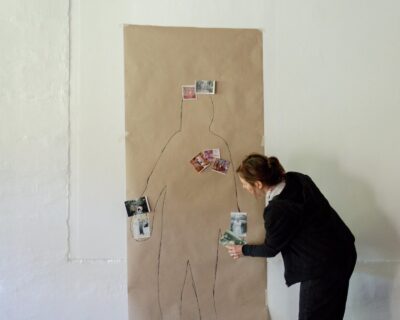
JoAnn Stevelos and Sarah Blesener