Conversation Series Sofa Issues Winter 2026
Meet Me at the Parking Lot of Ideas
Clara Harlow + Midnight Variety Hour
Everybody wants to play with Midnight Variety Hour. Midnight Variety Hour (MVH) is a Portland-based performance collective of dancers, musicians, and filmmakers predicated on the liberatory potential of play. Together they’ve invented a signature sound (like a soundtrack to a dream you never want to wake from), signature moves (hip thrusts sourced from cinema), signature costumes (the widest brimmed sunhats you’ll ever see), and even a signature scent (with notes of digital waves and AstroTurf). Simply put: whatever they’re selling, we’ll take ten!
But Midnight Variety Hour is not just fun and games. Their process-based work leaves audiences eager to be included because it actualizes a future that we desperately dream of: one of resourcefulness, resilience, collective care, and good humor. A future where each person’s skills, visions, and shortfalls are not just useful, but treasured material we could tinker with forever. With buoyancy and rigor, Midnight Variety Hour shows us what we want is not as farfetched as it seems. In fact, it might be happening right in your backyard–or at your local comedy club, public-access television studio, or dive bar. For this conversation, they let me play along.
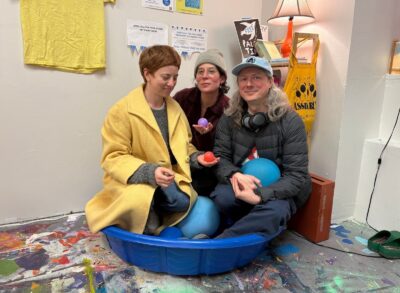
Much to my delight, Midnight Variety Hour insisted on a group photo in my kiddie pool during their visit to my studio. Photo by Clara Harlow.
Clara Harlow: I thought we could game-ify the interview a bit, so I wrote down 12 questions on slips of paper that I was curious about, and here’s some more paper if you have any you want to add. I was thinking we could lay them all out and take turns choosing a question and bouncing off it and seeing where we end up.
Sean Christensen: This is a funny question: What’s a typical rehearsal like? I think there’s a lot here, because of what we do.
Fern Wiley: Yeah, let’s do it.
Sean: So, when we all very first started working together, our time together was almost entirely play without a specific aim, except to kind of lose ourselves in a thing and create as we go. And then at a certain point, we did start getting asked to do events and we did actually lock in on something, and start working on a version of repetition on a specific idea. I think that’s the closest to rehearsal that we really get.
Lee Wilmoth: Sometimes there can also be a little bit more structure to facilitate that play, like with the one-minute sculpture things [inspired by sculptor Erwin Worm’s prompts inviting the public to hold specific positions with props for one-minute].
Fern: Yeah, if we haven’t seen each other for a while, and we’re wanting to do generative play, we might ask everyone to bring in an object and see what happens. That might be a starting place for us to come together and start being in a conversation with each other. I remember coming back together from pandemic times and bringing a seashell and a ball of string. I think the bell came to that practice, and we just started playing, and so much has grown from that.
Sean: Oh, yeah! And sometimes something as simple as the group showing up in a space sharing objects or wearing [clothes] in a color palette–planned or serendipitously–has synthesized whole ideas together. That reminds me of when we gathered in one of our backyards once to talk over our future and got so inspired by the yard, some window blinds, and reacquainting [ourselves] with a structure we built, that we ended up making one of my favorite video pieces. Those moments feel like we have a shared language.
Lee: We’re all very interdisciplinary in the collective, but Fern and I have more of a movement-focused background. And in addition to having a very active Instagram thread, where we’re constantly sending each other visuals or videos or pieces of ephemera that inspire us, we’ve also brought in movements to do with the collective. Sometimes that movement sparks other movements in a performance or music, or video, or something like that.
Fern: Sometimes it’s like, Guys, can I tell you about the weird dream I had the other day? Yeah, it’s a lot of that.
Clara: So it’s sort of like designated playtime. Maybe there’s a seed there, some kind of prompt, and then you see what happens.
Fern: Yeah. It’s very fun. And then certain things stick and we get excited, and then those end up being things we keep building.
Lee: It’s been 7 or 8 years, and so I think we also have to name the psychological safety within the play. That us taking risks, or encouraging each other to try other things, I would argue, very much comes from the fact that we know each other in ways that I think helps that rehearsal play process to feel pretty comfortable and safe.
Sean: Yeah, there’s a lot of trust there.
Fern: I think that gets to this question of What does your collaboration provide that’s different from your individual practices? And I think it is that courage to take risks. That I feel supported by the collective. We all bring different skillsets or places we feel more comfortable, and the thing I love about our collaboration is that we support each other in stepping into new spaces. Like, I’m making more music now, which is something that I never thought I would be doing in front of humans, so that’s been really cool. Sean has been stepping into more movement.
Sean: Yeah, which is still really scary. But at the same time just witnessing my collaborators here also stepping into territories that are less comfortable for them has a reciprocal effect that can really make me want to try more things outside my comfort zone. I think the space between “knowing” something and “learning” something, is my favorite space of curiosity to create, and that is what we encourage in MVH.
Lee: Oh yeah, and I think that there’s a generative ideation perspective. Like, I know for myself, when I work in a solo movement capacity, I can sometimes get a little bored of my ideation process. And so, obviously, when you just have more minds in the room that you’ve worked with for so long, you know their skill sets, but you also know that they’re kind of down to let you fuck around and find out a little bit. I think it just creates more of a dynamic, expansive creative process than when I’m working by myself–just like with any collaboration–but because that is at the core of the Midnight Variety Hour, that collective aspect is just inherent. Which sometimes is our problem and we have to decide What are we gonna do for this performance? We have like 8 years worth of archival ideas, are we done with this one? Do we want to bring this back? We brought a zine back last year that the three of us started in 2019.
Clara: That honestly sounds like a good problem to have!
Sean: No, it’s true. And I mean, I would add that sometimes we’re so inside of whatever we’re doing for a while that it may even go unnoticed to all of us that no one else has seen whatever we’re doing. So if we get asked to do a performance, and we are like, What do we even want to do now with this available space that we’re being given? It can be funny cause it seems like we should do something new, but we haven’t shown anybody anything that we had been doing.
Fern: Exactly! [All laugh] Makes me think of this question of How do you get unstuck together? I’m thinking about a moment of stickiness for us when one of our beloved group members had to step down. We went from this foursome that had all really been part of the collective from the very beginning to this triangle, and we were like, What are we now?
Sean: Yeah, What is this?
Fern: Like really having to reassess what was next for us. And something that I think helped us get unstuck was to look to our archives, and look at what was beckoning for attention, and we found stuff there that made sense for the three of us, like the zine.
Sean: Oh, yeah. It’s really funny. If that person hadn’t stepped out, I don’t know if I would have questioned so much how each of us as individuals got comfortable with a certain personality role amongst the group. Because the person that left, I think we would all say, was the silly person, the one that’s got all the humor and all the wildcard theatrics. Once that was removed I was like, What do we do? Will this be humorless now? Fun’s over! It’s serious art from now on. But thankfully, I think we all realized that we’re all very silly also. It was cool to have that reset as much as we wanted that person to be there.
Clara: Yeah, that’s interesting. I was just talking to my sisters about this. Family is also a place where you form your identities in relationship to each other. It’s like, You’re the that one, so I must be the this one. Then as you’re becoming adults, you’re negotiating some of those historic roles and hopefully moving into new ones, and trying to let go of those attachments to those past roles for ourselves and each other. Like how can we keep seeing each other in new ways and locating each other here right now, you know?
Lee: Yeah, like giving ourselves permission to notice the opportunities within that change that felt scary, but then acknowledging it’s also good for this person to leave, they’re listening to what they need. And this actually did create a lot of capacity for the three of us to get a little unstuck. It shook us up in a good way.
Fern: I’m in a counseling master’s program right now, so I’ve been learning all of these frameworks for looking at individuals within the context of their family system. And we learned this theory last term used to look at a family’s level of resilience. The model asks questions, like Does the family have shared beliefs that support them to see opportunity in adversity? Are they organized in a mutual support system? Do they have support systems outside of the family that can help them? Is the communication open and clear and are emotions freely expressed?
I was sitting in class, looking up at this lecture slide, and I thought about us. We are a resilient family. I was like, check, check, check. This is why we’ve been able to sustain 8 years through a pandemic, through illness, through injury, through loss, through relationship changes, through shifting life demands, because we’ve been able to be really flexible with each other.
Lee: We had a residency at the Sou’wester Lodge in spring of 2024 as part of their Arts Week, and a month before I had broken my ankle and had surgery. I ended up performing in my boot, and I sat and we adapted to the moment.
Fern: I think a big learning I gain from being part of this group is that we practice the skills needed to be resilient and adaptable humans in a collective, and I think that those skills are so important in the world right now, and I hope that that comes through to the audience when they see our work.
Lee: And that’s actually a really good segue to this question: What questions are you currently asking in your shared practice? So, I think one of the things that came up for us is What is play for us? We’re understanding it more as a very liberatory practice. We take play very seriously, especially because we are a group of adults. A lot of feedback we’ve gotten after our shows, performances, whatever, is that people are like, I want to play with you guys, I want to be in this thing. What you’re presenting feels so freeing, it feels liberatory. We’re in so many oppressive moments and systems, but the fact that you guys are organizing as a collective and have been for so long around these particular practices is inspiring.
One of the ways we’re playing with this aspect more concretely, is Saturday School. So, I grew up going to this thing called Saturday School, which was essentially a theater camp in Ann Arbor. The big, big city of Ann Arbor. At one point, I got in my local paper for Saturday School, and my mom sent me this newspaper clipping, and I was like, Yo, you guys, look at this! It sparked this idea that we should make a workshop and call it Saturday School. For this exact reason, right?
We’ve been together this long, it sounds like we’re at a place where we really can speak to and codify some of these practices, mindsets, and behaviors in a more educational, workshop-y, still very emergent, improvised kind of thing. So Saturday School is something that we want to explore more of this year.
Clara: Gosh, I would love to go. Please, please let me enroll!
[Lee grabs the question: What are some of your primary influences?]
Lee: Meredith Monk is a big influence for us, I would say. She’s quite beloved, an interdisciplinary performance artist and vocalist. Weird, tender.
Sean: Yeah, [an influence] in every direction. I am a big big fan personally of Monks’ [experimental performance/video piece] Turtle Dreams, which operates in the Robert Ashley camp of opera meets cable access video art. I had been dying to explore these modalities in music making with MVH for a long while. That’s sort of where we aimed in our recent music performance in-progress at Performance Works [NorthWest] curated by Stephanie Trotter.
The three of us attended one of Monks’ pandemic Zoom workshops. It felt so magic to be guided by the real Meredith Monk and then see your tiny faces on the laptop together. Just a lot of grinning warmth.
Fern: Totally. I’d say Agnes Varda too and David Byrne and dance stuff.
Sean: Like the videos of Byrne dances, prompted by Toni Basil. Who I feel deserves more cred for that magic.
Lee: Yeah, postmodern dance, Yvonne.
Sean: Oh yeah, Yvonne Rainer. I was like, there’s somebody so obvious to me that I couldn’t… I mean Rainer is also so interdisciplinary. Made some truly incredible movies too.
Fern: Pina Bausch, too
Lee: with more humor.
Sean: I think Pina’s pretty funny.
Clara: Do you have any non-art influences?
Sean: Maybe Balloons
Clara: [Laughs] Me too!
Fern: The wind?
Lee: Shells, bells, candles.
Fern: AstroTurf.
Sean: A lot of household objects. Clock faces.
Lee: The heat of stage lights. In addition to facilitation, I also do a lot of human-centered design thinking work, so that ended up showing up in our last performance. I talked about the time-love continuum, pulling from design methodologies for change and innovation, like prototyping, testing, and iterative feedback and that totally showed up in our performance.
Sean: Oh, and maybe early TV as a form of community. That was in many ways MVH’s first playground where Fern and I, with other earlier collaborators, started forming MVH.
Lee: Cable access. We’ve done a lot of videos. Much of our video work has been shot at Open Signal [Portland Community Media Center].
Clara: Yeah, I’ve watched some of that! The Signature Moves one. It’s kind of like your alphabet.
Sean: Yeah, thank you. That’s exactly right.
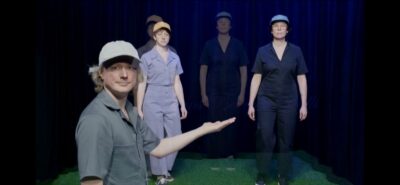
Film still from Midnight Variety Hours’ dance instructional video, Signature Moves. Photo by Maura Campbell-Shun.
Lee: I loooove when Fern and I come up with choreography, whatever we even want to call it, and then whenever Sean does that movement, I’m always like, oh my god, it’s so great! And again, the interdisciplinary thing of working with non-dancers is the best.
Sean: Yeah, just me attempting what I’m seeing so it’s already gonna be an interpretation.
Clara: I can really relate to that, because a lot of my friends in New York are dancers and performers and I’m always so curious about what’s going on in those rehearsals. That’s why I’m glad I get this insight here. I’m always like, Let me do what you do. You tell me what to do, and I’m gonna give it a whirl.
Lee: 100%. Yes!
Sean: I personally really wanted to break out of my shell and into more performative art as opposed to art on paper where I feel cozy. And there was a similar desire between Fern and me that sort of got that going. I met Fern at a crossroads where I was testing my feet, trying to see what my feet could do. Fern had made this amazing performance and sculpture video work that got my wheels really turning, and I wanted to work with Fern in a similar way but bridging more modalities between what we both have a background in.
Clara: Yeah it can be really fun to not have the training in something, you can feel very untethered in it. Recently, I’ve been thinking about what being an amateur opens up for you. When you’re trying on something that’s not your medium or expertise, what possibilities you can access that an expert may not be in touch with. What rules sort of melt away or don’t apply to us when we’re coming in without expectations around what it’s supposed to do or be, you know? So, it’s fun to hear about your interdisciplinary approach, because there’s always someone who’s a little out of their element and down to be in the question of it.
Fern: I love being a beginner, and I feel like we get to do that all the time together.
Sean: Yeah, it’s pretty special. Being vulnerable together and making discoveries.
Clara: Well it sounds like even the entry point to some of your playtime together is similar to Beginner’s Mind methods [the Buddhist practice of having an open mind and lack of preconceptions]. Where together you’re asking, What is this really? This is a shell, but maybe it could be something else…
Lee: Going back to the whole design thinking approach, a beginner’s mindset is crucial for innovation because you can’t be clouded with an immediate solution. You have to be open to all the possibilities, and ideally, be aware of your biases as you’re going along the design process.
Fern: I feel like art is a place to practice life, and the things that we learn in our time playing together, and that I hope people glean from experiencing our work, are things that definitely help me just navigate living and make it more fun.
Lee: And to play! We’ve been really honing in on this idea of play as a liberatory practice thing.
Sean: Yeah, I think it’s probably the central thing to do.
Fern: There’s research now about how experiencing awe and wonder lowers cortisol levels for our mental health.
Lee: And we need that as adults! There are so many places for youth to play, but it kind of goes out the window a little bit [in adulthood].
Sean: There was this indoor play chain called Discovery Zone in my childhood. And THAT name, paired with its encouraged extreme PLAY…
Clara: Yeah definitely, and especially, play that doesn’t involve consumption or productivity or intoxication in some way. Just actually being really present and open to what can unfold with other people. We don’t have that so often because it’s not profitable. And it’s powerful!
Lee: I feel like with social practice, and with what we’re doing, where there’s a lot of play, or almost joy, there’s also so much depth, there’s so much intensity and furiousness in what maybe just on the surface looks kind of light and playful. My background’s in art history, and so I’m also coming at it from this lens, too, of like, Oh, that’s not serious art.
Clara: Totally.
Lee: That’s not deep. There’s not a lot to unpack there. It’s something that I kind of just don’t give a fuck about anymore actually, but I know that I still have these moments of thinking people are just being lazy in their interpretation of what we’re doing.
Sean: I don’t usually get feedback like that.
Lee: Oh, interesting.
Sean: I feel like we get a lot of good feedback about there being something powerful in just the action that we’re doing.
Lee: Yeah, I think I’ve experienced it as a mixed bag, some people are like, Oh, that’s cute. And then other people being like, That was really profound and disturbing and strange. I’m wondering if you encounter that too with social practice?
Clara: Oh, definitely. And I think it’s really interesting because there might be different things happening inside of it versus outside of it. Because a lot of it is time-based or experiential in some way, so there’s these layers of audience and their proximity to the work. And in those moments, if you’re lucky, there’s this thing that can emerge in real time that you can’t really assign language to so easily, but if you were there, you felt it, you know? Like, there’s some kind of magic material that emerges, that just naturally emerges when people are together trying a thing, or feeling open enough and safe enough to be a little bit weird together.
Lee: Absolutely.
Clara: It also makes me think about how we’re defining art, and what or who it’s for, right? Does art have to be serious in order to do something meaningful? Who decides what’s worth taking seriously? I think where I see the most tension is when people are holding on to a certain definition or expectation of art and what it needs to be in order to be worth our time. Like art as something that needs to be shown in a certain space or connected to a market to be legible or legitimate in some way. But I’m more interested in what can happen when you don’t want to operate so neatly within that. And often that’s not even really a choice for a lot of artists, you know?
Sean: Right, it’s important to remain conscious of who is deciding what “serious” means in art. It’s an establishment mentality, or attempt at ownership for financial gain and that restricts so much creativity.
Lee: Which is kind of where I think, intrinsically or intuitively, we’ve all landed. The inherent nature with all of our art practices is something that has been kind of out of the marketed system, to a certain extent.
Fern: But we’ve also been having fun kind of poking at that space by creating products.
Clara: Yeah, I love that, too. There’s nothing like a pretend commercial.
Sean: Or repurposing a product in a new placement.
Lee: Like, we collaborated on a perfume called Midnight Variety Hour, our signature scent, that went with the signature moves.
Fern: We have lots of objects and merch in mind. We have what we call our parking lot of ideas, where we put things, and right now we have a lot of interesting objects in the parking lot.
Sean: Yeah, it’s really full.
Fern: Almost at capacity. We need valets.
Midnight Variety Hour (MVH) is a performance collective of interdisciplinary dancers, performers, musicians, and filmmakers. Through the build-up of layers, patterns, imagery, and sound, MVH engages in immersive world-building that distorts time and space. Distinct sections of improvisation emerge through the tension and release of accumulated instrumentation, movement, and video.
Current members include: Sean Christensen: sound and vision, drawing. Fern Wiley: movement, object inventing and reinventing, sound. Lee Wilmoth: movement, voice and sound, facilitation. Each individual artist within the group has focused disciplines, but through encouraging each other to step into the less familiar, they discover connection and authenticity, finding prompts in the circumstances and dissolving the concept of the individual by uplifting the collective. MVH values acts of play as liberatory practice.
Clara Harlow (she/her) is an interdisciplinary artist and educator interested in the question of how we can make today different than yesterday. Her work operates as an invitation into themes of celebration, exchange, and alternative ways of measuring time and value. Through unconventional parties, workshops, and interactive objects, Clara is invested in how we can turn the dilemmas of the everyday into an opportunity for experimental problem solving and collective delight. Her practice aims to create responsive public containers for unexpected joy and connection, but if she can just get you to forget about your To Do list for a little while, that’s pretty good too.