Sofa Issues
Tuning Back In with Mr. Ghost
April 23, 2025
Text by Sarah Luu with Lewis Alexander Geist of 90.5 KSJS
“The most amazing thing I’ve seen continuing despite all these digital changes is that radio continues to be a beacon in the community…When one discovers something that they really enjoy on the radio, it’s as if they’re entered into a club that they didn’t know existed.”- Lewis Alexander Geist
It was around 6AM and I had just finished delivering the last case of pastries for the morning. I never figured out how to play my own music in the delivery van, though I tried. After a week or so, I just gave up and turned on the radio. I flipped through various channels of static, throwback hits, and classical music until I suddenly heard the voice of Lucy Dacus on 90.5 FM. I was totally caught off guard– she was the last artist I expected to hear on air. I looked up the channel online, and there it was: “San Jose State University’s Student Run Ground Zero Radio Station.” So, being the music nerd that I am, I joined the radio station, 90.5 KSJS, in Spring 2022 and would find myself spending the last half of my undergraduate program almost entirely at the station. I became engrossed in the world of radio, immersed myself in my local scene and left as radio’s biggest advocate.
After a year in this program, I began to question how I could use my other interests in my practice. I sat down for a chat over the phone with one of the first friends I met upon joining KSJS to uncover some of his thoughts on how radio is currently evolving, how it may change for the future and what ideas he might have to push radio into becoming a more flexible tool of expression and communication.
Sarah Luu: I have a loaded list of questions for you about your experience in radio and what you think about radio as a whole. Let’s start off with an introduction.
What’s your name and story?
Lewis Alexander Geist: My story is…whatever comes out of my mouth. Frankly, I’ll say anything. I’ll say anything I can all the time if in jest or for humor, and it may not necessarily be the truth, but my name is Lewis Geist. Lewis Alexander Geist, if you want to be specific.
I’m from the Haight in San Francisco, California and I really enjoy helping people. I would say that’s my main story.
Sarah: How long have you been working for KSJS?
Lewis: Man…I got involved with KSJS back in 2012…That’s crazy.
It was the spring semester of 2012. I was learning how to become a DJ and that summer I would have my first show, which was an overnight show going from 2AM to 6AM.
Sarah: What drew you first to working in radio and what made you want to stay so long?
Lewis: What drew me is that they offered elective units toward my degree and I needed those units so I could get loans, so I could attend school. What kept me around was that the radio station at San Jose State, KSJS, had jazz as one of their music genres that they played on their station.
I grew up listening pretty exclusively to jazz and so I was really excited to have an opportunity to play jazz music in general, not only for myself on air, but also for anybody else who decided to listen in. On top of that, the station also did sports broadcasting for San Jose State Athletics, which I’m a big fan of, so I started doing sports broadcasting and got even more work in that as life moved along.
Sarah: Yeah, you’ve been running your jazz show for years since then, too. Have you ever thought about exploring other genres for a show?
Lewis: Not entirely. It’s not that I don’t appreciate the other genres that are played at KSJS, which include electronic, rock (which we call subversive rock), hip-hop R&B, and what is currently Latin, but in the past has been Alternativo en Español. Currently all those genres, with the exception of Latin, generally have plenty of DJs or folks familiar with those genres as they’re more popular with modern audiences, or today’s audiences, I should say. So, I continue to play jazz as my choice just to make sure that it’s around.
Sarah: That’s beautiful. You’ve been in radio for quite some time, then. I’m very curious to know what potential shifts you might have seen in the culture of radio in the past 10 years or so, especially with the different types of media we play and interact with as well as the technology we use?
Lewis: That’s a really good question. It’s a really important question.
As you’ve noted, our tastes have entirely shifted. Our areas where we get this service, if you will, from radio (broadcasting) has now moved to an online platform. Radio is limited by the amount of licenses that the federal government has given out, whereas we have an unfettered distribution of music, viewpoints, opinions– whatever it may be, that the people can broadcast on the internet– so that’s one way things have changed. The listener now has a multitude of options to choose from. But, something that keeps radio incredibly unique is that it’s not only the music stations that you’ll hear in English, but multiple languages, at least fortunately here in the San Francisco Bay Area. Here, I know I can turn on the radio and hear things in Spanish or Chinese. I’m sure if I go to different parts of the Bay, I’ll hear Vietnamese. A bit further out, Korean. Japanese, as well. Definitely Tagalog. I’m sure they’re all out there.
Radio can serve specialized local needs, whether that is in the political opinion sense or in the music sense. You’ll see so many folks still post online in their social media like, “Hey, my song is on the radio!”, and it’s usually starting with local radio. This is a barometer that people still want to get to or clear.
And also, there’s the news. The news on the radio hasn’t very much changed. It’s still pretty locally focused. It’s still telling you the weather and the traffic ‘cause I imagine the majority of radio listeners are still kind of car-based? Radio isn’t as ubiquitous. If we imagine in the 1940s and 50s, before television really expanded across America, people would sit around and listen to the radio! They’d look at the radio! And that was the major form of entertainment.
So obviously, in terms of its overall popularity across the populace, it has just declined with the competition that’s been out there. But now, it allows for even more hyper local abilities. Even with nationally syndicated radio, there’s still that ability to connect within your community that exists only in these places because their bandwidth only exists within their community. Their power from their stations only exists within their community. The most amazing thing I’ve seen continuing despite all these digital changes is that radio continues to be a beacon in the community.
Sarah: That’s really insightful. I’d really love to know more about these changes you brought up. When it comes to the age of digitalization, how do you think that would affect the future of radio and how that would affect live broadcasted shows?
Lewis: Digitalization of radio would not only allow us to listen wherever, but folks who are no longer present in said community can have a chance to connect back. So if you’re living in New York City, but you’ve moved away and done work for a couple months or a year in some other place, you’d be able to go online and get the feed from your favorite station, still able to feel a connection back home. This also goes for some specialty shows that are now able to attract audiences from all around.
Sarah: So I know what specialty shows are, but some people might not. Do you have any examples? Maybe within KSJS?
Lewis: At KSJS, we have an oldies show run by Bay Area Radio Hall of Famer, Dennis Terry. Shout out to Dennis, who’s legally blind, who may not have previously (as he is a bit older than us) been able to deliver his choice of content without the radio. I don’t know how he would get oldies music to the masses without it. It’s his voice and his choice, and there are people who listen all over the nation who previously would not have had the opportunity to.
Not only does it help local communities, but it also helps those in niche communities. You can talk through the DJ to the other people, via the music, and thoughts being shared. While digitalization does decrease attention span (as we’ve seen with our relationship to our phones), it can really enrich folks who want to pay attention, as they now can access their desired content live from anywhere. I think that’s really cool.
Sarah: What do you think about this circulating idea about radio “dying”? Because that’s something that we both are trying to combat, largely in support of Kimb Massey, KSJS’s faculty advisor, who is incredibly outwardly passionate about keeping radio communities visible.
Lewis: Yeah, shout out to Kimb!
There’s this music group called “Jazz is Dead”. As someone who loves jazz, the wording freaks me out in a sense ‘cause the reason why they’re saying that, is because jazz and radio really came around at the same time in terms of their popularity.
But there’s still live jazz shows all over the place. There are still jazz festivals. Do these festivals now include some acts that may not be called ‘jazz’? Yeah, absolutely, I would say that. But everything evolves. Even though we’re in this digital world, radio will evolve with it. And hey, one day the power’s gonna go out, the phone lines will be down and the only thing you’ll have is your handheld radio. Stations usually have backup generators, too, so we’ll eventually have to fall back to listening to radio in general.
Secondly, radio is also not quite a secret society, but it can feel like a secret society you’ve walked in on. Nobody is really listening to the radio and in the amounts we used to. When one discovers something that they really enjoy on the radio, it’s as if they’re entered into a club that they didn’t know existed. And it’s possible that this club grows, but I imagine as we get more digital, there will be even newer things out there to take one’s focus away from the radio.
And you know, there’s podcasts. Podcasts, I’m sure, have taken away radio listeners. But in the end, the content from the radio will have to change in order to attract people. Maybe what I see in the future is that radio will change its content in order to stay relevant within the people.
Sarah: Do you think this digital shift has affected our relationship to physical media? Do you think we’ll lose our ability to connect in the physical?
Lewis: With more digital things, we lose more physical things. There’s no doubt about it.
Music these days is generally all distributed online, so we don’t get albums with covers that we can flip over and look at the backside, and see the tracks, and see the continuation of the artist’s work on the album. There’s no longer a little insert we can take out and read things about the album that were intentionally put in place for that specific album. We can certainly go online and read a bunch of different opinions people have on the album, but maybe someone got a music critic to write about that particular album and it gives you insights that are not necessarily accessible to you anymore. So, there are things that are lost. When we switch from physical media, which we might call radio, we may lose what makes radio, radio. Things may turn away from being live, and everything will start to be pre-recorded. But I suspect that going forward people will recognize that it’s one of the outlets that can connect to anyone anywhere.
You will still have a stronger community by still having radio because of it being used by the community as opposed to a large national syndication type thing. Not that there isn’t a place for a national conversation, there always is, frankly, but we don’t want it replacing all the local ones. I hope that as we move forward into the digital age, people will remember that it’s still pretty good to use these physical mediums. And that there’s still impact to be made from radio that just can’t be matched through other mediums.
Sarah: We’ve noted in the past that many college radio stations, even in proximity to KSJS within the Bay, have decided to operate fully online and how that may take away from the physical experience of radio in itself. There is a difference between clicking a mouse to play automated playlists and interacting with a soundboard and a music library as you broadcast. What do you think about these physical experiences that are lost when stations make the shift to go on the web? Do you think stations lose some credibility or validity when they make the decision to go online?
Lewis: A lot of stations that are now online-only originally had licenses to live broadcast. It’s very likely that during the great recession from ‘07 to ‘10, maybe even a little beyond that, they had sold their licenses off, especially if they were owned by non-profits.
At the time, we were facing massive financial issues and these licenses were (and are) very valuable. The fact that they’re now online-only is just a little bit different. You need to have that internet connection and you need to make sure that you go to it. It’s not as simple as starting your car and spinning a dial ‘cause the radio is already built into it. I don’t know if anybody still has clock radios anymore, but those things still exist and it’s also not as simple as just putting the power on. You have to connect to the right station you want. Even though it’s not on the same distribution level or wavelength system, its goals are generally the same, which is to connect the community with information. The goal overall is to provide content that interests, resonates or engages.
At some point, an online-only thing has to compete with other things that are also online, which could be watching some streamer play music and discuss it live in real-time with the chat. I’ve seen it happen now in our station; they’ll go live and say “Hey, I’m doing my show. Hit me up on my stream and I’ll answer your questions.” Maybe that is the next step, and I didn’t know that until we started having this conversation and that’s right where it needs to be. Current radio will adopt what the online radio people might have experienced and tailored to their own shows.
Sarah: Thanks for sharing that, it seems like radio will continue to exist as a critical tool to connect with our communities in any shape or form, from musical interests to personal opinions. In that sense, would you see radio as a potential platform for activism or other forms of cultural work?
Lewis: I think it’s always been a form of activism. There’s certainly different causes being taken up on airwaves, depending on what portion of the country you’re in. Sometimes you’re driving along a road and you’re listening to a station and all of sudden, it becomes another station, and you don’t even have to go far sometimes. I mean, where else is one able to get content that resonates with themselves? It takes a lot of community to make that happen. Almost all the time, radio very much responds to those who’s listening now.
Fortunately in our radio community, there are non-profit stations that are able to give us things that are not necessarily demanded by the public, things we might not know we need. Those things can be worship-related, language and culture-related, politics-related, and of course, music related. So, I think it is activism as we see the community push and pull their own individual thoughts and feelings reflected in our broadcasts.
Sarah: If you could reimagine the role of the DJ as a kind of public thinker or artist, what would that look like to you?
Lewis: I wonder if I can reimagine that or if I’m already too entrenched in being a “DJ”, that I couldn’t freely think of something else. Part of what may be inhibiting my imagination of rethinking is the fact that radio generally doesn’t have any silence.* When people tune in, whether it be online or the FM/AM bandwidth (though I guess actually the internet is bandwidth, too) there is this preconceived notion that the silence isn’t good. I guess I could imagine somebody adding silence, for a little while if it was part of an artistic demonstration. I’m also imagining somebody with a trombone just playing into the microphone for no particularly good reason.
*Note: When you are on air doing a show, there must be something playing at all times– music, dialogue, etc. Silence on live air waves is known as “dead air”, and you should never have dead air. Ever.
Jokes aside, because radio licenses are provided by the government, there are constraints even with some safe harbor hours. There are even further constraints depending on the radio station you work for. But it would be fun to be able to have an unconstrained stream of consciousness broadcasted on air. A stream of Art-ism. Um, that’s not a word. Art. A stream of artistic expression. And a part of that could be curated from other sounds or individuals, inviting others to come in and communicate.
Sarah: Wasn’t there a DJ that would read his dream journal on air?
Lewis: Yes, and that was incredibly popular. People would always ask about that.
Sarah: Has KSJS as a station ever pushed the boundaries of “typical” radio content?
Lewis: We do have the opportunity to use radio as a creative outlet within some of the confines of our station. Every April Fools Day we do something that’s satirical and mocking. Most recently, we changed song lyrics to cat meows, and that went unbelievably viral, relative to anything we’ve ever experienced recently, online and within our community. Even now, a couple weeks removed from April 1st, people are still talking to me about it, wondering if they could get copies of some of those songs, and relaying stories of how they called into the station that day and the DJs on the other side of the line would just meow. So, there are still opportunities within radio today that I don’t have to reimagine, because these DJs are already doing the things that I should have imagined already…
Overall, though, DJs have the responsibility to the community to give them something. And like everything in life, it’s not always the right thing or a good thing. We all miss every once in a while or some of us miss a little more frequently, but we’re not here to judge. Sometimes, it’s just how things go. I know I certainly miss every now and then but with such a platform, we have the opportunity to be able to give and share so much, and I love giving.
Sarah: Well, that is all the questions I have for you, Lewis. Do you have any for me?
Lewis: Yeah, absolutely, How do you feel about the SOFA journal being published digitally and not distributed with physical copies?
Sarah: Hm, well where do I start? As you know, I started this program last Fall. The SOFA journals were already fully digital at that point so this system is only what I know. It does make me a bit sad. I know it’s more cost-effective but it feels so much more special to read from something you can feel. The tangible, physicality of it. I feel more connected to things when I’m not receiving it from a screen. It’s why I do zines and stuff.
Lewis: You know, I wanna bring that up and this should be noted. You introduced zines back, or maybe for the first time, to KSJS.
Sarah: I did! ‘Soundshock’ was what Allyssa and I decided to call it.
Lewis: You even printed some cool stuff for us too…
Sarah: Yeah, I mean it all stemmed from wanting to help grow a community that I finally felt were my kinds of people. I joined in Spring 2022, post-covid and the beginning of “hybrid” learning at SJSU. I struggled to find my people through Zoom and made friends with the very few people that were present when I first joined…I always mention the small number of people when I first came because it sticks out in my brain so vividly. The station has grown so much since I’ve joined.
Lewis: It has amazingly recovered.
Sarah: Yeah, amazingly! I would table for the station a lot and noticed how many people came by just for the free stickers and shit. Sometimes they grabbed flyers but most times not. People wanted things to keep and personalize, or interact with. Since I was already making zines, I decided to just do it. I teamed up with Allyssa and we made it happen. It worked because we made it worth keeping. It wasn’t just a basic flyer you glance at briefly between classes. This had everything you needed to know to be a part of the station and an invitation to know more about the San Jose music scene as a whole. We put interviews, music recommendations by genres and photographs…I mean you were there.
Lewis: It was a very fun and tactile experience. You allowed us to promote KSJS in a different medium entirely, in an outlet that welcomed everyone.
Sarah: Yeah, and that was the goal of it all. Using an accessible medium to promote an accessible radio station for students by students. It reflected what we were already saying to our community, which was basically “Whatever we’re doing here, you can do, too”.
Lewis: Well, now people are still doing zines without you being here and they’re making…not knock-off or bootleg… but individually designed KSJS apparel, as well.
Sarah: Wow, that was my goal, honestly.
Lewis: You passed the baton. No, you built it! Like those things totally weren’t existing before the pandemic. You’ve created new paths that have rebuilt the station from that time.
Sarah: That’s sweet to hear. Thank you. It was so nice chatting and catching up with you Lewis.
Lewis: You’re very welcome.
Sarah: Bye! Talk to you later.
Lewis: Bye, bye. Bye!!!
If Lewis Alexander Geist (he/him) is not actively assisting in some matter for someone else, or walking in the middle of Haight Street, then odds are good that this San Francisco native is talking. Ever the conversationalist, his humorous and engaging manner meets all folks where they are. Even on his jazz radio show he will try to have (very, very one sided) conversations with the listeners. That motormouth does get put to good use in sports broadcasting where he does all manner of work; from play-by-play and color commentary, to sideline reporting and public address (plus less talkative roles such as camera operator, technical director and broadcast coordinator).
While studying political science at San Jose University, Lewis found his way to the campus radio station KSJS, where he would eventually become the Director for the Jazz/World/Blues Department and the Sports Department. Having loved jazz and sports for as long as he can recall, KSJS allowed Lewis to immerse himself in those worlds in ways he had never imagined…
Sarah Luu (she/they) is an interdisciplinary artist and writer. She gravitates towards photography, ceramics, zines and print-making. As a first generation Asian American, her work has touched on themes of her mixed Vietnamese-Chinese identity, intergenerational trauma and cultural tradition. She explores themes outside those topics by grabbing inspiration from her lived experience growing up and being raised in San Jose, California surrounded by a vibrant arts and music culture.
She holds a BA in Studio Art, Preparation for Teaching from San Jose State University and is currently studying for an MFA in the Art and Social Practice program at Portland State University. Her favorite food is her mother’s Bánh Canh and she can roller skate backwards.
Another Way to Hold Things
Simeen Anjum and Kristan Kennedy
“We don’t preserve; we work with living artists in the moment they’re making.”
Kristan Kennedy is an artist and curator currently working as the co-artistic director at the Portland Institute of Contemporary Art (PICA). In this interview, I speak with her about her artistic journey, the process of defining her core values in her profession, and how she navigates working within an institutional setting while staying true to her own principles. We explore the potential of museums and how we can reimagine these spaces to better serve their communities. Kristan, who came of age in Brooklyn in the 1980s and moved to Portland in 1995, has always been interested in examining the role of artists and creating community around art. Recently, Kristan and the PICA staff undertook a collective reorganization of the organization’s kitchen, transforming it into a more welcoming space for everyone—artists, visitors, and staff alike.
The morning of our interview, I visited Kristan at PICA just as she arrived with bags of groceries for a special event happening later that evening. Kristan and the team at PICA prepared dinner for the event, which included a Turkish tomato lentil soup. While we chopped vegetables and chatted, sitting across from each other, we dove into a conversation about our respective work, the intersection of art and community, and the importance of shared spaces.
Simeen: What were your curiosities when you were a student?
Kristan: When I was a student, my curiosity revolved around how one claims the identity of being an artist. I had always been engaged in art since I was a child. As an only child for six formative years—my sister wasn’t born until I was almost seven—my parents had to keep me occupied, and art was something I really connected with. From a young age, I was fortunate enough to have this identity of being “the kid who was good at art.”
As I moved into college, though, I started questioning what it meant to call yourself an artist. I wondered if it was just about skill, or if it was more about something deeper—maybe a way of being in the world, or a career. I wasn’t really sure, and I had my assumptions, but I wasn’t clear on what that meant for me.
Growing up in Brooklyn, I was lucky enough to be exposed to art through museums, and I even worked at one in high school. I had this idea that being an artist could be a career, and that there were different levels within the art world—maybe one of those levels involved becoming a “famous” artist who had their work in shows or magazines like Artforum. But even with these ideas, I really didn’t know what it all meant or how it would play out in reality.
Simeen: And how did you find an answer to that question?
Kristan: I am probably still doing research on the big project that is called “what does my identity as an artist have to do with my value as a person”. Ha! One way of answering this in the context of my life learning about art through, looking and making and doing especially in the context of art school is that I feel very lucky to have had the teachers I did. Leonard Bellinger my high school art teacher ( in a very small Catholic all girls school) also happened to be one of the very first artists in residence at PS1 in NY and a radical thinker who pushed me to think beyond materials into ideas of visual perception, at Alfred, I worked with Joseph Scheer and Mary Lum, Peer Bode and Ted Morgan they were all so generous and very much into art being a relational practice, one not devoid of humanity… Although they are all serious artists with long careers they also eschewed any obsession with fame or commercial success that came at the cost of their values. They shared information and knowledge, they celebrated each other’s success and were very much into process, collaboration, experimentation and questioning ( your motives, materials, methods). This helped me move towards my own philosophy that the art world should not be separate from the world world. So to be an artist is to be a human in the world who is curious and conscientious – who pushes at the sides of things and offers new perspectives. Who is creating a new language for the future, something that may not be understood in their lifetimes. It isn’t about chasing accolades or about a list of accomplishments.
Simeen: And how was your experience going to an art school? Was it competitive?
Kristan: When I first went to college, there were so many people with different experiences, which was amazing, but it also made me feel a bit lost at times. I was anxious and confused. I threw myself into my work, but I also invested a lot of energy into my relationships, especially with my friends. I think that’s partly from how I was raised, but it also directly relates to what we’re doing right now—chopping vegetables together and making food for artists. Creating a culture around art has always been interesting to me.
At art school, though, there were times when that sense of community didn’t feel as present. It was more about whether or not you did well on an assignment, and I remember feeling like, “Well, I’m not sure how I did on the project, but I do know we helped each other out.” Those kinds of values weren’t always encouraged, and they didn’t really factor into the grading system, but they were important to me.
Eventually, I found my way into the printmaking department, which allowed me to engage in a more collaborative practice. Printmaking, the way we were doing it, required you to work with others—whether you were on a press with someone or participating in group critiques. That wasn’t the case with more isolating practices like painting. Even though I now identify as a painter, my time in printmaking felt more collective, and that sense of community was something I really valued during my time in school.
Simeen: As a curator now, What are the values you bring into the culture you’re creating, both within the institution and beyond?
Kristan: Yeah, absolutely. The first thing I’d say is that I’m a curator without an MFA, and without a formal background in art history. I do have some background in social history ( which was my minor in college) , and now I teach in a graduate program, but when I first started, it was really about being an artist who knew how to work with other artists. My mentors, Kristy Edmunds and Victoria Frey, who founded PICA, were the ones who helped me understand that curating is about care. They reminded me that the word “curate” comes from the Latin word “curare,” meaning to care for. Historically, curators were people who worked in institutions like mental hospitals or zoos, caring for people or animals. So, they said to me, “Your job is to care for the artist, first and foremost—their well-being, their ideas, and helping them figure out what comes next.”
This philosophy really resonated with me, as it aligns with my values around relational practices. Even though I had to learn a lot on the job—like how to install a show—I’ve always been comfortable in relationships, asking questions, and bringing curiosity into institutional spaces. I came from a generation and art-making moment that was deeply influenced by identity politics, political work, and movements like those surrounding the AIDS crisis, Reagan’s policies, and other forms of oppression and fascism. That kind of work was very direct, sometimes didactic, and often took place in the public realm.
As practice has evolved, my interests have shifted, but I’ve always carried that questioning of systems and authority with me. That’s a big part of what I bring into my work at PICA—asking myself what kind of institution we are and what we’re doing. There are things we just can’t avoid, like being part of a capitalist system, operating within a nonprofit structure, and grappling with the effects of whiteness. When I started, we didn’t really have the language to articulate these things, but the questions were always present. I’m really fortunate to have had the mentors I did and to work with the artists I do.
Simeen: How has your experience been working with other artists and curating their work with this understanding?
Kristan: One of the key lessons I learnt was that, despite the common belief that curators are somehow “above” the artists, the value at PICA was that curators were on the same level as the artists—or sometimes even below. The core idea that was instilled in me was: follow the artist’s lead. This fundamentally shifts the role of the curator away from a top-down approach. It was really helpful to learn while in that environment. So, curating is like a mentor role for me here. It’s also about truly understanding what the artist is trying to express and where they might not be seen or understood. A good example of this is the show I did with the artist Storm Tharp, who currently has an exhibition at PDX Contemporary Art. A monograph of their work was just published—it’s an incredible catalog that took five years to complete.
When Storm and I worked together, they were facing a challenge in their practice. Storm has an incredibly diverse approach to art—they’re a talented draftsman, capable of rendering incredibly detailed garments and facial features. But they also have an interest in a variety of mediums, from making clothes to creating more abstract paintings, sculptures, and videos. This diversity in practice presented a challenge for their gallerist, who was very supportive but found it difficult to define who Storm was as an artist to collectors. To some, it seemed like seven different artists were involved in the work.
But to me, it was clear: this was all made by the same person. It was about ideas, color, and form. So when Storm and I discussed the possibility of having a show, I wanted to approach it from that perspective. I didn’t want to narrow the focus to just one aspect of their work, like the drawings, because that’s what was most commercially viable. Instead, we created a show called High House that was a more expansive representation of Storm’s practice. We moved a lot of their studio into the gallery—pedestals, plants, paint jars, and other materials—blurring the line between studio and gallery space. It also included all the forms of Storm’s work.
The exhibition was an installation that gave visitors an immersive experience of Storm’s creative world—essentially, an inside look at their mind.
Simeen: This sounds so exciting! I also just started working as a curator at Littman and White, a student-run exhibition space at Portland State. Lately, I’ve been really interested in learning and engagement in a gallery setting. A lot of times, when you go to a museum or an art show, it’s unclear what’s going on. Do you have any concerns about that when curating a show, or hosting something in this space? How do you make sure that the average person can be a part of the experience?
Kristan: Yeah, that position is always shifting depending on the project. But I’d say I try not to underestimate the audience. I’m not a fan of shows that are overly didactic. What I really hope for is to create an experience with the artist, the crew, and the entire team here that engages curiosity. This word—curiosity—is really important, it’s a core value for me. I hear it a lot here, like when we talk about who PICA is for, the answer is: curious people. That doesn’t just mean artists or people who “get” art—it’s for anyone who’s interested in things that are compelling or challenging.
Now, making a show that’s not heavily didactic can sometimes feel exclusionary, right? Because you’re not handing people a bunch of information as soon as they walk in the door. You’re not guiding them through the experience step by step. But my desire is to create an environment where people can walk in, observe, and be curious. What makes someone comfortable enough to walk through the door is a whole different question, though, and that’s what a lot of audience engagement programs are working to address.
I absolutely think about accessibility. Over the years, I’ve created more or fewer access points depending on the show, but it’s still something I’m always considering. For example, earlier this year, we had an exhibit called Policing Justice, which focused on police brutality and activism. The exhibit featured multiple artists. You might assume that a show like this would need context or explanation for visitors to understand the works, especially since much of the content was really challenging and could be triggering. There were discussions about whether we should write a statement explaining what people were going to see. But the artists were very clear—they didn’t want a statement on the wall. They said, “Nothing happening here isn’t already happening in the world.”
And that brings me back to the conversation around engagement. Nothing in an art exhibit happens in isolation from the world. Art just takes a different form and uses different materials.
I do think we want to get people in to see the work, especially those who might not have encountered these issues before, and that may require more development and understanding of the work. But for the most part, I believe that people already have the capacity for this kind of imagination and understanding. It’s about providing the space for them to connect with it in their own way.
Simeen: That’s really interesting. I have one last question. Since you mentioned that you grew up going to a lot of museums, dDo you have a favourite? And if you were to work in that museum, what event would you want to host?
Kristan: I may never work in a museum and to be honest Museum’s and the work of upholding the colonial project that most museums are is not interesting to me. PICA is not a museum. We’re intentionally a non-collecting institution. We don’t preserve; we work with living artists in the moment they’re making. If I had to pick someplace… I have always been inspired by Marsha Tucker, who founded the New Museum and I wish I could go back in time and work for her in that time and place…
As for an event, it’s very similar to what you experienced today. I think it’s essential that everyone in art spaces, regardless of their position, feels acknowledged as an important contributor to the work. That’s a tough system to break down, but I’d absolutely initiate a family meal or something centered around food. I cook for my crew, staff, and artists at PICA because it’s something I love, it calms me, and it allows for connection in a different way. Bringing food into a space that is often cold and about preservation can break down barriers between people. This isn’t a new idea, but I think it’s essential. My dream job in a museum would be to have an open kitchen, and as a curator, I’d just work in that kitchen where people could come in, talk to me, and share a meal. What we’re doing here with food is really about hospitality, and I think that kind of warmth inside an institution is so important. Not just through the education department, but from the top down. I want to see every director in every art space making someone a sandwich.
Kristan Kennedy is an artist, curator, educator and arts administrator. Kennedy is co-artistic director and curator of visual art at the Portland Institute for Contemporary Art (PICA). She is based in Portland, Oregon, and has exhibited internationally, working with various media including sculpture and painting.
Simeen Anjum is an artist and curator based in Portland, Oregon. She is currently interested in exploring the possibilities of education and learning within art spaces. As a curator, she works with artists to create shows that are engaging, inclusive, and provide space for people to connect with artists about their larger practices, thoughts, and processes, rather than just viewing art as objects. As an artist, she imagines alternative modes of existence and belonging in public spaces, which often take the form of singing groups, building a nap room in a mall, hosting a sky-watching party, among many other things.
Human Recognition: Honoring What We Know to Be True
Gwen Hoeffgen in conversation with Roberta Hunte
“Resistance doesn’t have to look big. It can look like the normalization of that which is hated. It can look like simply loving people. Or putting forward a model of what care looks like in birth. And doing it in artistic ways so that people, on a feeling level, can relax and have a moment with that. Because that’s our knowing. But whether we honor it or not, that’s the question. I think that’s the thing in this life, can we honor what we know to be true?” – Roberta Hunte.
I first met Roberta Hunte during a visiting artist course, where she generously shared both her personal narratives and her powerful work centered on Black women’s reproductive care. I was immediately drawn to how Roberta told stories about maternal health experiences and the way her work engages with the body, theatre, and resilience. As someone whose own artistic practice explores how stories are carried in women’s bodies—through scars, breaks, and bends—I wanted to explore her work more. I invited Roberta into conversation to talk about the intersection of public health and embodied storytelling, particularly how data points translate into lived realities. At the time, we were only a month into a seismic political shift, and I found myself questioning how, or if, social change is made within an institutional context. What unfolded was a dialogue not only about political crises, but about the role of storytelling in creating a “human recognition”, and in building connection. Looking back, I think this conversation was exactly what I needed to think more deeply about the work I want to do– around care, loving, and storytelling as a form of resistance and social change.
Gwen Hoeffgen: I wanted to thank you for taking time out of your day to talk with me. I was incredibly emotionally moved by the work that you showed us during your visiting artist talk in our class, and I really wanted to talk to you about it.
Roberta Hunte: Thank you!
Gwen Hoeffgen: First, I wanted to know how you feel at this moment, as an artist and someone interested in social change work, with this national, but really, global crisis that we are in.
Roberta Hunte: I don’t feel good.
Gwen Hoeffgen: Yeah, me neither.
Roberta Hunte: It’s bad, and they are going full tilt. They’re eroding people’s civil rights. I don’t think the US Constitution was that strong a document to begin with, and they are doing everything they can to weaken it to just flimsy paper. So, I feel really sad, and frustrated.
Because Trump telegraphed so hard what he wanted to do, and now that we are feeling the repercussions of these hateful policies. Different people are thinking that this doesn’t feel so good. Othering is very seductive. It’s very seductive to view ourselves as separate from the suffering of others and then to allow others to suffer. It’s the idea that somehow others’ suffering isn’t as important as our own or that it’s “better them than me”. We have to realize it doesn’t work that way.
I said to some of my freshmen, what wedge issue have you tolerated? I think that is the agenda for this regime. It’s to create wedges and for people to see how much of a wedge they can get in, and divide us collectively. It’s interesting, I spoke to an immigrant student. She’s very against the anti-immigration systems that are developing. But even in that stance, she said “Well, if they get rid of the criminals, then that’s okay.”
And, and I said, “Well, they’re saying that any undocumented person is a criminal.” We cannot tolerate the demonization of groups. It is a justification for violence against people and violating rights. So I think, you know, that’s just deeply painful.
Gwen Hoeffgen: Yeah. These are manipulative tactics that have been used throughout really all of colonial history. It’s an oppression tool, in this way of “othering”. And now people pained by our systems are ready to inflict pain on other people. It’s an “I’ve had my pain, now I need you to have yours.” kind of thing.
It’s a scary time. And, I think it’s scary to be in education. It’s scary for health care. Thinking about the work you do in reproductive care. I have a friend who’s a gynecologist. And there was this moment, a couple of weeks ago, when all of their resources on the World Health Organization website just totally shut down. And she told me that those are resources that her team uses daily for women’s reproductive care. And they just completely disappeared in the blink of an eye. So not only do we now have an issue with access to healthcare, which we always have had economically, and in a gendered experience in access to reproductive healthcare, but I feel now health resources are becoming even more jeopardized.
Roberta Hunte: It is a crisis for healthcare. It’s an absolute crisis for healthcare, but what I also think is important is state and local government. We will see how my institution responds to these attacks on DEI. Trump’s words around DEI are interesting. It’s DEI and environmental justice. What is emphasized is DEI, but if advocating for environmental justice is a crime, then fighting against pipelines, fighting to maintain the national parks and prevent them from being mined is a crime. So these different people who are like, “Yeah forget DEI, who needs that?” will fall on this sword.
Gwen Hoeffgen: Wow. DEI has been more publicized for sure. But yeah. It sounds like the effects of the climate crisis will be visible soon.
Roberta Hunte: Right. Our national forests will fall. The failure to recognize the interconnectedness of our survival is dangerous. Thinking about trans and non-binary folks. You don’t erase people simply by saying they don’t exist. Because they will continue to exist as they have always existed. However, this administration can pathologize people and make it harder for people to live. More people will die simply for being themselves.
Gwen Hoeffgen: Yeah, I think it’s become normalized to create an exclusionary, unsafe environment for people to just exist as themselves. And thinking about access to hormones, and how much that will be affected, again it becomes a health issue. The danger is not just social and psychological, but also there is physical reality too. Anyway, I’m sorry to bring all of this up, but I just wanted to talk to you a little bit about the context we’re living in, because I think it’s hard to keep up motivation when voices are constantly silenced and the scale just keeps sliding in one direction. I don’t know, I feel like the momentum for social change out here is very low.
Roberta Hunte: Tell me more about this low momentum.
Gwen Hoeffgen: Well, I don’t know. I think as an art student, it just feels like there is not a lot we can do that will change things. Or maybe, I think that the norm has been to just accept it and go on like “business as usual”. It doesn’t feel good. It’s like wait, I’m going to work and going to class while there is an act of violence being committed? And, I want to create some sort of social change, but how? And who is going to listen? Also, this is the second time that Trump has won. I feel like the first time there was a lot of energy and movement towards resistance and fighting it. And yeah, the second time I don’t feel that’s in the air as much. I really don’t. It feels like people have been hit while they’re down. That’s what it feels like in some sense. It feels low and different to me. But maybe that energy shift is fear-based.
Roberta Hunte: It’s hella fear-based. Hella, hella fear-based, shocking, and confusing. Particularly in the way Trump stacked the courts. He was doing it in public. And people didn’t organize as strongly against that as they needed to. He created a wall of protection around himself. And also only a certain number of folks really pay attention to what’s happening politically. Artists are incredibly important right now. Whether they are speaking actively against what is happening or whether we are simply telling different stories, it is incredibly important work. For yourself and your compañeros, what are the stories that you need to tell? And how do you get those out? Because what I see in this upcoming generation is that they’re overworked, right? They’re working really hard, harder than their parents had to work, to survive. Even though I worked hard– I was working two part-time jobs and doing my master’s– I made myself sick. But I was still able to buy a house for $127,000.00 and I still was able to finish my master’s at PSU with about $4,000 in debt. And that reality can be very hard to come by right now. So I think students need to understand that they’re being cheated. But, they have to find the right targets.
Gwen Hoeffgen: There is a fight going on, and yeah, that happens when people are angry about reality. There are people at the top and people and the bottom, and maybe when we can’t reach the top, we just start fighting the people down here with us. I think within what I see, it’s that people want to fight institutions, but sometimes I think you have to use it. But I do think a lot of it is economics. It’s transactional– Like I think people sometimes are using school as a transaction. Because we’re paying for the school, and it’s putting us in debt, maybe there’s this idea that the degree should be given to us for that. Because that’s the type of capitalized system that we live in. I’m sacrificing something financially for something in return. But also, what will that get you? Specifically in art.
Roberta Hunte: It’s part of achieving what you want. And no one who’s created anything gets away without working hard. But working hard can’t be what we fight. But I also say that as somebody who works hard and doesn’t really know how to not work hard. I often look at people with this kind of confusion. But one realization I had while I was sleeping the other night was this: As long as my university can fight for me, I can stay at my university. But if my university is not going to fight for my right and ability to do what I do, then I need to find a different place that will allow me to do what I need to do. Because voices like mine are critically important to resistance. And resistance doesn’t have to look big. It can look like the normalization of that which is hated. It can look like simply loving people. Or putting forward a model of what care looks like in birth. And doing it in artistic ways so that people, on a feeling level, can relax and have a moment with that. Because that’s our knowing. But whether we honor it or not, that’s the question. I think that’s the thing in this life, can we honor what we know to be true?
Gwen Hoeffgen: Hm. What you said about “relaxing” is interesting to me. Because it’s tense right now. And when we’re talking, I think an audience can’t hear it when they’re defensive, or already rigid in some way. But putting an example out and allowing it to sink on an emotional level is the goal. I’ve been thinking about how health data relates to your work on reproductive care. I’ve been thinking about how data points don’t stick with people on an emotional level, but people’s stories do. Can you talk about how maybe you utilize that kind of practice in your work? Why is it important to have people tell their stories rather than seeing statistics about them?
Roberta Hunte: Yesterday I was at a hearing for the early childhood behavioral health subcommittee of the Senate. And we were advocating for a bill, 691, 692, 693. These are related to the Momnibus. And so I’m at this event and I think about maybe 30 people testified or so, and they were testifying about substance use disorder and the need for doulas. And what was so real for me in that experience was folks had so much to say. There was so much wisdom in the room. The things that people said were more compelling than the mess I see on TV. It was searing. I felt in the room the human recognition of each other. That hearing was art.
Gwen: Thank you for telling me that story. It’s so simply put, but says everything. I know you have to go soon, but I wanted to quickly also ask about how you transitioned from studying conflict into the work that you do now.
Roberta Hunte: I still work in conflict. This is just a structural conflict. But I work very much in conflict. That’s all I work in, honestly.
Gwen: Thank you so much for your time, Roberta! I’m so happy we got to talk. Hopefully, I will see you again sometime soon.
Roberta Hunte: Yes, of course, bye friend!
Roberta Suzette Hunte is a health equity researcher, facilitator, professor and cultural worker. She is an associate professor in the School of Social where she teaches courses on reproductive justice and social justice. She is a maternal health researcher and uses theatre and film to share her research with a wider audience. In 2013 she co-wrote and produced the play “My Walk Has Never Been Average” with playwright Bonnie Ratner. The play is based on her research on black tradeswomen’s experiences. Other playwriting and production credits are We Are Brave (2016), Push: Black mamas changing the culture of birth (2025). She co-produced the short film Sista in the Brotherhood (2016).
Gwen Hoeffgen is a visual and social practice artist who currently investigates the physicality of emotional experiences, and how those experiences live within the body waiting to be released. After receiving her bachelor’s degree in psychology, she worked as a social worker in the mental health, addiction, and cognitive health fields, and then received her MA in Drawing at Paris College of Art. Currently, as an Art and Social Practice MFA student at Portland State University, she use mediums of painting, drawing, photography, sound, and conversation to explore how we find stories within pieces, creases, breaks, and bends.
One Thing Can Be Many if We Let It
Clara Harlow with Jorge Lucero
“I’m trying increasingly, and have been trying for about three decades, to take those activities that are frequently considered underbelly activities and turn those into the primary activities. Turn those into the works.”
Jorge Lucero
I found Jorge Lucero’s pedagogical work at a time when I needed permission myself. I’d been preparing to teach my first undergrad course on conceptual art and looking for ways to make it accessible and meaningful for my students, while also keeping it engaging and manageable for myself as a working artist and graduate student. In my course research, I was delighted to come across Illinois-based artist and educator Jorge Lucero. I was instantly struck by his expansive approach to teaching as a form of conceptual art in and of itself that reimagines the classroom as potential art material, research site, and experiment for both student and teacher.
In a moment when folks are eager to draw boundaries around life and work, Jorge wonders what might happen if we emphatically embrace the opposite. Through Jorge’s envisage of his daily roles of professor, administrator, colleague, and parent as an opportunity to embody his art practice, he offers an invitation into what else might be possible when we don’t change what we’re doing, but rather how we’re relating to it. On the last day of school, I sat down with Jorge to parse through the potentialities of art, education, and work, and was left with something far more resonant than any singular answer could provide.
Clara Harlow: I want to know a little bit more about the way you’re approaching the intersection of art, life, and teaching. What has that been looking like for you lately?
Jorge Lucero: It’s a more precise version of something that I have spent many years trying to articulate and carry out in a way that feels true to how I understand myself as an artist and increasingly, as an artist who has a lot of other activities that don’t immediately read or register as studio practices. So it’s about trying to figure out how these practices exist as hybrids, but also how the variations in all the different kinds of practices give permissions to each other for new ways to enact those things.
So, for example, I now hold an administrative position here at the University of Illinois Urbana-Champaign, and when that was offered to me, I was reluctant at first because I didn’t want anything to take away from my artistic practice, which is what has been driving me professionally for the last 25 years. But then again, I never wanted to be a professor, because I thought that was going to get in the way of being an artist, and I never wanted to be a high school teacher before that, because I thought that was going to get in the way of being an artist.
But what has been revealed in taking on all of those different types of tasks is their materiality. There’s a ton of permissions that these forms exchange with each other, and I’ve become increasingly attuned to how they speak into each other. And I give myself the latitude, which I try to pass along to my students and even to my colleagues, to be able to take methodologies, approaches, and discourses from each other. So I do think that there are a lot of things that being an administrator opens up for being a creative practitioner, and vice versa. It seems like a counterintuitive pairing or formula, but it has proven to be complementary practices.
Clara: Yeah, reading your work was making me think a lot about my own history with work both inside/outside of the art and design world in New York, and always trying to find that balance between the two. Do I need more time or more money right now? Do I want to work in proximity to the art world where my actual role isn’t going to be associated with being an artist, or do I want to work outside of that, and have free time to be working on my own practice? I feel like I’m always moving around between those axis.
Jorge: I think the reason that we make a difference between those types of activities is because we have different levels of tolerance for their arduousness. So let’s take a ceramicist, for example, who has to do the arduous work of either calibrating glazes or reclaiming clay, or fixing works that crack in the kiln or something. There’s a lot of labor and finickiness, and maybe what we could call banal activity that is a part of those studio practices. While the enjoyment of those activities may fall on a spectrum, they certainly don’t question their necessity as part of the sequence that allows for them to make the kinds of inquiries that they want to with those mediums.
Yet when it comes to finding that work-life balance, we tend to categorize things like filling out paperwork or working a “day job” or teaching as something else, as if those weren’t the equivalents of pugging clay or trial and error testing of glazes. It’s not like I teach or have managerial tasks in support of some other practice that I call my art practice. It’s that I’m trying increasingly, and have been trying for about three decades, to take those activities that are frequently considered underbelly activities and turn those into the primary activities. Turn those into the works.
Now, in order to do that I have to obviously reconceptualize my idea of what art is, but also how the work is put into the world. Because, you know, so much of the work that I do as a creative practitioner within the institution is never put on display, and, in fact, is incredibly difficult to document because of its expansiveness. So there are a couple of mind shifts that need to occur in order for me to get there, but that’s been the activity all these years.
Clara: What are some of those mind shifts for you?
Jorge: Well I’ll start with documentation for one. Even when it comes to social practice, there’s the expectation that even a blurry or bad photograph, or a partial recounting of the events on some level serves as the currency that emerges from the practice, event, or activity. But what I’ve been thinking about is what happens when the prioritization of documentation takes a backseat, or even proves to be impossible? What occurs then? So then you have an art practice that I would call an art practice of invisibility, meaning not that there isn’t something there, but that it’s very difficult to perceive. And it’s particularly difficult to perceive within the limitations of one lifetime. So there’s this kind of immateriality to it, or a kind of length, largeness, or impossibility to the materiality that invites us to be at peace about not being able to see it.
I get really curious about the extremes of that, about the projects that are so small that you can’t get them down on paper. You can’t photograph them, or you can’t talk about them. And then I also get really interested in the ones that are so big that they’re equally very difficult to capture. Even if you do something that has a large footprint like, for example, the Social Practice program there at Portland State, that has an incredible footprint that’s probably going to outlast, or probably has already outlasted its founders and many of its contributors. But even then, it’s gonna have a lifespan. Eventually people will come around and will either defund it, dismantle it, or there just won’t be any interest in it anymore. And then it will have lived its life. But it’s just too big to capture it all in even one very nicely designed website.
Clara: I’m curious how you talk about this sense of scale with your students? How do you share with them what you’re doing and the ways in which you’re playing with the expectations around what learning is and how it can happen. Do you find that it’s more of a showing and less of a telling?
Jorge: Actually, it’s funny that you pit showing versus telling because I actually think it’s more of a telling than a showing. And what I mean by that is I think people know that these things are true, we just don’t have the language to describe some of those things. So I do a couple of things, actually.
One being that there’s a difference between education and schooling. They all sort of intuitively know what schooling is, because they’re doing it and it’s being done to them. But they haven’t all thought about what their education is. However, when you can present to them something like their Instagram scrolling or hanging out with their friends as an educational activity, then things start to shift in their brain a little bit. Because when you’re scrolling on Instagram for 2 hours, you feel guilty about it afterwards, you feel like you wasted all that time. But didn’t you also engage with the world in some way? Didn’t you also learn a bunch of things?
And in order for that to make sense to them, I have to pull it back from the activity having been productive, right? So the instinct is, it’s not useful, or it’s not a good thing that I did because it’s not productive, but not all education has to be productive. That’s a schooling paradigm, but it’s not necessarily an education paradigm. Sometimes we go for a walk, and our body registers the temperature, the pace, the passage of time, the nostalgia of it all, the beauty of nature, all of these things which on many levels you could say are “unproductive,” yet at the same time we don’t downplay that as something useful or not useful, but simply as an enriching experience.
And I’m not saying that everything that we do has to be enriching, but that I try to bring my students to a place where they can be more attuned to the things that they perhaps dismiss, or have been told to dismiss, and that actually opens up a whole other field of experience that helps them to rethink what their education could be. Once they stop thinking about school as the only place you get an education, and they start thinking that you can get an education at any moment that you’re awake, or even that you’re asleep, then all of a sudden there’s a kind of curiosity that is enlivened in the students.
And then you can really talk about so many things that happen in art, and so many things that could happen in art that still haven’t happened that are on these edges that I’m talking about, like the edge of visibility, the edge of documentation, the edge of artist currency, the edge of thinking and experience. And then you’re really tapping into the idea that living life is a kind of material.
Clara: Yeah, that has been very top of mind lately for me in thinking about how I approach my process in making work that’s relational and often anti-capitalist in nature, and then coming up against my own conditioned and self-imposed expectations in the process of making that work. I’ve been holding this tension between wanting to make things and spaces where productivity culture is being challenged or questioned, then finding myself also having to do a lot of internal work alongside that in unlearning the ways that I can reinforce this productivity value system in my process. Even in my learning, my real impulse to be like, “Oh, okay great, this is a thing that keeps coming up, now I’m gonna continue to research it and see it from all these different sides.” But I’m trying to learn when it’s sometimes just about being in the experience and trusting all the different ways that we can access learning and knowledge, that it doesn’t need to be a certain way for it to work.
Jorge: Sure, the only other thing that I would say in addition to that is that it doesn’t have to be either/or because we’re really elastic. We have a lot of capacity for imagination and for multimodality. So there’s also a lot of room to say, I’m a person who gets things done, and a person who enjoys and can be enriched by the process.
I try to get the students to not throw out the baby with the bathwater. I do want them to think about being more conscious of the fact that they might be contributing to projects and work that are way beyond them that will outlive them, that may not be recognized until way after they’re gone, or may not be recognized at all ever. But at the same time continuing to keep in consideration the ability, pleasure, and sense that we get when we close a circuit, either on a daily basis or moment to moment basis, whatever that circuit is. Whether it’s the conclusion of a 15 week class or the making of a singular meal, or the completion of a 4 year project, I believe we can have both.
Clara: Yeah, you mentioned you taught your last class of the school year today and I’m curious how you reconcile this idea of students’ learning and contribution to something that’s way larger in scope than they might realize at the time while also working within these real temporal constraints of the class length. How did you close the circuit for your course today?
Jorge: This is going to be really corny, but I try to hold true to the idea of commencement, which usually schools do at the end of the year, but the term actually means beginning. So today, I had my last class called Art, Design and Society. After 15 weeks of giving lectures to 160 first year students about things like ecology, Utopia, invisibility, and absurdity, I ended with a lecture about permissions. That lecture is an attempt to give a singular tool that I’ve been kind of modeling throughout the entire semester. And the tool is, how do you look at the work or the creative gestures around you and take what you need from them in order to compose your own toolbox in your own imagination that you can go forward with?
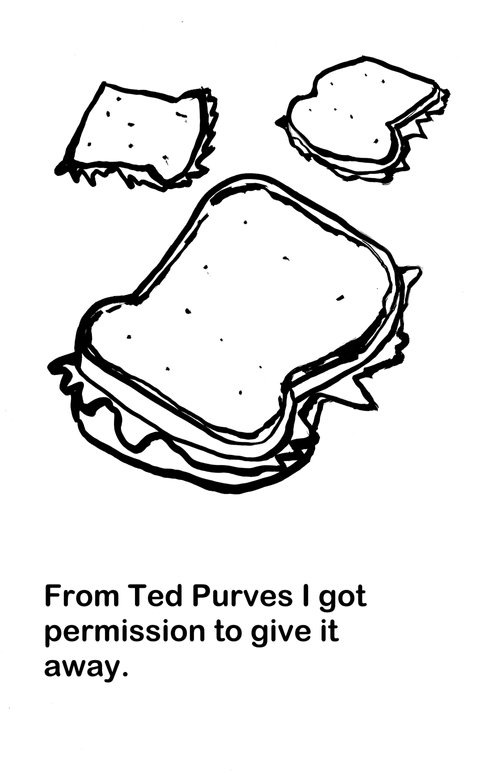
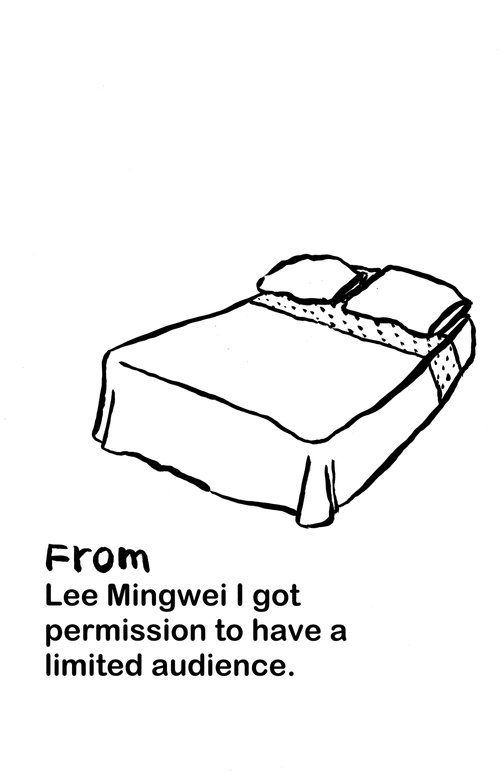
Conceptualist Permissions for Teacher Posture. Photo courtesy of Lucero.
I give some examples of a project that I did where I tried to examine as many of the posture permissions that I’ve gotten from artists over the last 30 years in my life. So I end the class by offering this project as a tool for how the students can go forward in the construction of their own education. And my hope is that it’s a kind of examining tool, a kind of microscope, that they could use to encounter all sorts of creative practice, not just art, design, or scholarship, but that they can use that tool to engage in the next 3 years of their undergraduate experience, and hopefully in all of their creative practices thereafter.
Clara: I’ve been thinking about that project a lot recently in my own life and practice, and I made a little list myself of all the different members of my MFA Program in this moment and the things that they’ve taught me.
Jorge: That’s great!
Clara: And my family, too. That practice was really meaningful to me because it almost felt like a kind of gratitude practice, grounding back into the idea that we all have something to teach, and we all have something to learn from each other. And even in moments of conflict or miscommunication that naturally arise in relationships, remembering that there’s no right way. There’s no expert here. We’re all kind of figuring it out together and what if we instead choose to see the material around us and each other as a kind of gift? It’s hard to phrase without sounding corny, but thinking of it as a practice that wonders how else we might see each other in this moment.
Jorge: I mean, it’s not. I know it sounds corny, but maybe the only reason it sounds corny is because it’s elementary in a certain way, you know? Like the way that I think about it is not very different from Show and Tell, a gift that I was given when I was very young, which was to have this opportunity to have the floor. And so here I am, 6 years old bringing in my treasured Star Wars action figures and I’m given the chance not only to show them, but to speak on them as if I have some expertise about them. Which of course I did, because I’m the one who plays with them, I’m the one who treasures them, I’m the one who knows where they come from, right? And I’m not saying that that wasn’t a shared sensibility with other kids in the room at that given moment, but the gift of being given the opportunity to hold the floor was like being told something that you like matters.
Maybe the learning objectives of participating in Show and Tell were to encourage me to come out of my shell or learn how to tell a story or something like that. But the hidden curriculum of that was being empowered to say the thing that I am drawn to is important. I think that the permissions project is just one step more sophisticated version of that same activity.
It’s connected a little bit to the word “like” and the way students who are new to an art critique setting are oftentimes told they need to give more sophisticated responses beyond expressing that they “like” something. And I understand why teachers do that because we think there’s a more robust way to talk about what we’re experiencing. But I also think we don’t give enough credit to the expression “I like.”
The etymology of the word “like,” which is also where we get our word alike, has to do with an echo, an echoed body or a mirrored body. And it basically means something that is similar to you, so when we say “I like this,” or even when we give a like on Instagram or Twitter, we’re kind of saying, here’s an echo of me. And that for me has become a really important thing to highlight in the way that I, as an artist, move through the world, but also in the way that my students move through the world because I don’t want them to discount that feeling that they have as if it’s not a smart feeling. I think it is a smart feeling. It’s an incredibly intellectual response to phenomenon in the world, right? I like this song. I like the green in this painting. I like the risk that you took here. I like you. This kind of thing where we express similitude to something else, I think, is an underrated, but very potent way to be in the world.
Clara: Well, I like that. I like that a lot, in fact.
Jorge Lucero (he/him) is an artist from Chicago who currently serves as Professor of Art Education in the School of Art & Design and also as Associate Dean for Research in the College of Fine and Applied Arts at the University of Illinois, Urbana-Champaign.
As part of his decades-long work to test the creative and conceptual pliability of “school as material” Lucero participates in and around the academy in every manner possible. He has exhibited, performed, published, administered, and taught through his work all over the U.S. and abroad. Lucero is an alum of Penn State University and the School of the Art Institute of Chicago. Prior to working in higher education, he served as a high school art teacher at the Chicago Public School Northside College Prep.
Clara Harlow (she/her) is an interdisciplinary artist and educator interested in the question of how we can make today different than yesterday. Her work operates as an invitation into themes of celebration, exchange, and alternative ways of measuring time and value. Through parties, workshops, and interactive objects, Clara is invested in how we can turn the dilemmas of the everyday into an opportunity for experimental problem solving and collective delight. Her practice aims to create responsive public containers for unexpected joy and connection, but if she can just get you to forget about your To Do list for a little while, that’s pretty good too.
What if We Became Artists?; The Audacity To Try It
Domenic Toliver in Conversation with Xavier Pierce
“I see a little me in my students, and I want the kids to see they can be all of these things. You can be an athlete, an artist, a lover of music, a scholar, all of these things together. You don’t have to pick just one. That drives my creativity now.” – Xavier Pierce
What if the question wasn’t “Who do I want to be when I grow up?” but “How many things can I become?” I sat down with Xavier Pierce, a first-grade teacher at Dr. Martin Luther King Jr. Elementary and the Spring Artist in Residence at the King School Museum of Contemporary Art. In him, I saw a version of myself, a Black male teacher, an artist, a quiet disruptor of expectations. We discussed growing up, the scarcity of role models beyond sports, and what it means to create space for kids to see themselves differently. What unfolded wasn’t just an interview, but a reflection on what it means to become, again and again. Through our similarities and differences, we realized that questions aren’t always meant to be answered. Sometimes, they’re just invitations to grow.
Domenic Toliver: Lately, I’ve really been thinking about art as life, and art as a way of being. For me to view life that way, it really gets me to be excited for each day, because it’s what you make it. We have these opportunities to learn, grow, and change. And I feel like listening to you talk at KSMoCA, you might be able to connect to that?
Xavier Pierce: You know, I’ve always been excited to get up and go teach, but now I got this project to do with y’all and now I see the excitement in the students, and they wanna make sure the academics are taken care of so that we can get to the art. And it’s just fun to watch the kids be really excited about something. And, I’m really excited. The whole community is excited about this thing.
Dom: Yeah I can definitely sense the excitement. I think part of it comes from not many people knowing you as an artist.
Xavier: I don’t know if you were in the room when Laura asked me if I tell my students that I’m an artist, but I really don’t ever tell anybody that I’m an artist because I feel like art is just kind of ingrained in being human. Because humans have been doing art forever and ever. It’s natural. I’m always wanting to be creative in life. Do something new with my day, learn something new with my day, wake up and figure out how am I gonna experience this day to the fullest. Sometimes it’s through putting some paint onto a canvas. Sometimes it’s making a good meal with my loved ones. And I feel those are the same thing.
Dom: Yeah, they are the same. Do you feel like this project at KSMoCA brought some of that out of you?
Xavier: I do. Now I have this new resurgence of creative energy. And it’s because KSMoCA invited me to do this, but it’s also helping me understand now that this source of creativity is nostalgia, and this source of creativity comes from being a role model at school. I see a little me in my students, and I want the kids to see they can be all of these things. You can be an athlete, an artist, a lover of music, a scholar, all of these things together. You don’t have to pick just one. That drives my creativity now.
Dom: No, you don’t have to pick one. The kids definitely need to know that.
Being at King School helps reinforce this process of focused creation. The object really doesn’t matter there as much as the process. It makes me think of how you mentioned how naturally humans want to create. Like in cave drawings, it wasn’t about the drawing on the rock, it was the process, the hunt, and how to express that to others.
Xavier: Yeah and they were using berries, charcoal from the fire of the night before, or whatever they could find. That’s something I always think about when I’m painting. Maybe I’ll run out of colors. So I think of how I can find a substitute or how to morph this idea so that it still has the essence of what I’m trying to say. LIke how we used cardboard as a paint brush for this last workshop. That’s what I feel art is all about, the process, adapting, learning, way more than the product itself. Even when I don’t like the product I appreciate the process. That raw art is real dope to me.
Dom: Yeah. I think it’s really about being more present. I feel that with photography. Especially when traveling. I’d have my camera and sometimes I would forget to take a photo. And that’s what I fell in love with. Being a photographer that takes no photos. Building relationships and listening to people. I’m currently doing a workshop with older adults and I feel like the conversations, the honesty and vulnerability is what it’s really about.
Xavier: Exactly. Man, and that is such an important thing too. Intergenerational communication. I grew up with two sets of grandparents and a set of great, great grandparents. My dad’s great grandparents raised him. And so they’re my great-great grandparents. And they were alive. They died when they were 99 and like 89. So I got a chance to kick it with my grandparents so much. I think that really taught me how to listen. It taught me how to have a good conversation and how to just take people where they’re at.
Dom: I was close to my grandma. Most of the conversations I remember or moments as a kid that have really sat with me or, you know, had some type of impact. They all come back to something she did or said to me or told someone else.
Xavier: I really think kids listen to their grandparents more, they watch them. I mean they’re so cool, they have so much wisdom, and they’re chill. There’s something about that communication, right?
Dom: I think it has something to do with the two both not being listened to.
Xavier: Yeah, no, that might be it. Both aren’t being listened to. So that communication with each other is, I don’t know, like one has a lot of patience. Because your parents want the best for you, but they also see you as that extension of them so they don’t exactly listen. They tell. Whereas grandparents are usually more patient. Makes me think of my parents. I grew up playing football and running track and I knew that I didn’t want to go to school for it. I was always pretty grounded in my academics. I wanted to go to college and focus on school. My dad ran track for Oregon and he was a track coach most of my life. While he never actually told me the plan was for me to run or be an athlete I felt it. So when I chose to go another route the energy was kind of, “so… what ARE you going to do?”. My sister ended up throwing at Hawaii U and Biola down in Orange County so they (my parents) still had a star athlete.
Dom: Man same. My dad was my coach my whole life, I ended up playing at Idaho State, going the avenue paved for me. About halfway through college though I lost the passion for it. I had other things I wanted to try.
Xavier: Yeah exactly, and so they say, “so what are you gonna do?”
Dom: Man, yup!
Xavier: And so I had to really figure that out, what am I gonna do? Because our guidelines for us were to go to school, get a scholarship so you can go to college and then you figure it out from there.
So I went to North Carolina AT right after high school. Greensboro, North Carolina for a semester. I didn’t really like it ’cause the town was just too small. It was fun though, HBCU, real cool. But I had walked that small town a few times in that short span. I decided I was just going to go home. So I went to PCC, got my pre-reqs. I still didn’t know what I wanted to do. So I started going to art shows just with the homies. That was real tight. The community was tight. Everybody’s having fun, everybody’s doing something. I started thinking to myself, “man, I’m not doing anything but just coming and drinking a little wine and, you know, head banging at a house show from time to time. But what am I contributing to this? I was living with my homie from high school at the time, and he was like, “man, what if we became artists.” I was like, “What are you talking about? How are we just gonna become artists?”
Lo and behold, I was sitting around one day, I was playing Super Mario Sunshine on the Game Cube, on this big TV that I dragged into the house. I was tired of it. So I went over to Scrap, and just started looking for things that I could maybe make something with. That’s really how I started painting. Was just out of boredom and I like trying to figure out how I could be a contributor to the communities that I operate in.
Dom: Dang. That’s crazy, just a big what if question led you down a new path. What if I became an artist, what if I use something other than a paintbrush? That’s dope. I had a real similar experience with my roommate, he wanted to act. At the time, we were all like okay man, go act then. But over time, that childlike mindset got contagious, I was asking myself what if I wrote scripts, what if I acted too. We fed off that energy, that childlike imagination. It led us down this creative path, trying new things and really just pretending to be what we wanted to be. Soon enough you start to be it.
Xavier: I figured out like you really can’t take yourself that seriously, man. If you take yourself too seriously, you’re missing out. You have to stay open to change, growth, and trying new things.
Dom: I agree. I think you have to be curious and vulnerable so you’re not stuck in doing one thing your whole life.
Xavier: Do you think traveling influenced you to be more open-minded?
Dom: Yeah most definitely. I think traveling introduced me to that openness. Seeing all types of perspectives, different lifestyles, honestly different ways of coping with life. It definitely changed me.
Xavier: Travel puts you in situations that influence you for sure. This one time Hannah and I, we were on a road trip down to California and we ended up having to get gas in Trump territory. This dude, I’m just sitting there chopping it up with him.
He got his little Make America great again hat on and we’re just sitting there having a conversation and as a black dude I have to play a cool, you know, or I’m gonna mess around and get shot. I have to play it cool, gotta be the mediator.
I’m laughing with him and talking with him. We get on the subject of teaching and he says “You some kind of communist?” I’m like we just started talking about teaching bro. Like how did you get that? But after talking to him again, I still don’t agree with everything he was saying, but through talking to him, I was like this dude is just another dude. That just made me realize that I do need to talk with the opposition more often. Especially right now, everybody is so divided, so polarized and like the only way to get over that is not to move to one side of the spectrum more. It’s honestly to move closer to the middle.
And it’s not that my beliefs have to change, it’s just that I need to be more comfortable talking to those people who make me uncomfortable. And also in that process, making them more comfortable talking to people who they might not agree with. Through that you can start to kind of heal. cause man, it’s getting weird. It’s getting really sticky right now. I feel like people need those conversations with outsiders to start to change their minds a little bit.
Yeah. And I’m not, I’m not saying like I’m gonna go out to every single place. I, you know, I walk in and I’m gonna change somebody’s mind, but at least I can have a conversation with them and I can better understand. If they listen to me, they can better understand my stance. Maybe over time, like we were saying before, like they might not change their mind right then and there. They might sit on it for a little bit and then later on when they’re met with the same question or. Met with somebody who has the same conversation. They can bring that different idea and then through that, just like those little, those little trickle effects, you know?
Dom: That’s true. While travelling I’ve met so many people with conflicting ideas and beliefs but I think just being honest, you’ll find those common things that’ll make you both reconsider why you differ with each other in the first place.
So where do you go from here, what are some ambitions you have?
Xavier: I think I really wanna try being a professor. But not in a traditional sense. So I think it’ll take a lot of building blocks to get there, I feel like it’s gonna be a long process. ’cause there’s not necessarily a department or a class for what I’m thinking. I gotta kind of wiggle my way into an institution and then you know make that class. I’ve always had this idea of taking a class where it’s more focused on questions. A conversation class, but focused on asking questions. Cause I like questions more than I like answers. It gets people’s minds moving. You just learn so much about another person through asking questions. I guess I’m just overall more of a listener.
Dom: Lisa Jarret always says, “Live in the question.” Right now that’s my favorite quote. Crazy part is I could totally be wrong but I guess the way I interpret that is like living in the response really. Not the answer to the question, but the response to the question. So like if your question is “what does it mean to be a, a black man in America?” What does that really mean? There’s no answer. Because everyone’s experience is different, you know. But there’s a response to that question that we live in and it changes overtime too though.
Xavier: If I think about how many times I’ve been asked that question and how many different responses I’ve given based on the time in my life, or the person who I’m talking to. I’ve been thinking about representation in art, in making these new pieces, I was like, okay, it’s gonna be in King. Kids are gonna be walking past this every day. They do need to see themselves in the work. Reflected in some way. So I just tried my hand at it and I got out my anatomy books and tried to figure out how I’m going to do this, so that they are reflected in some way. They’d see full lips, a wide nose, an afro. Then I got some gold leaf. I put gold in his mouth instead of teeth. It came out pretty good. It took a lot for me to bring that out. One of the hardest things, it’s just not in me to do portraits and portray us like that. It became a study of the body as well.
Dom: I get that. I think I struggled with that too. When I was in France, I used to send my pops a few photos I would take. One time he was like, man, there ain’t no black people out there.
He made me really look at all my photos. There were black people everywhere, all around where I was staying. But in the photos, no black people. It made me think for sure, maybe there’s some resistance in not wanting to mess up. I got to get the lighting right, I can’t portray us the wrong way. There’s a lot to think about. And then also, to me, there’s also a fear of doing it wrong. And misrepresenting your own culture, you know what I mean? Who am I to be representing all of one people?
Xavier: That was a huge fear with this portrait that I did. Because I knew I wanted full lips.
I wanted a wide nose, but I don’t want this to be a caricature. I have to do this right. I’ll probably still keep tweaking it until I have to give y’all, cause it needs to be right.
Dom: I feel that. And I think that’s always going to be evolving. You’ll always ask yourself if you’re doing it right. You might try to do something new every time. For me there’s a lack of knowledge there too, as far as in film and photography. They don’t really teach how to light for darker shades of skin so you have to learn by just doing it, by trying. Then I think once you mess up a few times or you feel you might have misrepresented, that might lead to a version of avoidance too. I know a lot of filmmakers and painters that are black that resist black topics or subjects, and I think it’s because you don’t want to be wrong. Or you don’t want to be put into a box.
Xavier: Yeah, I’ve always tried to figure out like, why, why do I resist it so much? Yeah. And it is, it’s because I don’t wanna misrepresent it.
Dom: Yeah. And maybe there’s a privilege to it. Like, dang, I have the privilege to be speaking for all my people. I don’t want it. That’s too much responsibility, so you resist it. And I think once you stop resisting it, the intentions in our art might be clearer. But within that, we also get put in a creative box, being categorized as a black artist who only makes black art, rather than an artist making work, who is black.
Xavier: We have to have the audacity to do something different. That’s kind of what I’m trying to show. I am a black man making art. Making abstract art. I do also want to start representing more of my culture though. So breaking that wall with this painting I’m working on. I’m excited honestly to see how the kids receive it and how my community receives it because that feedback will also inform how I continue. Art is a conversation like that.
Dom: I think it’s gonna be important for them. Like in terms of how the art is presented. It’s been up to an amazing level. Last term, Napoleon’s work was up and he had the blind boys of Alabama. You got these three dudes with glasses, singing, with the gold behind them,
That hit me, because it was the culture. Represented for the culture, in collaboration with the culture. Man, so I think your work is gonna speak on that level. Displayed in a professional way for the culture. I’ve noticed a lot of the little black boys at that school and they don’t look at the walls as much. Especially at that age, I feel like they’re learning a lot about their masculinity and masculinity is different for us. Being a painter or a dancer isn’t a common option. That’s a different level of masculinity. But having that representation and knowing the possibilities, knowing they can go hoop but they can pick up a paint brush too. That’s different.
Xavier: Exactly. That gets me so excited to read the commentary from the kids. Once they start looking at their own work on the wall. How they see mine. That’s gonna be crazy, that’s what I’m most looking forward to!
Xavier Pierce is a multidisciplinary artist whose work explores memory, emotion, and the act of being present. Raised in Northeast Portland just off Alberta Street, he received both his undergraduate degree in Liberal Studies and a master’s in Education from Portland State University.
Pierce draws inspiration from his lived experience, using art as a metacognitive tool to navigate the emotional currents of life. What began as a personal process to make sense of change and growth has become a lifelong practice rooted in the belief that creativity is essential to the human experience.
As a teacher at Martin Luther King Jr. Elementary and now visiting artist at the King School Museum of Contemporary Art, Pierce continues to develop a body of work that invites reflection, groundedness, and emotional clarity.
Domenic Toliver is a storyteller. Working across film, photography, performance, and socially engaged art, he explores how personal and collective narratives shape memory, identity, and community. Whether through photography or collaborative projects, Domenic invites others into the storytelling process, creating space for layered voices and shared meaning. Currently pursuing an MFA in Art and Social Practice, he sees storytelling as both an artistic method and a tool for imagining new ways of being together.

Letter from the Editor
Imagination, dreaming, creating new worlds–what’s possible when we are open to new ways of being? What happens when we make the thing that doesn’t exist, because we think the world would be better with that thing in it?
Many of our interviews this term talk about the worlds we’d rather be in. Worlds of care, respect, curiosity, and spas. Worlds that allow us to heal. Worlds that honor our pasts and our family traditions and worlds that can teach us new things. In a time when so many structures of our own world continue to break apart and harm, we turn to artists, chefs, community archivists, friends, soccer team founders, and our fellow classmates. These people have made their own visions of the world possible, in small ways and large, and we all get to benefit.
As we discover how to cultivate our own imaginings for better worlds through our practices, we find guidance through these honest conversations with each other. We hope that by inviting you to step into some of the different worlds we explore in this issue, that you might also discover new and more expansive ways of being in your own.
Your editors,
Nina Vichayapai, Lou Blumberg, Clara Harlow
Copy editing by Adela Cardona Puerta, Gwen Hoeffgen, Sarah Luu, and Dom Toliver
Cover by Sarah Luu
Copyleft: Art That Belongs to the People
“I used to put people like that on a pedestal, thinking they were doing these amazing things, but then I realized that I can do this too, anyone can do it. It’s accessible, and we can all create in ways that work for us.”
Ali Cat
Ali Cat is a printmaker and artist based in Portland, Oregon, whose work beautifully blends art and activism. A cultural worker and anarchist, Ali seeks to transform the tradition of printmaking, using it not only as an art form but also as a way of sharing ideas and making those ideas accessible to a wider audience. Their practice embraces the power of reproducibility—whether through risograph prints, clothing, tapestries, buttons, or banners—allowing the work to spread, resonate, and have a tangible impact. I’ve often seen Ali’s illustrations, particularly in the form of woodcut prints and buttons, being sold at various fundraisers for Gaza aid in the city since last year. What sets Ali apart is their commitment to making art that is freely available: on their website, you’ll find a collection of downloadable graphics that anyone can use, remix, and repurpose for their own creative projects. In this conversation, we dive into Ali’s approach to art and explore how it challenges traditional notions of ownership, value, and accessibility in the art world. We’ll also consider the question: Where do we want our art to exist in the world today?
Simeen Anjum: Ali, it seems like much of your work is deeply connected to the community, especially with pieces that can be used in protests and are sold in local businesses. Can you talk more about how your work exists and interacts with the city and the world around you?
Ali Cat: I come from a punk rock background, so I was always around political prints and that kind of art growing up. When I started learning printmaking, I was creating “copyleft” and anti-copyright pieces. It made me realize I could create art for the commons—pieces that others could access and print for themselves.
It’s been a balancing act of figuring out how to support myself in a capitalist system, while also giving away work and creating pieces that are free and accessible. It’s a reciprocal process—people support your work, and in turn, you’re trying to support them.
Simeen: What is “copyleft”? I am curious how that works.
Ali: “Copyleft” is a concept where I choose not to copyright my work. Instead, it’s shared under an open license, with some limitations. Essentially, no one can sell my work for profit—so, for instance, a company like Disney couldn’t take one of my pieces and use it commercially. However, people are free to use, share, and reproduce my work for non-commercial purposes. They can print it in a free zine, use it for a flyer, or incorporate it into a community project. The goal is to make the work part of the commons—accessible to everyone and used for the collective good, without the restrictions of traditional copyright.
Simeen: That’s really interesting—being thoughtful about how we want our work to exist in the world and be more “for” the people. How does an artist go about implementing something like “copyleft” in their practice, and what has that process looked like for you?
Ali: There are websites where you can specify what you’re allowing with your work. For example, some people might allow reproduction and sharing, but not printing. Others might restrict commercial use but leave everything else open. I actually learned about this concept and got inspired by zines and punk rock culture, where “copyleft” was already being practiced in literature and ephemera. In the art world, Justseeds is a good example of this. I’m not sure if you’re familiar with them.
They were really inspiring to me when I was in art school. I even interviewed one of their members, Roger Peets, who I admired for how they worked in the art world. We later both worked at a nonprofit print studio together, and I realized, “Oh, you’re just a person.” I used to put people like that on a pedestal, thinking they were doing these amazing things, but then I realized that I can do this too, anyone can do it. It’s accessible, and we can all create in ways that work for us.
Simeen: What are your thoughts on this idea of putting artists on pedestals? There’s often this mystification of artists, where they’re seen as distant or somehow better than others. How did you decide to approach things differently?
Ali: I’m an anarchist so I’m against hierarchies. Then I went to this fancy art school, and I quickly realized it was built to make people put each other on pedestals and feel like some were more important than others.
I remember during the tours for new students, I was asked what I thought about going to art school, and I said, “I don’t think anyone needs to go to art school to be an artist.” And That’s not the answer they wanted to hear.
I had to reconcile what I was learning in art school with my own beliefs and figure out what worked for me. It’s not that you can’t go to art school or get a degree and still be a radical artist—those aren’t mutually exclusive. But it’s something you have to unlearn or call out, and then do what feels right for you.
The idea of putting people on pedestals just feels strange to me, and I try not to do it myself. I definitely get caught up in thinking, “Wow, that person seems so cool,” but then I meet them and realize they’re just a person like anyone else. Everyone’s just a regular person, and I don’t want to be around people who think they’re better than others. We all just want to support each other, share, and build community together.
Simeen: Totally. It made me think about how, in art schools, we’re often taught to market ourselves in a certain way, which ties into this hierarchy. Do you think language plays a role in that? I mean, the way we’re taught to speak about or write about our work—using certain kinds of language, sometimes complex or even pretentious jargon—does that contribute to reinforcing this hierarchy? At times, it can even make art seem impossible to understand for people outside those circles.
Ali: Language definitely plays a role, whether it’s the work being presented in English, where it’s coming from, or who’s given opportunities. We’ve been working to make spaces like white-walled galleries more accessible, not just for rich white men, as they’ve historically been. But the bigger question is: why does art even need to exist in those kinds of spaces? Sure, you can diversify it and market people as “tokens” of representation, but the real question is, who’s actually attending these spaces? Regular people don’t typically go to white-walled galleries.
Similarly, the language used in these spaces often isn’t something people can relate to or understand. That’s something I try to focus on in my work—using both imagery and text to make things clear. I don’t want it to be some vague idea where people think they understand what’s being said. For example, when I say we’re against occupation, I don’t want it to be misunderstood as just some abstract peace concept. The imagery can carry meaning, but the words also carry weight, and I try to use both together to make the message as clear as possible.
Simeen: Definitely. And thinking about what you said about galleries—they shouldn’t be the only place where art exists. What are your dreams for where you’d want your work to live, outside of typical art institutions? If it could be anywhere, what would that look like?
Ali: I’d love for my work to be in the streets, in community spaces—places where people gather, like zine libraries or third spaces, libraries or political organizations.
For example, I’m part of a stitching circle called SWANA Stitch, and we recently had a show. But it wasn’t a typical gallery show—it was in a community space. Everyone who participated in the show was actively involved in making it happen. It felt different from a gallery show, where there’s a curator and a sense of hierarchy, with the curator being the “professional” and the artists being the ones handing over their work. In our space, we gathered in a circle and asked, “What do we all think about how we display this work?” The space felt alive—there were teachings and workshops happening alongside the art.
There was art on the wall, sure, but the focus wasn’t on “fine art” or selling things. It wasn’t about wine and cheese and discussing how much something costs. It felt more like a living, breathing space where everyone was engaging with the work, not just standing behind a rope, admiring from a distance like you would in a museum. That separation, that gap between the viewer and the work—it’s something I don’t want for my art.
I know there are installations where you get to interact with the art, but even then, you’re still in a gallery, and there’s a certain behavior you’re expected to adhere to. It just doesn’t feel as alive or connected. And I don’t want my work in that kind of space.
Simeen: You’re clearly intentional about making your art more accessible, ensuring it’s easily available to those who may want or benefit from it. How do you view your work in terms of reproducibility?
Ali: I think there’s a bit of a distinction to be made. We’re living in a time where mass production is so prevalent. For example, there are websites where you can get things printed, and it raises the question—are they printed or reproduced? There’s something special about a handmade piece, even when it’s reproduced. It’s the difference between someone carefully reproducing their work, like in screen printing, versus just sending it off to a factory on the other side of the world, where it’s mass-produced and shipped back to you. While both kinds of work often end up in similar places, there’s a special quality to the process of printing it yourself. It’s just not the same as factory printing.
In printmaking, there’s this idea of assigning market value to rarity. You’ve probably seen editions, where prints are numbered to create the perception of scarcity. I’ve always pushed back against that, especially in college, because I see it as a relatively new European tradition. For example, if there are only 20 prints, they must be valuable because they’re rare, while prints with larger runs are seen as less important or cheaper. But to me, that’s a false value based on the concept of scarcity. I don’t edition my work because of that. If I run out of a print, I simply make more.
Simeen: I’m really glad we’re living in a time where art isn’t just this rare, untouchable object, but something for everyone to experience and engage with. I love that as artists, we’re starting to think differently about the role of art and how we share it.
Ali: Yeah, and with that, we also need to create our own systems. We have to be able to support artists who are supporting our communities and movements, not just by paying them. For example, when things get tough, and artists are still passionate about creating accessible art—even if that sometimes means working for free—we have to ensure they have a community safety net. They shouldn’t have to worry about being kicked out of their apartment or not being able to buy food. We need to build those kinds of support systems within our communities.
Everyone is right on the edge so often. I think it’s especially hard for artists to justify their work, to prove that it’s important and that it sustains us in different ways.
Simeen: Definitely. As an artist, you have to think about how your work sparks action and educates people. You have to be intentional about how it supports the people it is made for. For example, if you create work about Palestine, you have to think about how it is being put to use: Is it being distributed for free? Is it fundraising for material aid? Am I monetizing it, or gaining opportunities based on the movement? We have to actively think about how we are building and contributing to these systems of people and supporting the people. It’s much harder to find your place and create work that genuinely supports the community, especially when it’s tied to important causes.
Ali: It’s about being part of a community and building relationships. Often, artists can get caught up in just responding to a situation or focusing solely on the aesthetic. In my opinion, you shouldn’t create work about something you’re disconnected from without taking the time to truly understand it. For example, in our community, there’s been a lot of use of the watermelon as a symbol. But the watermelon became significant because Palestinians couldn’t fly their flag, so they used it as a substitute. We can fly a flag, so why is the flag not more commonly used in our art?
People might say, “It’s cute,” but that’s not a strong enough reason. The watermelon isn’t just a random symbol of Palestine—it has deep cultural significance, like the oranges or other foods that are tied to Palestinian heritage. The watermelon was a response to a specific circumstance. So, it’s about educating ourselves and each other, building relationships, and understanding that this process takes time. It’s not easy, but it’s necessary.
Simeen is an artist and curator based in Portland, Oregon. She is currently interested in exploring the possibilities of education and learning within art spaces. As a curator, she works with local artists to create shows that are engaging, inclusive, and provide space for people to connect with artists about their larger practices, thoughts, and processes, rather than just viewing art as objects. As an artist, she imagines alternative modes of existence and belonging in public spaces, which often take the form of singing groups, building a nap room in a mall, hosting a sky-watching party, among many other things.
Ali Cat is a printmaker, cultural worker, and steward of collective memory living in Portland, Oregon. Ali received her BFA from Pacific Northwest College of Art and has extensive experience working in various print studios. They produce their work under the name Entangled Roots Press. Their creations take the form of risograph prints, clothing, tapestries, buttons, zines, and prints on paper and fabric. Ali currently teaches and volunteers at the Independent Publishing Resource Center and also volunteers at the SWANA Rose Culture + Community Center.
Girls Just Want to Have Cool Cars and Learn About Them
“With women in automotive, so many people just can’t accept it. I feel like automotive largely goes out of its way to exclude women. I’ve had men tell me to go make them a sandwich. And to be quiet because the men are talking. They said these things while I was being top paid. So I found the door.”
Rose Brooks

Emily and Rose, 2023, Portland, Oregon, photography by James Rexroad, courtesy of Emily.
After recent car troubles sent me to an auto shop for the first time in my life, I’ve been on a search for care and comfort in automotive spaces. Growing up with a mechanic for a dad meant that I was fortunate enough to be able to turn to him every time car issues arose. But this time he was out of the country.
I took my car into a nearby garage and experienced confusing communication about the repairs I needed. It wasn’t until I pushed back by letting the shop know that my mechanic father would soon be able to take a look at the car that they relented. The cost of the repairs dropped to a fraction of the original quote.
Automotive spaces have always represented care and comfort to me because of my dad. Yet my first experience of this world without him as an interlocutor made me aware of what many other women experience: that knowledge about cars and how to fix them is largely gatekept by men.
This led me on a search to connect with and document people creating spaces of belonging in the automotive world for women. In Portland, Emily Olivia Tyler has been doing exactly that. Since 2011, Emily has run a femme-forward automotive interest group called Car Krush. Over the years, Car Krush has centered women in their many community offerings like car shows, classes, movie nights, podcasts, and more. From the start, Car Krush has been a team effort assisted by eager collaborators like Rose Brooks. A “master of everything,” Rose is a producer for the Car Krush podcast, a professional car mechanic who teaches classes for Car Krush, and a knowledgeable van enthusiast.
As I continue to explore within my practice the power that comes with centering communities at the peripheries, I asked if Emily and Rose would chat with me to share more about their experiences having collaborated on creating an inclusive world of girls and cars.
Nina Vichayapai: Emily, could you talk about how Car Krush started?
Emily Olivia Tyler: It started when I blew up the engine on my ‘89 Trans Am back in 2011. I was heartbroken. I didn’t know how to fix my car. And all of my girlfriends at the time were buying plastic cars. A lot of us didn’t really know how to fix our cars or really even know how they work.
At the time I couldn’t find classes to take to learn how to fix my car. I called around to community colleges and all of them were either ASC certified (which means that you were going to be a mechanic and working with new cars or fixing their cars) or there were “how to buy a used car” classes. I’m not ASC and I have already bought plenty of cars, so those weren’t going to work for me.
I had to figure a lot of things out myself. That basically was the catalyst of what Car Krush came from. There’s been a few different iterations since then.
I wanted Car Krush to have a slumber-party-with-wrenches vibe. Just something fun that isn’t too serious, but definitely heavy on information. At the same time I wanted to do events and car shows because I wasn’t really seeing what I wanted represented at car shows. There’s really great shows around here but I wanted a show with a more pop and street style aesthetic. And not just old dudes. I wanted there to be a lot of fashion involved. My girlfriends are just very sharp dressers.
Nina: And you also run a fantastic podcast, was that part of your plan for Car Krush from the start?
Emily: The podcast started because we wanted to talk to women about not seeing yourself represented in automotive media. We were around all these women that were buying cars and doing stuff with their cars so we started with interviewing our friends that were car enthusiasts.
Nina: I love the podcast. You have a great interview style that’s so personable. And you’ve interviewed all sorts of interesting people, including Rose here, too.
Rose: I started off as a guest, and then Emily and I started talking pretty constantly. I now have a role as a producer for the podcast. We’re also launching our own podcast soon. I’m a new character to the Car Krush scene though.
Emily: The first time that Rose and I had our interview, Lauren and I were on the phone with her for three hours for it. And then Rose and I were on zoom for an additional two hours after that. As soon as I got off the phone, I was like, “Okay, you have to learn from Rose. That’s where you have to go.” Seeking out the people you want to learn from and work with was a big lesson. After that I just wouldn’t leave her alone.
I feel really fortunate to have met Rose. It was so serendipitous. Rose is a master of everything. She’s a publisher, fabricator, and mechanic. Rose was coming through town and we decided to teach an engine class. Procuring an engine came so easily. I just found one right away. And then just next thing you know we’re doing an engine class.
Nina: That’s amazing. There’s a real range in what you offer at Car Krush. And lots of different people that you talk to. What do you look for in inviting people onto the show?
Emily: When I started I really wanted to bring in fresh, green people, so the podcast didn’t have to be super serious, you know? One girl we interviewed bought a Camaro and she didn’t know anything about it except for she thought this car was cool. It was a really interesting interview. Then we ended up branching out some more. We’ve had professional mechanics, a stunt woman, a fabricator…We recently started bringing men onto the podcast too because we want our group to be accessible for everybody. We picked the name Car Krush because it specifically didn’t have “girl” or “woman” in the name. Our group is just very feminine leaning. We wanted men to be able to get involved with the group by buying something from us or supporting us in some way.
Nina: I think that’s great, to have men supporting femme-led spaces and not seeing it as something for women only. What is it like for you both to collaborate together?
Rose: I bounce ideas off Emily and talk about things that I’ve done in the past. I’ve worked in publishing and started a magazine about vans, and worked on television shows before. Through those I learned to just keep pushing through. Emily recently took a break from the podcast and I finally had to go, ”I think you’re done. Time’s up.” Beginning of the year, you need a new episode. So she got back to it.
Emily: Yeah, it was a very worthy episode and a good interview. I just couldn’t bring myself to publish or edit it. There was burnout.
Rose: It’s easy to be burned out on stuff when it feels like nobody cares. But with a lot of creative tasks, that’s the question. When will somebody see it? Is it enough to just do it and do it and do it? Success is such a crapshoot.
So that’s my chief motivation. To be a sounding board for Emily when enough has been done in an episode and it’s ready. I try to help keep things moving. With people coming and going in Car Krush, things are just easier when you’ve got a partner.
Emily: As for working with Rose… Rose is basically the dean of education for our classes.
Rose: I was coming through town last summer and we put together the engine class to help pay for the trip. It wasn’t exactly a venture that made a lot of money. Because we spent so much energy on putting together a quality day. But it was good. And we’ve continued to do it. I mean it’s a shame. It’s the kind of thing that I wish that we could do for free, but we wind up wrangling up a lot of resources.
I do that class, and then El from Stargazer Garager is going to do one–
Emily: “How to diagnose shitbox with an untrained professional.”
Nina: That’s a great official class title!
Emily: And we’re going to do a casting class too.
Nina: I think it’s cool that the classes you offer are pretty advanced. It’s nice to have those more technical sorts of offerings.
Rose: I think it bends people’s mind on what is actually useful. It does get pretty technical pretty fast. I’m sure some might get overwhelmed. But someone else sees it as a key. It’s empowering to know that much, especially about your own car or something you’re working on. It’s why a lot of people get into it.
Nina: Definitely! So Emily, you’ve had quite a few collaborators over the years, including Rose. Who else has been part of the team?
Emily: Kristen is a designer who did the logo and the website and was in the graphic design program at PSU. Lauren, who I also hosted the podcast with, came to us of her own volition. She had a LandCruiser and was into cars and tried to go to school to be a mechanic. The instructor pulled her into his office like before school started and said,”hey, I really encourage you to go to this other program because women don’t usually finish the programs here.”
And so then she was just like, “well, fuck you, I’m not going at all.” So then she worked in a few shops here and there. Her sister told her about what we were doing so Lauren came to one of our movie nights and she was like, “sign me up!” So she started working with us. And then my friend Mandy was also working with us. That was our crew at that time. Everybody kind of volunteered to get involved.
Nina: That’s so rare. A lot of people, when they start something, get possessive about organizing it. What do you think it is about your mindset that has allowed you to feel comfortable bringing people into Car Krush? It seems like you’re really able to recognize when people have something to offer and have been generous about bringing on collaborators.
Emily: Team work is dream work. I am a control freak. And I had to learn that you can’t do everything. You have to give up control. That’s what’s going to make it human. I had to learn those lessons. I have had some people not work out. But pretty much, if anybody wanted to get involved I would be like, sure, there’s room for you. Because we had such a big vision. There was always room and there was always stuff to do.
Nina: How would you describe the community of Car Krush? The people who are part of the larger community and come to the events?
Emily: I’d say it’s girls that want to have fun. They have cool cars and they want to learn about them. They’re really sweet and open with their knowledge of anything that they have access to. They’re all spectacular dressers and very cool. What do you think, Rose?
Rose: Well, we’ve also met some guys that aren’t assholes. Some guys register for our engine classes too. A few people have asked us “this isn’t specifically just for women, is it?” Because that’s what we were known for. Car Krush is very punk rock adjacent. In a way it sorts itself out. But I mean, it’s car enthusiasts, but it is people that don’t need it to be branded a certain way or delivered to them a certain way.
Nina: What’s the experience been like for you working in the auto industry?
Rose: With women in automotive, so many people just can’t accept it. I feel like automotive largely goes out of its way to exclude women. I’ve had men tell me to go make them a sandwich. And to be quiet because the men are talking. They said these things while I was being top paid. So I found the door.
I’d been in street rod shops up until that point and I was like, “I don’t think this is a good place for me anymore.” And that person went out of his way to prove it to me.
And so that’s what Car Krush is offering, a slice of automotive that isn’t like what the other 99% of it is like.
But I think in terms of doing the classes, it does give a lot of people proximity to what it’s like to just see and touch the cars. I think that we’ve had a lot of really positive experiences with the engine class in that way. We’re showing people that there’s actually a limited number of core ingredients to an engine.
Nina: It was really amazing watching Emily take the engine apart and do it so casually. It felt really special to be able to see how it all comes together since it’s not something a lot of people know much about.
So any plans to do events in the future?

Emily working on the Car Krush class engine, 2025, Portland, Oregon, photography by Nina.
Emily: I would love to do another block party or car show. They are so fun. It takes a lot of money to throw those events. But as soon as I can, I would love to do another one. But basically right now it’s just focusing on the classes and the podcast.
Nina: Nice. The podcast is a great resource. You put a ton of work into it.
Emily: It is a lot of work. That’s the thing, I’m coming to the point where I’m starting to get serious about working more and having a more professional job. So Car Krush has to go on the backburner a little bit. I’ve given so much and have gotten a lot back as far as personal satisfaction, but it’s not paying the bills. You got to live. You do have to pay bills.
Nina: Definitely. I’m curious what that’s like for you to organize something and also make room for it to shift or change over time?
Rose: You mean the freedom to change the project without backlash, because you’re at the top of the top of the creative process? Yeah. I think that it can be confusing because sometimes if you come up with a formula, you can become a slave to the formula. You’re like, “but this is what people expect.” And I think another thing is that you have things going on inside your life, but you also have things happening outside of you in the world. We don’t have a lot of control over that.
I started doing my magazine in 2011. And I haven’t published in a couple of years now. With a world like this I thought, who needs a magazine? What are the next four days going to look, or the next four years? It’s hard but I’m saving my energy for other things. I keep thinking I might just have to jump the van up here and throw all my energy into something else because my immediate personal safety is coming up as a concern. I just had a nasty phone call with a member of someone in my van club. I’ve known him since 2009. And he wanted to ask me all these questions about me being trans. It basically devolved into the point of him accusing me of being a rapist because I go to the bathroom.
Nina: That’s just awful.
Rose: Yeah, so it’s getting to this place where I feel like I’m wasting my energy with these people because some just don’t care to understand. And then there’s others who do support you but still haven’t considered that when they invite you somewhere, it might not even be safe for me to travel there.
I used to travel cross-country every summer for Van Nationals. And there’s places where I’m just like, no, I’m not going to go there. Even if the destination seems fine. There’s a lot of gas stations in between. Passing through Wyoming the last time I did was unnerving, even though the year before it was cool. I got stalked by cops in a small town while just getting gas.
Nina: That’s really tough. What about locally, what has your experience been like with the car scene in Portland? What’s it like organizing a group like Car Krush in this town?
Rose: I think that Portland is such a ripe place to have community and art based groups and adventures. I think if anybody wants to have a space in automotive, they should be doing a zine or a podcast or figuring out how to make their own version or pocket of it. We’ve been paired up with the shop that I’m in, which is called Q-Hut. There’s a motorcycle club in the shop and they teach motorcycle maintenance classes. They told us after the fact that they were actually inspired by our engine class and started doing their own. We feed off of each other and cross-promote a lot, so it’s cool to be in a community. I think Portland just sort of makes that easy. Portland is so DIY and community based that it’s fertile ground for people to make their own communities here.
Nina: Other than your classes at Car Krush do you have any resources that you would share with someone who’s interested in getting more into fixing their own car or just cars in general?
Emily: The classes at Clackamas Community College are awesome. Lauren and I took the fix-your-own-car classes there a couple summers ago. You can pick a project and then they’ll walk you through it. They also give you access to tools and a lift. And they teach you how an actual mechanic would do things and the language used. They also teach car restoration classes where you can paint stuff. Oregon State has similar classes.
Hawthorne Auto is great for car maintenance classes. And the Oregon Tool Library is a community place where you can rent all sorts of tools.
Rose: I feel like I’m one of the rare people that likes to learn from books. You have to learn the language of something, which books can really help with. A lot of times people want to talk to an expert to learn that, so they come to us. We usually try to send people away with a book of some type to help.
Nina: So what’s next for you both?
Emily: Our new podcast, The Pile Up, is coming out. It’s pretty funny.
Rose: It’s inspired by this podcast we really like from the UK called No Such Thing as a Fish. It’s five people who are researchers on the show. They present four new facts they found each week that are always interesting. We were like, let’s do something that’s like that but with cars. Emily has a huge catalog of documentation of women that are coming up or getting established in the automotive scene.
Emily: There’s parts where we laugh so hard that we can’t stop laughing for a minute. We’ll also have some different classes coming starting in the spring including the engine class, a metal class, and we’ll see what else. I’d love to do events again in the future.
Nina: Amazing. Well thank you both so much for taking the time to talk today. And if you ever need a volunteer let me know!

Emily and Rose, 2023, Portland, Oregon, photography by James Rexroad, courtesy of Emily.
Emily Olivia Tyler lives in Portland, OR. When she’s not doing Car Krush she can be found window shopping or dancing with her friends.
She can be reached at emily@carkrush.com
Rose Brooks is a metal fabricator and artist from Portland, OR. She occasionally publishes under the moniker Custom Vanner magazine. Her bubble windows for vans are like jewelry and she always appreciates a good hair day for what is.
She can be reached at customvanner@gmail.com
Nina Vichayapai makes art that explores what it means to be at the intersections of society’s margins and peripheries. Through her practice she invites you to be neighbors with her in occupying unlikely intersections and celebrate yours too.
Intentional Community or Conceptual Art Piece?
“social practice and relational work is about what it means to be human”
Carol Zou
Social practice is a term that I use almost everyday. It’s also one that my parents probably don’t completely understand (yet!). So talking with other people who work in deep relationship with others, whose work is about understanding and uncovering the ways we live together, is a refreshing change.
I was lucky enough to talk with Carol Zou, a self-described cultural practitioner living in Los Angeles, to talk about their work and understanding of social practice and how to move in crushing times. We spoke in October of 2024, before Trump and a temporary ceasefire in Gaza, but a lot of what we discussed still resonated deeply with me when I went back to it. Even now, we need time for imagined worlds and—more importantly—spas.
Carol Zou: Thanks for reaching out. The PSU program has always been kind of a sister program to where I did my MFA. It’s nice to see that it’s still going.
Lou Blumberg: Yeah thanks for agreeing to be interviewed! Something I remember from your “Crafting the Social” article, which is how I found out about your work –
Carol: That’s so weird and silly. I literally don’t anticipate anyone reading my master’s thesis.
Lou: I won’t hold you to it because I know grad school can feel like another world! But I think you said something about how social practice is the term that describes what so many people, often people who hold oppressed identities, have been doing already to support each other and create communities of care. I wonder if you still feel that way or how you might elaborate on that.
Carol: I think this does relate to my thoughts on the institutionalization of social practice, and I feel like all radical practices, like abolition, right? Creative or not, I think there is this tension between what is legible and what is not legible. I think social practice is really just a term that makes that legible.
And I feel like, in some ways, there’s a need to create that legibility–I support social practice programs. I support field building. I support meeting other social practitioners. I think there’s value in legibility, but you just have to acknowledge that tension of legibility.
Lou: I was excited to hear you talk more about one of your current projects around spas with Queer Spa Network. I think a lot of your projects have an ethic of care in them, which is something I think a lot about in my own practice. I would love to hear you talk more about how that project is going, how it started, and how you’re thinking about it.
Carol: The spa project started because I was recovering from PTSD. That shit is real. I was working with refugees and an unhoused refugee died in one of our art spaces, which was really intense. The week after I just laid in a warm bath and ate weed gummies. The somatic is very present when we’re thinking about trauma. That’s where my interest started, but of course, spas are also a space of pleasure, pleasure activism, and all that.
I think it was nice that I could find a space to heal, but also share pleasure with others. It first began by collaborating with Carrie Marie Schneider on our love of spas, and now it’s morphed into Queer Spa Network, which has about six core group members thinking through topics centered around care, disability, and potential values-aligned public projects.
What I really appreciate is that we have astrong disability justice ethic within our group and everyone holds that, not just me. I really feel it in the way that we move—we move very slowly. We meet once a month. We’re not perfect. We’re not trying to operate at the pace of capitalism. Sometimes we just do internal culture-building stuff like pooling funds to rent out a swimming pool and sitting in a hot tub together.
I feel like this undoes some of my personal urgencies around art making. Because I feel like, in the art world, I’m like, “I have a CV. I gotta produce X amount of stuff per year. If I’m in a collective I’m still producing. What’s the artwork? What’s the output? What’s the blah, blah, blah.” The ethos of this group allows us to just slow down and internally build with each other. It feels like intentional community as much as it does a conceptual art piece.
Lou: I really appreciate that notion of slowing down and moving at the speed that makes the most sense for everyone in the collective. I see that in and of itself as a social practice: the way that you work together besides just the thing that you’re creating.
Carol: It’s felt like a good organism. Being within Queer Spa Network feels the way my body does when I’m in a spa, like I’m just slowly moving and relaxed. Because there’s this contradiction, right? I feel it too, as a social practice artist, I have a huge output, actually. And I’m very used to, like, output, output, output. So this has been a learning for me in terms of a different way of working that is a lot more aligned with values of care and healing.
Lou: That relates to another thing I wanted to ask you about. You describe yourself in your CV as a reproductive laborer. I’d love to hear you talk more about that and what reproduction means to you and what labor in that sense means.
Carol: I am very influenced by the work of Merle Lederman Ukeles, as well as Silvia Federici, the feminist economist. Once again, it’s that tension between production and output seen in the logic of capitalism, which tells us to always be producing something new, something visible. And of course, Ukeles famously questions this by saying, “actually, what if our work is cleaning? What if our work is actually the maintenance of the everyday, which is actually what leads to reproduction?”
Federici builds upon this by talking about the work of women in social reproduction and saying, well, the reason that men are able to be in the workforce is because women are doing the social reproduction work, they’re doing the child care that allows us to grow up and enter into the workforce.
I also build upon both Ukele’s and Federici’s work by thinking about queer social reproduction. To add gender diverse folks to feminist analysis, I think there’s a lot of queer ways in which we maintain the social fabric. One of my favorite roles is being an auntie. One of my favorite roles is being part of the village. I feel like within our modern social structures, we have to have these other reproductive roles because the nuclear family has in a way failed us. We have teachers who are doing so much care work. We have social workers, right? They are also part of the reproductive fabric as much as “actual” caregivers and mothers are.
Lou: I love being able to break apart the notion of the nuclear family as the central unit because that’s not how we actually exist as a species or as a community of people.
Carol: Also, the nuclear family is a structure that was encouraged by capitalism.
Lou: So much of your work seems to work towards bringing the world that we want into the now. I want to make work that not only speaks to oppressive conditions, but actually kind of tries to intervene on them. I wonder if that’s important to you, or if that’s too high a bar and instead the important part is the beauty of what imagination and speculation can do.
Carol: I think about Deepa Iyer’s graphic where she lays out the different social change roles that we play. Some of us are disruptors, some of us are visionaries, some of us are builders and weavers. I think it’s important to hold that there are a variety of change strategies out there, and it’s okay to respect people who choose a different change strategy from you, right? I think my personal change strategy is that I am a builder and I am a weaver. So I like connecting people, I like building networks. I also believe that it’s important to build institutions, or rather, build social organisms larger than the individual. And of course, this does not discount the value of any of the other social roles, right?
Lou: I think something that is constantly on my mind when thinking about our roles in social change is how this year of witnessing a live-streamed genocide has impacted us all. I’m sure it’s on your mind too, especially with a lens of disability justice, which you already talked about. I wonder what this last year has meant for you or if it’s changed anything for you and your practice.
Carol: Yeah, that is a really big question. I circle back, once again, to the limits of legibility. It’s like, do I need to be making an art project right now? Or do I just need to be donating to GoFundMes? And I don’t need to say, hey, I donated to GoFundMes and now it’s social practice, right? At some point as a social practitioner, you need to know when to stop doing social practice. Responding to the moment right now, none of it has to be legible within this professionalized field.
Something that I have been thinking about a lot is what witnessing a genocide and being complicit in committing a genocide with our tax dollars does to our understanding of what it means to be human. Because in a sense, I think that’s how the Holocaust is narrated. Like, how could this ever be humanly possible, this extreme atrocity? And of course, we’re seeing this extreme atrocity happen before our eyes right now. I think something I also return to is that social practice and relational work is about what it means to be human. It’s very much about people, it’s very much about how we engage with people, it’s very much about our ethics around relating to each other. I feel like there’s just been a really great unsettling of the foundations of what it means to be human, which is also connected to the extreme dehumanization of Palestinians, which is used to justify their genocide.
Lou: I appreciate that. Sometimes I feel like we are becoming so much less human by witnessing this violence. It’s a hard place to be because if I don’t look at this, I’m not human, because I’m not connecting it to people who are suffering on an empathetic level, but if I do look at this, that vicarious trauma is changing me and normalizing this violence.
Carol: Yeah. I think it’s a very strange time for social practice because we are obviously also seeing the limitations of art institutions, in terms of silencing folks who support Palestine even as they espouse radical politics. I think this past year has made me question a lot about what kind of art I make, or question what question needs to be asked right now.
Lou: Thanks for sharing. One other thing I wanted to ask you about is your writing practice. You’re such a prolific writer – I was enjoying reading a lot of your work in preparation for talking to you. I wonder how you think of your artistic and your writing practice together. What does the label “writer” do for you versus artist, and how do those two inform each other?
Carol: I think writing is a more introspective practice. Sometimes it can be difficult for me as someone who’s so used to dialogic or relational practice. I also feel like that is a tension I have as a social practitioner. Sometimes I’m extremely social. And then other times I need to retreat into my own world.
It’s also that negotiation of self and community, which I think we’re always negotiating. I think field building is important. I think creating mirrors for people to see each other is important. And I think that as social practitioners it’s actually really hard sometimes to see mirrors for ourselves. I get really excited when I meet other artists working in the same way, because there’s that moment of recognition. What I try to do with my writing is to field build and try to provide moments of recognition for the situations we found ourselves in. Once again, I’m shocked when people read stuff I’ve written. I’m genuinely shocked.
So what are you investigating? What are you up to? What’s exciting for you?
Lou: I’m thinking a lot about security and safety and what that means. Right now I’m doing a deep dive into Portland’s private security industry. Because there are so many private security guards here, more than any other place that I’ve ever been to, and I was super struck by that. Something I’ve been thinking about also in such a relational field is how to hold my own politics and belief in an abolitionist vision of safety while speaking with people who are engaged in something I see as the opposite of that, but who are human beings with their own life stories.
So that’s been a really insightful investigation for me, giving me a chance to feel through my own politics in that relational way. So yeah, that’s what this year is looking like so far for me.
Carol: That sounds like a really worthwhile and meaty thing to investigate, especially with Portland’s race relations and history as a sundown town, right? I mean, in L.A., the security guards are primarily people of color. I don’t know if that’s the case in Portland.
Lou: It seems like that in Portland, too, from what I’ve seen.
Carol: So then there’s also like a class and race intersection, right? People who are forced to take these jobs and maybe thinking, “what are my personal politics vis a vis my material reality?”
Lou: Yeah, and I know we all value safety, even if that might mean different things to us.
Carol: I’m also curious, what is the premise? Because, I mean, the question is safety for whom? I’m curious about the origins, even, of the words security and safety, right?
Lou: Oh, this is super juicy. Well, thank you for being willing to chat! There’s so much rich stuff to think about. Thanks for that.
Carol: Yeah, of course. Take care.
Carol Zou (b. 1988, Hepu, China) is a U.S. based community-engaged artist whose work engages themes of spatial justice, public pedagogy, and intercultural connection in multiracial neighborhoods. They engage durational, process-based collaborations with community contributors using mediums of craft, media arts, and public installation. As a counterpoint to their collaborative work, their writing and conceptual works interrogate questions of conflict and antagonism constitutive of the public sphere. Their style of multi-sector collaboration gestures to an interdisciplinary, liberatory future in which we are all hopefully a little more undisciplined.
Lou Blumberg is an artist, educator, and facilitator interested in how we make our lives more liveable. They use facilitation and mediation skills built over ten years as a sex educator and organizer to find ways to be together that strengthen our connection to each other and our capacity for conflict. Their practice stems from a belief in the connective and humanizing power of vulnerability, especially the vulnerability of trying things we aren’t perfect at. They are also a community mediator.