Conversation Series Sofa Issues Uncategorized Winter 2026
Miscellaneous Projects
Simeen Anjum and Daniel Tucker
“I realized I had a choice: I could do a really short project and move on to something else, or I could be responsive to the moment and engage with opportunities for the project to be politically useful to people trying to have difficult conversations in their communities.
I think that was the moment I decided to put in the work to make this project live in a way I never anticipated.”
During my summer internship in Philadelphia, where I was learning about museum education and exploring the city’s vibrant art scene, I discovered the work of Daniel Tucker. Daniel is an artist, arts organizer, and educator, among many other roles. He is also a very celebrated community member and valuable resource in Philadelphia, where he is currently documenting local art histories and collaborates with a variety of people and organizations. His practice spans multiple projects and disciplines, reflected in his website, Miscellaneous Projects, which fittingly highlights the range of his work.
In this interview, I speak with Daniel about organizing and gathering as tools for socially engaged artists. We discuss several of his projects, including Organize Your Own: The Politics and Poetics of Self-Determination Movements, which toured nine venues between 2016 and 2019. Daniel also shares insights on creating frameworks that allow the public to actively engage with his work.
Simeen Anjum: Can you tell me more about what you are working on right now? I am curious about the different curation practices you use in your work.
Daniel Tucker: I am developing a book with University of Pennsylvania Press as part of my curatorial residency with the Press, supported by the Sachs Program for Arts Innovation as well as my upcoming fellowship with the Center for Experimental Ethnography. It focuses on interviews with visual artists in Philadelphia who are over the age of 60. It comes out of my longstanding interest in local art histories as well as the realization that many incredible artists and arts organizers that I have met in the city have passed away in recent years. This is a way to try and document their work while they are still active. The way an academic press typically works is that they work with academics who have already written a book. But in this case I am working with the press from the inception of the project. In this residency what I’m doing requires a production budget in order to be able to convene the participants and interview them and then to photograph them.
It will ultimately all feed into this book but I’m trying to produce it in a way that honors the work that these people have done and convene them as a roundtable interview for a meal. So they’ll have a meal together and I’ll conduct this interview and have the photographer Ken McFarlane document them. So I am making a kind of a gathering out of the interview process.
I also have a fellowship at the University that’s through an organization called the Center for Experimental Ethnography. Over the fall semester, I’ll begin developing the project, and then in the spring, I’ll continue conducting interviews in collaboration with a class of students. The course itself will be organized around this project and larger themes running through my work and is called Grassroots Archiving & Curating Engagement.
Simeen: That sounds really special, especially turning an interview into a feast. And it also makes me wonder about your relationship to Philadelphia, if you already know these people that you’re interviewing and have worked with them in the past. Do your projects in Philadelphia ever overlap?
Daniel: Yes, in some cases I know the people and I’ve met them through my work, but then in other cases, I don’t know them. I might have seen their artwork, or heard about their contributions. And in a few cases, I don’t know them at all. I convened an advisory group of people to help me think through the list of interviewees, so that I was able to get some input outside of my own experience and perspective. So there’s a couple of different pathways that people have come to be invited to participate in.
I have lived in Philadelphia for a little over 11 years. When I came here, I came from Chicago, where I had lived the majority of my life before then, and I felt a really strong rootedness in that city, and I had done a lot of projects that were focused on local art and social movement history there including AREA Chicago and Never The Same (in collaboration with Rebecca Zorach). When I moved to Philadelphia, I gave myself the permission to not really focus on being a locally-oriented practitioner. I tried to learn as much about the place as I could but I didn’t want to act like I knew much about it.
And after I had lived in the city for about 10 years, I realized that I actually do finally know quite a bit about the place, and I can do a project of this kind. I also realized that despite there being many universities and art history departments, there was no one who was doing this kind of local art history project. And so I felt motivated to pursue this project and document these histories.
Simeen: Was this your first project or inquiry into the city—documenting the local art histories?
Daniel: Yes, I would say it is the first officially focused on Philadelphia. As I said, I had done similar projects in Chicago. For many years I also organized lectures and panel discussions at various universities like the UArts Museums Forum and Conversations@Moore series and now the Crafting Kin series on socially-engaged art I am developing at Swarthmore College with Paloma Checa-Gismero and through those, invited important contributors to the local arts ecosystem to talk about their work and their histories. Besides just being an audience member at other people’s programs and exhibits, those lecture series are the way I had familiarized myself with the local context.
Simeen: Getting people together and hosting such spaces where people can talk and discuss is also an important part of my art practice. Do you have any tools or learnings you can share to facilitate conversations or host such spaces?
Daniel: A big part of my practice is various kinds of gatherings—conferences, retreats, sometimes one-off panels, or workshops. So there’s a lot of different examples I could draw from.
But in terms of advice, I think the first thing that comes to mind is that there’s a responsibility on the part of the organizer to create a really compelling frame for the conversation or the gathering. To be frank,sometimes people are motivated to participate because they are getting paid, or because they want to talk about a current project that they’re doing. But beyond that, I think that some of what you’re able to offer people when you share their work is that really interesting context for them to explore their work.
And so, the more that you build out that context, the more that is going to be compelling to people. They might think, “Oh, this person sees me, understands my work, and knows how to contextualize it.” Or they might be intrigued by the framing itself, finding it surprising or thought-provoking and feel that they could learn something new by taking part.
I could give an example:
For several years, I would attend different retrospective exhibitions of different artists. And they were artists who maybe had been overlooked in their practice. An example would be the 2021 retrospective at the Institute of Contemporary Art about the video artist Ulysses Jenkins curated by Meg Onli and Erin Christovale. Another example was the Lorraine O’Grady exhibit at the Brooklyn Museum. Around that same time, there started to be more retrospective exhibits that were looking at artists who had had a long career, but their work had not been presented in a museum context—maybe like a solo or retrospective exhibit.
But one of the things I noticed in several of these exhibitions focused on underrepresented solo artists was that the curators would also dedicate space to the community in which that artist participated, sometimes through showing ephemera and documentation from exhibits or spaces they were connected to, and sometimes actually showing artwork by their peers and community. Sometimes also showing collaborative artworks that they had produced.
So that’s just an example where I started to notice something happening in the field that was interesting to me. And I thought for a while, “Okay, this is sort of a subtle trend in curatorial practice right now.” But it had not really been named or framed as such.
So I did a gathering when I was at the University of the Arts that was called From Me to We: Curating Collective History Through Solo Retrospectives, and I invited curators from several of these exhibitions to essentially reflect on this dimension of their curatorial practice. The participants included: Cindy Kang (The Barnes Foundation), Catherine Morris (Brooklyn Museum), Laura Phipps (Whitney Museum of American Art, Lilia Rocio Taboada (MoMA) and moderated by Brittany Webb (who was then at PAFA, and now is at Museum of Fine Arts Houston).
I think it was not a coincidence that everyone immediately said yes. And it wasn’t as if they weren’t busy people with lots of things going on, but I think they felt that I was identifying something that they had put a lot of work into and never really been able to discuss publicly. So they were compelled to participate for that reason.
Simeen: That’s a very helpful example. I think for many of us, we go to exhibitions without always knowing how to recognize such patterns. When you go to a museum or see a show, what’s your process for exploring that space?
Daniel: It’s definitely not a standard set of questions but I tend to look at exhibitions the way I would look at artworks that ‘they are an accumulation of decisions’. I try to understand what those decisions were.
Sometimes there’s help with that, like there might be interpretive text that offers some insight. And sometimes there are more obvious choices you can recognize. I’d say that approach developed from spending time with artwork, seeing an artist’s project and trying to understand what choices they made and why, as a way of evaluating the work on its own terms. That’s something that’s been really important to me.
Simeen: Do you have a favourite socially engaged art project?
Daniel: There was a project that I encountered when I was an art student at SAIC in Chicago around 2001. It was called the Library Project, developed by an art collective called Temporary Services.
I went to this opening reception at their space which was in an old office building in downtown Chicago. There were a bunch of artist books on a table and it was fun looking at what people had made. It was everything from a book that would make spooky noises as you walked past it (it had a motion sensor in it) to a project I really loved by the artist Michael Piazza that was three books that he saw being read simultaneously on the bus, on Division Street in Chicago. I love that something as simple as three different books being read simultaneously could then become the premise for a project where he assembled those books and bound them together as a set. They were just totally random in terms of their content and subject matter and style, but they were brought together because they could tell you something about that bus at that time.
It was like 50 or so different projects of this variety that were artists’ books, many of which were about books themselves. At the opening, Temporary Services gathered all the artists and participants, and we walked together down State Street in Chicago to the Harold Washington Library, the city’s main branch. Once we were there, everyone placed their books on the library shelves and then just left them there. The opening officially ended once all the books had been quietly deposited, without permission, among the library’s collection.
I love that that was just, like, a form that a project could take, where you would have something kind of resembling a traditional exhibition opening. Then all the work would be walked down the street and inserted into this other location. And then years later the librarians had found those books that were not officially a part of their collection, and they had accessioned them into the library and made a special collection for them.
Simeen: Okay, what is the shortest project you have ever worked on and how did you end?
Daniel: My version of short is a month, because most of my projects last several years. At the beginning of the pandemic lockdown, my wife Emily Bunker and I received those checks in the mail that provided financial relief during the pandemic.
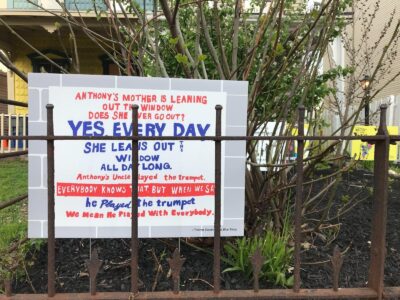
But since we had jobs we were not in as desperate of a need for those funds but we knew some people who were freelancers that were in need. It was also the time in 2020 when the presidential primary election was happening. We commissioned about ten artists to make yard signs, in the style of political campaign signs. We had them printed and installed them in our front yard. The project was called Yes in My Front Yard (or YIMFY 2020).
The YIMFY project lasted for about a month, running up until the primary elections in the spring. Each artist was paid to design a yard sign, and we printed enough copies so that each artist received one, plus an extra that could be sold.
We donated the money from these sales to an organization in our neighborhood that was called the People’s Emergency Center, which was doing food distribution and relief during the pandemic. This was very much an early-pandemic project. Social distancing was in full effect, people weren’t attending art events, and many artists were having their projects canceled at the time.
So it was very much in that spirit and that moment. After the election happened, we took down our yard signs, and that was the end of the project.
Simeen: My next question is about your project Organizing Your Own: The Politics and Poetics of Self-Determination Movements. This connects to one of our earlier questions about organizing as an important tool for artists. Could you share some insights from that project and talk a bit about how organizing has functioned as a tool in your own practice?
Daniel: This project started at the very beginning of 2016. And it was primarily an exhibition, an event series, and a book.
Organize Your Own grew out of a history that inspired me and that I felt connected to. Specifically, two historical events from around 1966, which was about fifty years before the project took place:
Black Power activist Stokely Carmichael once told his supporters in a speech that it was time for white people to organize within their own communities against racism. He was essentially saying, “Don’t come down to Mississippi to work in our communities. Stay on your college campuses and in your suburbs, and organize where you are.”
The other history I was interested in centered on the Rainbow Coalition, a short-lived alliance that formed in Chicago. It brought together the Black Panther Party, the Young Lords, a Puerto Rican organization, and the Young Patriots, a group of working-class white Southerners who had moved to Chicago and organized in an anti-racist, community-based model similar to the Panthers. These were in many ways similar to the kinds of working-class white folks often discussed in conversations about the 2016 election.
Some members of the Young Patriots had published a book of poetry in the late 1960s and early 1970s and later asked me to help republish it. While I was honored by the opportunity to collaborate with them, I felt that simply reprinting the book would turn it into a nostalgia project, so I proposed creating a broader framework—one that would place the history of their work with the Rainbow Coalition in conversation with contemporary political concerns.
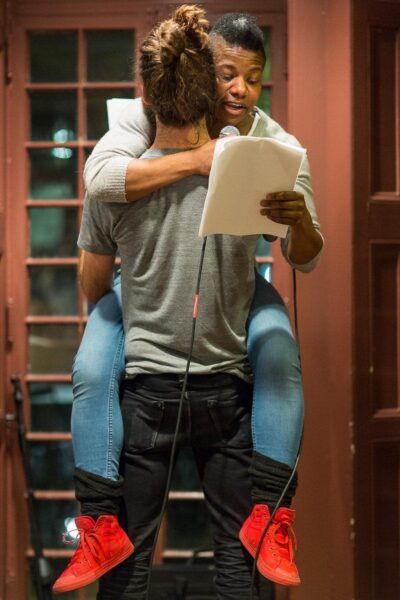
So I invited a number of artists and poets to create new projects inspired by the history of the Rainbow Coalition, the poetry of the Young Patriots, and by Stokely Carmichael’s call for people to “organize your own” communities. That collaboration ultimately became the foundation for the project Organize Your Own.
In 2016, that’s when Donald Trump defeated Hillary Clinton in the presidential race here in the U.S., and there was also, it was sort of the time period where Bernie Sanders had risen in prominence. So it was sort of the first time that there was, like, a socialist that had some prominence on the ticket in many, many decades.
And one of the questions that came out of that election was around what is it that is not understood about the white working class? As a constituency of people who had been a part of not only some of Bernie Sanders’ appeal, but had also then kind of shifted and voted for Donald Trump in his first term.
So to be clear, this project had started before all this unfolded and was not explicitly about the election. In fact the first exhibits in Chicago and Philly were before the 2016 Presidential primary and general election took place. But after the project was essentially finished, people started reaching out and saying “hey, can we tour this exhibition to our venue”. Because we all really feel like we need to talk about racial justice, we need to talk about whiteness, but do it in a way that has some kind of generous and hopeful history that we can draw from that isn’t just totally about white guilt and white privilege, but also serves as a counterpoint to popular narratives about the election and specifically about working class white communities in books like Hillbilly Elegy by now-Vice President JD Vance.
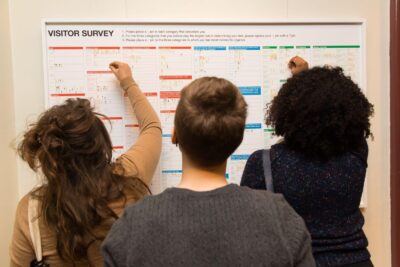
So after having mailed all the work back to the contributors, I recollected all the artwork and then toured it for four more years to nine geographically and culturally diverse contexts across the country including Portland (Oregon), Louisville (Kentucky), San Marcos (Texas), Grand Rapids (Michigan), and San Luis Obispo (California) among others.
I think this was a moment where I realized I had a choice: I could do a really short project and move on to something else, or I could be responsive to the moment and engage with opportunities for the project to be politically useful to people trying to have difficult conversations in their communities.
That was the moment I decided to put in the work to make this project live in a way I never anticipated.
Simeen: What advice would you give to me as another artist moving to a new city soon?
Daniel: If you’re someone who wants to build audiences for the kind of projects that you’re interested in and that you work on then maybe you could spend some time just being the audience that you want to have. Be the Audience You Want to See! Just modeling what it is like to be a good community member who shows up and attends and asks questions of people, when there’s an opportunity to ask questions, and helps stack the chairs when you’re staying around late, and talking to somebody after a program, someone who just puts in that extra effort that is necessary to make community happen. And do that before you start even trying to organize your own stuff or invite people to your activities.
That’s very basic advice.
Daniel Tucker (He/Him/His) helps artists, activists, and organizations to create impactful work. He has done this through creating independent publications, academic programs, dynamic gatherings, and critical exhibitions. He develops projects inspired by his interest in social movements and the people and places from which they emerge. His writings and lectures on the intersections of art and politics and his collaborative art projects have been published and presented widely and are documented on his website.
Simeen Anjum (she/her) is a social practice artist and museum educator. In her practice, she explores new ways of fostering solidarity and community in response to the late-capitalist world that often isolates us. Her projects take many forms, including sunset-watching gatherings, resting spaces in malls, and singing circles in unexpected locations. She is based in Portland, where she works as a learning guide at the Portland Art Museum.